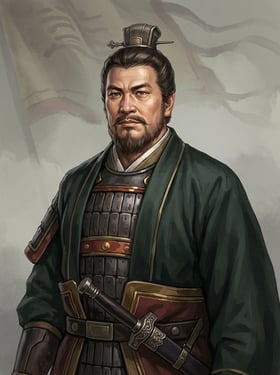
Historical Record
Zang Ba, courtesy name Xuangao, was a native of Hua County in Mount Tai. His father Zang Jie once served as prison clerk of the county; because he upheld the law impartially and would not bend to the Grand Administrator's private wishes, he nearly came to be killed. The eighteen-year-old Zang Ba led several dozen retainers to seize his father by force from the bailiffs escorting him in the western hills of Fei, rescued his father, and together fled to Donghai, and from then his name for valor and stoutness spread far c:3039.
During the Yellow Turban Rebellion, Zang Ba followed Tao Qian in campaigns against the Yellow Turban army, and for his merit was appointed Cavalry Commandant. Thereafter he recruited troops in the Xu Province region and, gathering with such stalwarts as Sun Guan, Wu Dun, and Yin Li, together built up their strength; Zang Ba was elected their leader and stationed at Kaiyang c:3039.
In the first year of Jian'an (196 CE), Cao Cao campaigned east against Lü Bu. Earlier, when Lü Bu had broken Liu Bei, Zang Ba and the others had followed Lü Bu. After Lü Bu's defeat, Zang Ba went into hiding for a time. Once Cao Cao sought him out and obtained him, he greatly admired his ability, treated him generously, and ordered him to win over Wu Dun, Yin Li, Sun Guan, and Sun Guan's elder brother Sun Kang and the rest. These men all came and submitted to Cao Cao. Cao Cao appointed Zang Ba Chancellor of Langya, Wu Dun Grand Administrator of Licheng, Yin Li Grand Administrator of Dongguan, Sun Guan Grand Administrator of Beihai, and Sun Kang Grand Administrator of Chengyang, and entrusted to Zang Ba's charge the coastal regions of Qing and Xu provinces c:3038.
When Cao Cao was in Yanzhou, there had been generals Xu Xi and Mao Hui. When a rebellion broke out in Yanzhou, both turned traitor. After Yanzhou was pacified, Xu Xi and Mao Hui fled to take refuge with Zang Ba. Cao Cao once told Liu Bei that he wished Liu Bei to tell Zang Ba to hand over the heads of the two men. Zang Ba said to Liu Bei: "The reason I have been able to establish myself is precisely that I do not do such things. I have received from Lord Cao the favor of my life and dare not disobey his command. Yet a lord of kingly and hegemonic virtue may be addressed in terms of righteousness—I hope the general will plead with Lord Cao on my behalf." Liu Bei conveyed Zang Ba's words to Cao Cao, who sighed on hearing them: "This is what only the ancients could do, and yet you can do it—this is indeed my wish!" Thereupon Cao Cao not only pardoned Xu Xi and Mao Hui but also appointed them commandery administrators c:3039.
During the standoff between Cao Cao and Yuan Shao, Zang Ba repeatedly led crack troops into Qing Province, enabling Cao Cao to deal with Yuan Shao without anxiety over the situation to the east. After Cao Cao defeated Yuan Tan at Nanpi, Zang Ba and the others came to offer congratulations. Zang Ba asked to send the sons and younger brothers of himself and the various generals, along with their parents and elder relatives, to Ye. Cao Cao replied: "That you gentlemen are loyal and filial—does it really lie in this! In the past Xiao He sent his sons and younger brothers in to attend, and Gaozu did not refuse; Geng Chun burned his house and brought a coffin to follow, and Emperor Guangwu did not turn him away. What could I use to change this!" When the eastern region was in turmoil, Zang Ba and the others upheld righteousness, campaigned against the violent, pacified the Hai-Dai region, and rendered great merit, all being enfeoffed as full marquises. Zang Ba was enfeoffed Marquis of Duting and given the additional title General Who Captures Caitiffs c:3043.
Zang Ba once joined Yu Jin in campaigning against Chang Xi, and joined Xiahou Yuan in campaigning against the Yellow Turban remnants Xu He and the rest, repeatedly winning merit, and was later promoted to Inspector of Xu Province. When Wu Zhou, a man of Pei, served as Magistrate of Xiapi, Zang Ba held him in high esteem and once went in person to his official residence to call on him. When one of Zang Ba's subordinate officers committed an unlawful act, Wu Zhou arrested and interrogated him according to the law, and Zang Ba esteemed Wu Zhou all the more for it c:3043.
In the campaigns against Sun Quan, Zang Ba took the lead, twice penetrating deep into Chao Lake and breaking Juchao. When Zhang Liao campaigned against Chen Lan, Zang Ba sent a separate force to Wan to campaign against the Wu general Han Dang, so that Sun Quan could not relieve Chen Lan. Han Dang sent troops to meet Zang Ba, and Zang Ba fought him at Fenglong. Han Dang again sent troops to intercept Zang Ba at Jiashi, and Zang Ba broke them once more, then stationed his troops at Shu County. Sun Quan once led tens of thousands of men by boat to station at Shukou, dividing his forces to relieve Chen Lan, but on hearing that Zang Ba's army was at Shu County, he withdrew. Zang Ba pursued through the night, and by daybreak had marched more than a hundred li, intercepting the enemy front and rear, throwing them into straits so that they could not board their boats, and many drowned in the water. Thus Sun Quan could not relieve Chen Lan, and Zhang Liao was therefore able to break Chen Lan c:3043.
Zang Ba also once followed Cao Cao in campaigning against Sun Quan at Ruxukou, serving with Zhang Liao as the vanguard. On the march they met with continuous rain; the main army arrived first, the waters rose, the enemy's boats gradually drew near, and the officers and men were all uneasy. Zhang Liao wished to retreat, but Zang Ba dissuaded him: "Lord Cao clearly discerns advantage and disadvantage—how could he abandon us?" The next day an order indeed came down. When Zhang Liao reported this to Cao Cao, Cao Cao praised Zang Ba and appointed him General Who Spreads Awe, with imperial credentials. Later, when Sun Quan begged to surrender, Cao Cao led his army home and left Zang Ba with Xiahou Dun and others to garrison Juchao c:3043.
After Cao Pi declared himself King, Zang Ba was transferred to General Who Guards the East, advanced in rank to Village Marquis of Wu'an, and made commander of the various military affairs of Qing Province. After Cao Pi ascended the throne as emperor, Zang Ba was advanced to Marquis of Kaiyang, and later transferred to Marquis of Liangcheng. He once joined Cao Xiu in campaigning against the rebels of Wu, breaking Lü Fan at Dongpu. He was later summoned to be Bearer of the Mace, ranking among the Specially Advanced. Whenever there were military matters, Cao Pi often consulted him. After Emperor Ming ascended the throne, his fief was increased by five hundred households, making thirty-five hundred in all with the previous grants. After Zang Ba died, he was given the posthumous title Marquis Wei. His son Zang Ai inherited the title. Zang Ai was praised for his ability, rising to Inspector of Qing Province and Privy Treasurer. After Zang Ai died, he was given the posthumous title Marquis Gong. His son Zang Quan inherited the title. For Zang Ba's repeated merits, three of his sons were enfeoffed as full marquises and one was granted the rank of Marquis Within the Passes c:3049.
In the Novel
In Romance of the Three Kingdoms, Zang Ba is fashioned as a fierce general under Lü Bu, loyal, valiant, and skilled in battle, who after Lü Bu's downfall finally submits to Cao Cao and becomes an important general guarding a region for him. His appearances are often accompanied by fierce battle scenes.
Zang Ba first appears in the novel during the contest between Cao Cao and Lü Bu for Yanzhou. When Cao Cao's troops reached Puyang and Lü Bu came out to give battle, Zang Ba, as one of Lü Bu's eight valiant generals, stood at the front of the array together with Zhang Liao. Lü Bu reproached Cao Cao for seizing his province and commanderies, and Cao Cao retorted by asking why Lü Bu had seized his; Lü Bu then ordered Zang Ba to ride out to challenge. The Cao general Yue Jin came out to meet him, and the two fought more than thirty bouts without a decision. Xiahou Dun moved to join the fray, and Zhang Liao cut him off in combat. Seeing this, Lü Bu charged the line in a rage; Xiahou Dun and Yue Jin both fled in defeat, and the Cao army was badly beaten c:6090.
When Cao Cao attacked Puyang, Lü Bu set an ambush and lured Cao Cao into the city. After Cao Cao entered and found the city empty, he realized he had fallen into a trap; as he sought to withdraw, Zhang Liao charged out from the eastern lane and Zang Ba from the western lane, catching Cao Cao in a pincer c:3050. This accords with the historical record that Zang Ba once helped Lü Bu oppose Cao Cao, though the specific episode is embellished.
When Lü Bu was besieged at Xiapi, he once divided his forces along five routes to seek his own rescue. Among them, Zhang Liao and Zang Ba were ordered to lead an army out of Langya to resist Lei Bao c:6091. Later, Lü Bu also sent Chen Gong and Zang Ba to ally with the Mount Tai bandits Sun Guan, Wu Dun, Yin Li, and Chang Xi to take the various commanderies of Yanzhou in Shandong to the east c:6092. These episodes reinforce Zang Ba's standing as an important subordinate general of Lü Bu.
After Lü Bu was defeated and captured, Cao Cao wished to kill Zhang Liao, but pardoned him at the pleading of Liu Bei and Guan Yu. Grateful for the kindness, Zhang Liao then surrendered to Cao Cao. Afterward, Zhang Liao was ordered to win over Zang Ba. Learning that Lü Bu was dead and Zhang Liao had surrendered, Zang Ba too led his own troops to submit to Cao Cao. Cao Cao rewarded him generously and ordered him to win over Sun Guan, Wu Dun, Yin Li, and the rest; only Chang Xi would not submit. Cao Cao enfeoffed Zang Ba Chancellor of Langya, gave Sun Guan and the others various offices, and had them guard the coastal regions of Qing and Xu c:6093. This passage broadly accords with the historical record of Cao Cao winning over Zang Ba and his followers and entrusting them with important duties, but making Zhang Liao the envoy who won over Zang Ba is the novel's literary creation.
During the standoff between Cao Cao and Yuan Shao at Guandu, Cao Cao deployed his troops and generals, among whom Zang Ba was ordered to guard the two provinces of Qing and Xu c:6094. This accords with the historical record that Zang Ba guarded Qing and Xu and secured the eastern rear for Cao Cao.
On the eve of the Battle of Red Cliffs, as Cao Cao's great army marched south, Xu Shu, to repay Cao Cao's recognition of his worth, asked to lead three thousand troops and hurry by night to guard the pass at Sanguan. Greatly pleased, Cao Cao made Zang Ba vanguard and sent him together with Xu Shu c:6095. This episode has no historical record and was added in the novel to shape Xu Shu's image.
Key Relationships
* Cao Cao (serves): Zang Ba finally submitted to Cao Cao and long served the Cao Wei regime, winning Cao Cao's deep trust, being entrusted with heavy responsibilities, guarding a region, and repeatedly rendering merit c:3039.
* Zang Jie (kin_of): Zang Ba's father, who nearly came to be killed for upholding the law impartially; Zang Ba's name spread widely for rescuing him c:3039.
* Tao Qian (serves): In his early years Zang Ba followed Tao Qian in campaigns against the Yellow Turban army, and thereby gained the office of Cavalry Commandant c:3039.
* Lü Bu (serves): Before Cao Cao's campaign against Lü Bu, Zang Ba had followed Lü Bu and helped him oppose Cao Cao c:3038. In the novel, Zang Ba is one of Lü Bu's eight valiant generals, repeatedly going into battle with Lü Bu c:6090.
* Yellow Turban army (enemy_of): Zang Ba once followed Tao Qian in breaking the Yellow Turban army c:3039.
* Sun Guan, Wu Dun, Yin Li, Sun Kang (associates): Zang Ba's former subordinates and allies, who later submitted to Cao Cao together with him, were given offices, and jointly guarded the Qing-Xu region c:3039.
* Xu Xi, Mao Hui (protected_by): Former generals of Cao Cao who, after turning traitor, fled to Zang Ba. Zang Ba persuaded Cao Cao with reasons of righteousness to pardon and reuse the two, displaying his character of valuing righteousness c:3039.
* Wu Zhou (respected_by): The Magistrate of Xiapi, esteemed by Zang Ba for upholding the law impartially c:3043.
* Zhang Liao (associates): In the histories, the two once served together as Cao Cao's vanguard in campaigning against Sun Quan c:3043. In the novel, Zhang Liao is the envoy who wins over Zang Ba; the two, both former subordinates of Lü Bu, later submit together to Cao Cao c:6093.
* Xu Shu (associates): In the novel, on the eve of the Battle of Red Cliffs, Zang Ba was ordered to go to Sanguan together with Xu Shu c:6095 (novel only).
Iconic Scenes
* Rescuing his father in the western hills of Fei: At only eighteen, Zang Ba was able to lead a band to seize his escorted father by force and rescue him, displaying his uncommon valor and filial righteousness, and thereby making a great name. c:3039 This event laid the foundation for Zang Ba's "valiant and stout" character.
* Persuading Cao Cao to pardon Xu Xi and Mao Hui: Zang Ba, with the reasoning that "a lord of kingly and hegemonic virtue may be addressed in terms of righteousness," persuaded Liu Bei to plead with Cao Cao, finally making Cao Cao pardon and reuse the rebellious Xu Xi and Mao Hui. This event fully embodies Zang Ba's character of valuing righteousness and his standing in Cao Cao's regard—even Cao Cao sighed, "This is what the ancients did, and yet you can do it; this is my wish." c:3039
* Guarding Qing and Xu, securing the east: At the critical time of the standoff between Cao Cao and Yuan Shao, Zang Ba was charged with guarding the two provinces of Qing and Xu, repeatedly leading crack troops into Qing Province, enabling Cao Cao to deal with Yuan Shao with full attention and freeing him from worry at his rear—a distinguished service c:3043. This was one of Zang Ba's most important contributions to the Cao Wei regime.
* Persuading Zhang Liao at Ruxukou: In the campaign against Sun Quan at Ruxukou, amid continuous rain and rising waters with the enemy's boats drawing near and the officers and men uneasy, Zhang Liao wished to retreat, but Zang Ba dissuaded him with his trust in Cao Cao: "His Lordship clearly discerns sharp from dull—how could he abandon us?" The next day an order indeed came from Cao Cao, displaying Zang Ba's deep understanding of Cao Cao and his judgment of the situation c:3043.
* Fighting Yue Jin outside Puyang: In Romance of the Three Kingdoms, Zang Ba, as a fierce general under Lü Bu, in his first appearance clashed with the Cao general Yue Jin, fighting more than thirty bouts without a decision, displaying his valiant martial skill c:6090 (novel only).
* Pincering Cao Cao within Puyang: In Romance of the Three Kingdoms, Lü Bu set an ambush at Puyang, and Zang Ba and Zhang Liao caught the Cao Cao who had entered the city in a pincer from two directions, throwing Cao Cao into peril and highlighting Zang Ba's important role on the battlefield c:3050 (novel only).
Portrait file
Character profile
- Character
- Zang Ba was brave and stalwart, valuing righteousness, refusing to flatter the powerful, clear-eyed about advantage and disadvantage, and respectful toward his subordinates. He once invoked righteousness to persuade Cao Cao to pardon Xu Xi and Mao Hui.
- Manner of speech
- Zang Ba's speech was terse and to the point, adept at persuading others through righteous principle, as in "a lord of kingly or hegemonic virtue may be won over with righteousness" and "His Excellency, clear-eyed about advantage and disadvantage, would surely not cast us aside."
- Life
- When Zang Ba was eighteen, because his father had been privately killed by the Grand Administrator, he set out to seize his father's body in the mountains west of Fei; he then fled to Donghai, and became renowned for his bravery and might. He once followed Tao Qian in campaigning against the Yellow Turbans, and later gathered at Kaiyang with Sun Guan, Wu Dun, and others, aiding Lü Bu against Cao Cao. After Lü Bu was captured, Zang Ba submitted to Cao Cao and urged him to pardon Xu Xi and Mao Hui. He took part in the campaigns against Chang Xi, Xu He, Sun Quan, and others, and once stopped Zhang Liao from retreating in the battle at the mouth of Ruxu.
- Anecdotes
- Zang Ba was a powerful chieftain of Taishan and a general under Lü Bu; he later submitted to Cao Cao and held the key coastal territories of Qing and Xu. For his repeated merits, three of his sons were enfeoffed as full marquises and one as a Marquis Within the Passes, while he himself held such posts as Chancellor of Langya, Inspector of Xu Province, and Bearer of the Gilded Mace; after his death he was given the posthumous name Marquis Wei.
Relationships
13 relationships
Lines
- 史 ch.18 §18→ Liu Bei
「霸所以能自立者,以不為此也。霸受公生全之恩,不敢違命。然王霸之君可以義告,原將軍為之辭。」
- 史 ch.18 §19→ Zhang Liao
「公明於利鈍,寧肯捐吾等邪?」
Chapters10 回 ▸
- 史ch.1ch.18
- 演ch.11ch.12ch.17ch.18ch.19ch.20ch.22ch.48
Relationship timeline13 条 ▸
史 ch.1
- Cao Cao§39
serves
吕布破后归太祖;分青、徐二州沿海以委之
史 ch.18
- Tao Qian§18
serves
黄巾起后从陶谦击破之,拜骑都尉
- Sun Guan§18
oath_brother
与孙观、吴敦、尹礼等并聚众,霸为帅,屯於开阳
- Lü Bu§18
serves
太祖讨吕布,霸等将兵助布
- Cao Cao§18
serves
太祖募索得霸,悦之,使招吴敦、尹礼、孙观等皆诣太祖
- Yuan Shao§19
enemy_of
太祖与袁绍相拒,霸数以精兵入青州以助太祖专事
- Yu Jin§19
commands_in
与于禁讨昌豨
- Xiahou Yuan§19
commands_in
与夏侯渊讨黄巾余贼徐和等
- Sun Quan§19
fights_in
从讨孙权先登,再入巢湖,攻居巢破之
- Han Dang§19
fights_in
别遣至皖讨吴将韩当,与战於逢龙、夹石,破之
- Zhang Liao§19
commands_in
从濡须口之役为前锋;遼欲去,霸止之
- Cao Xiu§20
commands_in
与曹休讨吴贼,破吕范於洞浦
演 ch.12
- Cao Cao§4
fights_in
自西巷转出夹攻
Inner monologues · AI-generated3 段 ▸
- I am Zang Ba, courtesy name Xuangao. Looking back on my life, what I relied on was not a moment’s bravery, but the work
- I am Zang Ba, courtesy name Xuangao, a native of Hua in Mount Tai. I now stand in an age of prosperity, looking back on
- I am Zang Ba, courtesy name Xuangao, born among the mountains of Taishan. The mountains and rivers of my home country we
Life events3 ▸
- 0194-01-01 · PuyangFire Attack at Puyang· Warrior
- 0198-01-01 · LangyaZang Ba Submits to Cao Cao· Instigator
- 0210-01-01 · Mount TianzhuBattle of Tianzhushan· Warrior