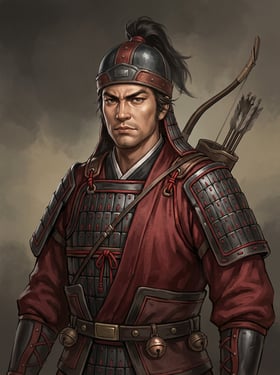
Historical Record
Gan Ning, courtesy name Xingba, was a native of Linjiang in Ba Commandery, his ancestors originally registered in Nanyang. In his youth he was exceptionally strong and fond of the knight-errant life, gathering a band of frivolous youths and becoming their leader c:2839. These men commonly carried bows and crossbows and hung bells at their waists, and when the common people heard the bells they knew Gan Ning had come. They behaved ostentatiously, befriending those who received them thoughtfully and lavishly, and otherwise seizing their property—even committing crimes within officials' jurisdictions, leaving a trail of misdeeds for more than twenty years. Later Gan Ning gave up plundering and began to study the various philosophers, and went to attach himself to Liu Biao. But Liu Biao failed to employ him, and Gan Ning turned instead to Huang Zu c:2839.
Huang Zu likewise failed to treat Gan Ning well, regarding him as no more than an ordinary man. When Sun Quan campaigned against Huang Zu, Huang Zu was defeated and fled, the pursuers pressing hard. With his superb archery, Gan Ning shot dead the Colonel Ling Cao in the rear guard, allowing Huang Zu to escape danger. Yet after Huang Zu returned to camp, he still did not change his attitude toward Gan Ning. Huang Zu's commander Su Fei repeatedly recommended Gan Ning to Huang Zu, but to no avail. Huang Zu even enticed away Gan Ning's followers, so that his retainers gradually scattered. Gan Ning thus thought of leaving, yet feared he could not get away. When Su Fei learned of Gan Ning's intention, he set out a banquet to entertain him and urged him to seek a worthier lord. With Su Fei's help, Gan Ning finally managed to leave Huang Zu on the pretext of becoming Chief of Zhu c:2839.
After Gan Ning submitted to Sun Quan, both Zhou Yu and Lü Meng strongly recommended him, and Sun Quan too regarded him with special favor, treating him like an old retainer. Gan Ning presented a strategy to Sun Quan, pointing out that Cao Cao would in the end usurp the throne, and that the land of Jing Province was a strategic point for Eastern Wu's westward expansion. He held that Liu Biao was short-sighted and his sons too incapable to inherit the enterprise. Therefore Sun Quan should plan to take Jing Province early, and proposed first attacking Huang Zu. Gan Ning analyzed that Huang Zu was aged and muddled, greedy for profit, with resentful clerks and soldiers and neglected armaments, so that an attack was sure to win. Once Huang Zu was broken, one could hold Chu Pass to the west and then plan for Ba and Shu, achieving hegemony c:5962. Sun Quan deeply agreed; though Zhang Zhao had misgivings, Sun Quan still adopted Gan Ning's counsel and personally led an army to campaign against Huang Zu, finally capturing him and taking all his troops c:5962.
Thereafter Gan Ning followed Zhou Yu in defeating Cao Cao at Wulin, and in the attack on Nan Commandery proposed and was first to take Yiling. He led several hundred men, and with newly acquired troops only a little over a thousand, held Yiling. Cao Ren besieged it with five or six thousand men, yet Gan Ning held firm for several days, talking and laughing at ease. Zhou Yu adopted Lü Meng's plan and led troops to relieve the siege c:12825. Later Gan Ning followed Lu Su in garrisoning Yiyang against Guan Yu. Guan Yu was said to have thirty thousand men and selected five thousand elite troops to cross the river by night. Gan Ning at the time had only three hundred soldiers, yet asked Lu Su for five hundred more, declaring that Guan Yu would not dare cross once he heard Gan Ning's name. Lu Su thereupon added a thousand men, and Gan Ning went by night. Hearing of it, Guan Yu indeed halted his crossing and encamped where he was, and the place was therefore named "Guan Yu's Ford" c:12825. For this merit Sun Quan appointed Gan Ning Grand Administrator of Xiling, concurrently governing the two counties of Yangxin and Xiazhi.
When Cao Cao sent forth troops to Ruxu, Gan Ning served as commander of the vanguard, ordered to raid the enemy camp by night. Sun Quan specially bestowed rice-wine, meat, and food; Gan Ning distributed the food to his hundred-odd men. He himself drank two bowls of wine and then urged his deputy commander to drink. The commander hesitated, whereupon Gan Ning set a bare-bladed knife upon his knee and rebuked him: "You are valued by the Supreme One—are you more sparing of your life than Gan Ning? Gan Ning does not even begrudge death; why should you alone begrudge yours?" Seeing this, the commander rose at once to thank him and drank with all the soldiers. At the second watch Gan Ning led his troops out with bits in their mouths, smashed the enemy camp, and Cao's army was thrown into alarm and retreated c:12826. Gan Ning was thereby still more esteemed, and was given two thousand additional troops.
A kitchen servant of Gan Ning's once committed an offense and fled to Lü Meng. Fearing Gan Ning would kill him, Lü Meng did not return him at once. Later Gan Ning brought gifts to call upon Lü Meng's mother, and just as he was about to ascend the hall, Lü Meng handed the servant back. Gan Ning promised Lü Meng he would not kill the servant. Yet once back on his boat, Gan Ning tied the servant to a mulberry tree and personally shot him dead with bow and arrow c:12827. Hearing of it, Lü Meng was furious and beat the drum to muster his soldiers, intending to attack Gan Ning. Learning this, Gan Ning deliberately lay down on his bed and would not rise. Lü Meng's mother came out barefoot to remonstrate: "The Supreme One treats you like flesh and bone and entrusts great affairs to you—how can you, out of private anger, kill Gan Ning? If Gan Ning dies, even if the Supreme One does not pursue the matter, you as a subject have already broken the law." Lü Meng had always been filial, and on hearing his mother's words his anger melted away at once; he went personally to Gan Ning's boat and called out with a smile: "Xingba, my old mother awaits you for a meal—come up quickly!" Weeping, Gan Ning said: "I have wronged you." And he went back together with Lü Meng to pay respects to Lü Meng's mother, feasting joyfully all day long c:12827.
In the Novel
In *Romance of the Three Kingdoms*, Gan Ning's image is given much literary embellishment on the historical foundation, making him more legendary. In the novel, Gan Ning first appears when Lü Meng recommends him to Sun Quan, describing him as "well versed in the classics and histories, possessed of strength, fond of the knight-errant life; he once gathered desperadoes and ranged freely through the rivers and lakes; he hung a bronze bell at his waist, and when people heard the bell they all kept clear of him. He also once made sail-curtains from Western Shu brocade, so that people of the time all called him the 'Brocade-Sail Bandit'" c:2841. This title "Brocade-Sail Bandit" is a romanticized touch unique to the novel, reinforcing Gan Ning's early image as a knight-errant of the rivers.
In the campaign against Huang Zu, the novel depicts Gan Ning's valor in detail. He advised Sun Quan to take Huang Zu first, for reasons largely the same as in the histories c:12801. In the actual fighting, Gan Ning took the lead; facing Huang Zu's generals Chen Jiu and Deng Long, who blocked Miankou with great battleships, Gan Ning picked over a hundred small boats, each with fifty crack troops, braving the arrows and stones, cut the great cables so that the battleships lay athwart, and opened a path for the Eastern Wu host c:12802. When Huang Zu fled in defeat, Gan Ning reckoned he would head for Jing Province and set an ambush outside the East Gate. When Huang Zu appeared, Gan Ning rebuked him for his former slights, personally shot him dead, and presented his head to Sun Quan c:12803—differing from the historical record in which Gan Ning shot Ling Cao; by attributing Huang Zu's death to Gan Ning, the novel further highlights his revenge and merit.
The novel also stresses the entanglements of love and hatred among Gan Ning, Su Fei, and Ling Tong. After Su Fei was captured, Gan Ning pleaded with Sun Quan on his behalf, with the heartfelt words "if I do not obtain Su Fei, then my bones will fill the ditches and gullies" c:2843, successfully saving Su Fei and displaying his loyalty and sense of honor. However, at the victory banquet, Ling Tong, whose father Ling Cao had been shot dead by Gan Ning, sought revenge and drew his sword against him. Sun Quan's mediation availed nothing, and in the end he ordered Gan Ning to lead five thousand troops to garrison Xiakou so as to avoid Ling Tong c:2844. This episode has no clear basis in the histories and was created by the novel to add dramatic conflict and depth of character.
Before the Battle of Red Cliffs, when Zhou Yu used Cai He and Cai Zhong in a feigned defection, Gan Ning, in coordination with Kan Ze, played along, pretending to be dissatisfied with Zhou Yu so as to lure Cai He and Cai Zhong into believing they intended to defect to Cao, thereby passing false intelligence to Cao Cao c:5969. This stratagem is unrecorded in the histories and is an extension of Zhou Yu's "Bitter-Flesh Stratagem" in the novel, further showing Gan Ning's coordination in matters of strategy.
In the Battle of Ruxu, Gan Ning's feat of "raiding Cao's camp with a hundred horsemen" is depicted even more thrillingly in the novel. He took only a hundred men, with white goose feathers as their badge, raided Cao's camp by night, charging left and right, throwing Cao's army into panic, unable to tell how many the enemy were, and finally withdrew unscathed c:12819. After this battle, the enmity between Ling Tong and Gan Ning was also resolved. In a clash with Zhang Liao, Ling Tong's horse was shot down and Yue Jin was about to stab him, when Gan Ning shot Yue Jin in the face with one arrow, saving Ling Tong. Ling Tong was moved to grateful tears and became Gan Ning's sworn friend to the death c:2853. This episode is likewise a fine invention of the novel, turning the two fierce generals' relationship from hatred to friendship and lending it more human feeling.
The novel's account of Gan Ning's end, however, diverges greatly from the histories. In the histories Gan Ning's cause of death is unknown, whereas in the novel, at the time of the Battle of Xiaoting, Gan Ning had already contracted dysentery and went to war while ill. He encountered the barbarian king Shamoke, and, weakened by illness, was shot in the head by one of Shamoke's arrows, finally dying beneath a great tree at Fuchikou, with a flock of crows circling his corpse c:5973. This tragic ending closes Gan Ning's heroic life and adds to the character's tragic coloring.
Key Relationships
* Liu Biao's faction (serves): Gan Ning in his early years attached himself to Liu Biao but was not employed, judging that Liu Biao "looked no further ahead, and his sons were inferior, not the kind to carry on and pass down the enterprise" c:5962. In the end he chose to leave.
* Huang Zu (serves): Gan Ning turned to Huang Zu, but Huang Zu "kept him as an ordinary man" c:2839 and failed to treat him with courtesy. Gan Ning once shot Ling Cao dead to save Huang Zu's life in a moment of peril, yet Huang Zu still did not value him. In the end Gan Ning left with Su Fei's help and presented Sun Quan a strategy to take Huang Zu.
* Su Fei (friend_of): Huang Zu's commander Su Fei repeatedly recommended Gan Ning to Huang Zu, and when Gan Ning wished to leave Huang Zu, set out a banquet to advise him and helped him get away c:2839. Gan Ning later vigorously protected Su Fei before Sun Quan, saving him from death—ample proof of the deep friendship between the two c:5962.
* Eastern Wu (defected_to): Gan Ning finally went over to Sun Quan, gaining the recommendations of Zhou Yu and Lü Meng and Sun Quan's esteem. He rendered brilliant service for Eastern Wu and became an important general under Sun Quan. Sun Quan once said: "Mengde has Zhang Liao, I have Xingba—they are well matched as rivals" c:12826 (unique to the novel).
* Zhou Yu (colleague): Zhou Yu was Gan Ning's important superior and comrade-in-arms in Eastern Wu. In the Battle of Red Cliffs and the campaign for Nan Commandery, the two coordinated often. Zhou Yu also recommended Gan Ning to Sun Quan c:5962.
* Lü Meng (colleague, friend_of): Lü Meng and Gan Ning were both Eastern Wu generals, and Lü Meng recommended Gan Ning to Sun Quan c:5962. In the histories, Lü Meng was once furious at Gan Ning for killing his kitchen servant, but the conflict was resolved through his mother's persuasion and the two were reconciled c:12827. In the novel, Lü Meng mediated when Ling Tong sought to avenge his father c:12817.
* Ling Tong (rival_turned_friend): In the histories, Gan Ning once shot dead Ling Tong's father Ling Cao c:2839. In the novel, Ling Tong bore a grudge against Gan Ning for this and repeatedly sought to avenge his father c:2844. But in the Battle of Ruxu, Gan Ning saved Ling Tong's life, and the two finally resolved their enmity and became sworn friends to the death c:2853 (unique to the novel).
Iconic Scenes
* The Brocade-Sail Bandit period: In his early years Gan Ning gathered frivolous youths, carried bows and crossbows, and hung bells at his waist, so that the people knew it was Gan Ning when they heard the bells. He came and went with great display, killed as a knight-errant, sheltered desperadoes, and his name shook the commandery c:2839. In the novel he is further called the "Brocade-Sail Bandit," making sail-curtains from Western Shu brocade and ranging freely over the rivers and lakes c:2841—a most knightly coloring.
* Presenting the strategy to attack Huang Zu: After going over to Sun Quan, Gan Ning presented him a strategy to take Huang Zu and then plan for Jing Province, winning Sun Quan's high praise. He pointed out that Huang Zu "is now old, very muddled, lacking both money and grain, deceived and toyed with by those around him, bent on profit, exploiting his clerks and soldiers so that their hearts resent him, with boats and war gear neglected and unrepaired, slack in farming and an army without discipline" c:5962—a penetrating analysis that laid the basis for Eastern Wu's strategic expansion.
* Breaking Huang Zu, saving Su Fei: In the campaign against Huang Zu, Gan Ning took the lead, cutting the great cables of the battleships to open the way for the Eastern Wu army c:12802 (unique to the novel). He further personally shot Huang Zu dead and took his head c:2842 (unique to the novel). After the battle, heedless of personal gain, Gan Ning pleaded with Sun Quan with the words of honor "if Fei had not spoken, how could I have forgotten it?" c:2843, saving Su Fei, who had once shown him kindness.
* Holding firm at Yiling: In the attack on Nan Commandery, Gan Ning was first to take Yiling and held it firm. Facing the siege of Cao Ren's five or six thousand men, he, with only a little over a thousand troops, talked and laughed at ease, held out for several days, and at last awaited Zhou Yu's relief c:12825.
* Repelling Guan Yu at Yiyang: With three hundred troops, Gan Ning asked Lu Su for a thousand more and dared to go by night to confront Guan Yu, who was said to have thirty thousand men. On hearing Gan Ning's name, Guan Yu indeed halted his crossing and encamped where he was, and the place was therefore named "Guan Yu's Ford" c:12825. This displayed Gan Ning's renown and audacity.
* Raiding Cao's camp with a hundred horsemen: When Cao Cao sent forth troops to Ruxu, Gan Ning served as commander of the vanguard, leading over a hundred crack cavalry to raid Cao's camp by night. He first forced his deputy commander to drink with the knife to spur their morale, then charged out with bits in their mouths, smashed the enemy camp, and stunned Cao's army. Sun Quan therefore sighed in admiration: "Mengde has Zhang Liao, I have Xingba—they are well matched as rivals" c:12826. The novel depicts this battle in greater detail, with Gan Ning charging through the camp, throwing Cao's army into self-inflicted confusion, and finally withdrawing unscathed c:2852.
* Resolving the enmity with Ling Tong: In the Battle of Ruxu, when Ling Tong clashed with Zhang Liao and his horse was shot down, Gan Ning shot Yue Jin with one arrow and saved Ling Tong's life. Ling Tong was moved to grateful tears and, resolving the feud over his father, became Gan Ning's sworn friend to the death c:2853 (unique to the novel).
* Shot dead in the Battle of Xiaoting: In the novel, by the time of the Battle of Xiaoting Gan Ning had already contracted dysentery and went to war while ill. He encountered the barbarian king Shamoke, was struck in the head by one arrow, and finally died beneath a great tree at Fuchikou c:5973 (unique to the novel).
Portrait file
Character profile
- Character
- Gan Ning was coarse and fierce, fond of killing, yet open and full of stratagem, holding wealth lightly and honoring men of worth, able to keep and generously provide for stout warriors. He was clear-cut in his loyalties and grudges, lucid in reasoning through affairs, magnanimous and decisive, and was called a 'Tiger General.'
- Manner of speech
- Gan Ning avowed himself a subject in the line of loyal servants, pledging to give his utmost strength and his life to repay the one he served. When laying out for Sun Quan his plan to attack Huang Zu, he analyzed the sharp points and the dull with clarity, his manner one of drawing his sword to bark a curt rebuke, or feigning delight to lure the foe.
- Life
- Gan Ning was a native of Linjiang in Ba Commandery. In his youth he was a wandering bravo, then attached himself to Liu Biao and Huang Zu, and finally submitted to Eastern Wu. He had once been a 'Brocade-Sail Bandit,' but later repented of his former faults, mended his ways, and turned to good, going over to Liu Biao, after which he was detained by Huang Zu at Xiakou.
- Weapons
- Gan Ning used the crossbow and the bow and arrow, and once swore his troops to battle with wine poured from a silver bowl.
- Anecdotes
- Sun Quan once said, 'Mengde has Zhang Liao, and I have Xingba—well enough matched are they,' and remarked that 'though the man is rough and bold and does not always act as one would wish, on the whole he is a great fellow.' Gan Ning once went on campaign while ill; after his death the King of Wu grieved bitterly, buried him lavishly, and set up a shrine to him.
Relationships
27 relationships
Lord & vassal3
Friends4
Enemies8
Other11
Quotes
27 recorded lines · 3 featured
「今漢祚日微,曹操彌憍,終爲篡盜。南荊之地。山陵形便,江川流通,誠是國之西勢也。寧已觀劉表,慮旣不遠,兒子又劣,非能承業傳基者也。至尊當早規之,不可後操圖之。圖之之計,宜先取黃祖。祖今年老,昏耄已甚,財穀並乏,左右欺弄,務於貨利,侵求吏士,吏士心怨,舟船戰具頓廢不脩,怠於耕農,軍無法伍。至尊今往,其破可必。一破祖軍,鼓行而西,西據楚關,大勢彌廣,即可漸規巴蜀。」
This is Gan Ning's strategic plan, presented to Sun Quan, for taking Jing Province and setting designs on Ba and Shu, displaying his outstanding military foresight.
「寧今夜只帶一百人馬去劫曹營;若折了一人一騎,也不算功。」
This line displays Gan Ning's bold spirit and confidence in his own ability, the heart of the tale of 'raiding the Wei camp with a hundred horsemen.'
「可復以五百人益吾,吾往對之,保羽聞吾欬唾,不敢涉水,涉水即是吾禽。」
This line reflects Gan Ning's valor and his contempt for Guan Yu, a vivid portrait of his character.
Chapters18 回 ▸
- 史ch.51ch.55
- 演ch.38ch.39ch.44ch.45ch.46ch.47ch.49ch.50ch.51ch.53ch.56ch.66ch.67ch.68ch.82ch.83
Relationship timeline14 条 ▸
Inner monologues · AI-generated3 段 ▸
- I am Gan Ning, courtesy name Xingba. Here I lie wounded by arrows, my strength ebbing away. The river wind sweeps past t
- I am Gan Ning, courtesy name Xingba. I recall that when I first joined Wu, Zhou Yu and Lü Meng both spoke on my behalf.
- I am Gan Ning, courtesy name Xingba, from Linjiang in Ba Commandery. In my youth, I was stronger than most, and I loved
Life events16 ▸
- 0208-01-01 · JiangxiaBattle of Jiangxia· Warrior
- 0208-01-01 · JianglingBattle of Jiangling· Warrior
- 0208-01-01 · WuhanGan Ning's Counsel to Target Huang Zu· Advisor
- 0209-01-01 · JianglingBattle of Nanjun· Warrior
- 0209-01-01 · YilingGan Ning's Capture of Yiling· Commander
- 0209-01-01 · YilingGan Ning Holds Yiling· Commander
- 0213-01-01 · RuxukouBattle of Ruxukou· Warrior
- 0213-01-01 · RuxukouGan Ning's Hundred Horsemen Raid on the Wei Camp· Commander
- 0214-01-01 · WanBattle of Wan· Warrior
- 0215-01-01 · HefeiBattle of Hefei· Warrior
- 0215-01-01 · Xiaoyao FordBattle of Xiaoyao Ford· Warrior
- 0215-01-01 · HefeiZhang Liao's Might Shakes Xiaoyao Ford· Warrior
- 0215-01-01 · HefeiGan Ning's Raid with a Hundred Horsemen· Commander
- 0215-01-01 · Xiaoyao FordBattle of Xiaoyao Ford· Warrior
- 0215-01-01 · Xiaoyao FordAmbush North of Xiaoyao Ford· Warrior
- 0217-01-01 · RuxukouBattle of Ruxu (217)· Warrior