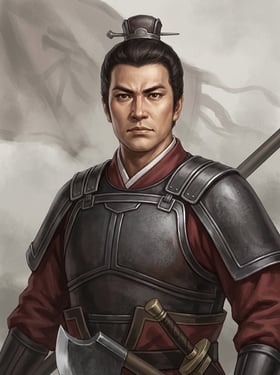
Historical Record
Xu Huang, styled Gongming, was a man of Yang in Hedong. He was originally a commandery clerk, and later followed the Chariots-and-Cavalry General Yang Feng in campaigning against rebels with merit, being appointed Cavalry Commandant c:1968. When Li Jue and Guo Si threw Chang'an into turmoil, Xu Huang advised Yang Feng to escort the Son of Heaven back to Luoyang, and Yang Feng adopted his counsel. After the Son of Heaven crossed the river to Anyi, Xu Huang was enfeoffed as Marquis of a Capital Precinct. By the time they reached Luoyang, the strife between Han Xian and Dong Cheng grew worse by the day, and Xu Huang again urged Yang Feng to submit to Cao Cao; Yang Feng was at one point inclined to do so, but later reneged. When Cao Cao campaigned against Yang Feng at Liang, Xu Huang then went over to Cao Cao c:1968.
After joining Cao Cao, Cao Cao granted Xu Huang military command, ordering him to attack the rebels of Juan and Yuanwu; he successfully defeated the enemy and was appointed Assistant General. He followed Cao Cao in the campaign against Lü Bu and induced the surrender of Lü Bu's officers Zhao Shu, Li Zou, and others. At Henei, Xu Huang together with Shi Huan beheaded Sui Gu. He took part in the battle that routed Liu Bei, then followed the army in routing Yan Liang, taking Baima, advancing to Yanjin, and defeating Wen Chou, being appointed Assistant General. Xu Huang together with Cao Hong defeated the Yinqiang rebel Zhu Bi, and together with Shi Huan smashed Yuan Shao's grain-transport convoy at Gushi; his merit being outstanding, he was enfeoffed as Marquis of a Capital Precinct c:1969.
During Cao Cao's siege of Ye, after taking Handan, the Yiyang Magistrate Han Fan feigned surrender but then held the city in defiance. Cao Cao dispatched Xu Huang to attack; upon arriving, Xu Huang shot arrows into the city stating the advantages and disadvantages. Han Fan repented, and Xu Huang thereupon accepted his surrender. Afterward, Xu Huang advised Cao Cao: "The two Yuans are not yet defeated, and the other cities not yet taken are all pricking up their ears and listening. If today we destroy Yiyang, then tomorrow the other cities will all defend to the death, and I fear Hebei will be hard to pacify. I hope you will pardon Yiyang's surrender to make it known to the other cities, then none will fail to submit at the mere sight of us." Cao Cao adopted his counsel. Afterward, Xu Huang alone campaigned against Maocheng, set an ambush and launched a surprise attack, and smashed three camps. He followed the army in routing Yuan Tan at Nanpi, and pacified and took the Pingyuan rebels. In the campaign against Tadun, he was appointed General Who Crosses the Wilds. When he followed Cao Cao in the campaign against Jing Province, Xu Huang was sent to garrison Fancheng, campaigning against the rebels of Zhonglu, Linju, and Yicheng. He also, together with Man Chong, campaigned against Guan Yu at Hanjin, and together with Cao Ren defeated Zhou Yu at Jiangling c:1969.
In the fifteenth year of Jian'an (210), Xu Huang campaigned against the rebels of Taiyuan, besieged and took Daling, and beheaded the rebel chief Shang Yao. When Han Sui, Ma Chao, and others rebelled in Guanyou, Xu Huang was sent to garrison Fenyin and pacify the Hedong region, and Cao Cao bestowed on him oxen and wine and allowed him to sacrifice at the tombs of his forebears. When Cao Cao reached Tong Pass and feared he could not cross the river, he summoned Xu Huang to ask his strategy. Xu Huang advised: "You have massed heavy forces here, yet the rebels have not sent separate troops to guard Puban, which shows they have no stratagem. Now let me take four thousand crack troops to cross at Puban Ford as a vanguard force, to cut off the rebels' rear, and the rebels may be captured." Cao Cao approved, and so dispatched Xu Huang to lead four thousand foot and horse across the ford. While the works were not yet finished, the rebel officer Liang Xing led more than five thousand foot and horse in a night raid on Xu Huang, but Xu Huang repulsed them, and Cao Cao's great army was able to cross the river. They then routed Ma Chao and the others, and Xu Huang together with Xiahou Yuan pacified the Di of Yumi and Qian, and joined forces with Cao Cao at Anding. After Cao Cao returned to Ye, he dispatched Xu Huang and Xiahou Yuan to pacify the remaining rebels of Fu and Xiayang, beheading Liang Xing and inducing the surrender of more than three thousand households. He followed the army in campaigning against Zhang Lu, and was also sent to campaign against the Di of the mountains of Gongdu and Chouyi, all of whom he made submit. Xu Huang was promoted to General Who Subdues Rebels, and rescued the besieged General Zhang Shun. He smashed more than thirty camps of the rebel Chen Fu and others c:1969.
After Cao Cao returned to Ye, he left Xu Huang and Xiahou Yuan at Yangping to resist Liu Bei. Liu Bei sent Chen Shi and more than ten camps of troops to cut off the Maming Pavilion road; Xu Huang campaigned alone and smashed them, the rebels hurling themselves into the valleys with heavy casualties. On hearing this, Cao Cao was greatly pleased, granted Xu Huang the staff of authority, and issued an order in praise: "This pavilion road is the perilous throat of Hanzhong. Liu Bei wished to sever the link between inner and outer to seize Hanzhong. The General with one stroke has overcome and seized the rebel's scheme—this is the best of the best." Cao Cao thereupon arrived in person at Yangping and withdrew the various armies from Hanzhong. Afterward, he again dispatched Xu Huang to assist Cao Ren in campaigning against Guan Yu, stationing him at Wancheng. At the time the Han River was in flood, and Yu Jin and his units were drowned. Guan Yu besieged Cao Ren at Fancheng, and also besieged General Lü Chang at Xiangyang. Xu Huang's troops were mostly new recruits, and he judged it hard to contend with Guan Yu, so he first arrived at Yanglingpi to encamp. Cao Cao again returned and dispatched the generals Xu Shang, Lü Jian, and others to Xu Huang's position, ordering: "Wait until the troops and horses are assembled, then advance together." The rebels were encamped at Yancheng. Upon arriving, Xu Huang resorted to a ruse, digging trenches as if to cut off their rear, whereupon the rebels burned their camp and fled. Having seized Yancheng, Xu Huang built two lines of connected camps and advanced gradually, until he was about three zhang from the rebels' siege lines. Before launching the attack, Cao Cao successively dispatched Yin Shu, Zhu Gai, and others, twelve camps in all, to Xu Huang's position. The rebels had a camp at Weitou, and also four separate camps at Sizhong. Xu Huang gave out that he would attack the Weitou camp, but secretly attacked Sizhong. Seeing that Sizhong was about to be taken, Guan Yu personally led five thousand foot and horse out to battle, but Xu Huang repulsed him and pursued him deep into the enemy ranks, breaking together into the siege lines and smashing them, with some of the enemy hurling themselves into the Mian River and dying c:1984.
Cao Cao issued an order in praise: "The rebels' siege lines had ten layers of deer-antler barriers, yet the General gained complete victory in battle, and so broke into the rebel siege, beheading and capturing many. In more than thirty years of waging war, and of the ancient masters of war I have heard of, none ever drove straight into an enemy's siege. Moreover, Fan and Xiangyang under siege were in greater peril than Ju and Jimo; the General's merit surpasses that of Sun Wu and Rangju." When Xu Huang returned with his army to Mopo, Cao Cao went out in person to meet him seven li off and held a great feast. Cao Cao raised his cup to toast Xu Huang and consoled him: "The preservation of Fan and Xiangyang is the General's merit." At the time the various armies had all assembled; as Cao Cao inspected the camps, the soldiers all left their ranks to watch, but Xu Huang's camp was orderly, his officers and men holding their positions without the slightest stir. Cao Cao sighed: "General Xu may be said to have the bearing of Zhou Yafu." c:1984
After Emperor Wen, Cao Pi, took the throne as king, he appointed Xu Huang as General of the Right and advanced his fief to Marquis of Luxiang. After Cao Pi proclaimed himself emperor, he advanced his fief to Marquis of Yang. Xu Huang together with Xiahou Shang campaigned against Liu Bei at Shangyong and routed him. Xu Huang garrisoned Yangping and was reenfeoffed as Marquis of Yangping. After Emperor Ming, Cao Rui, took the throne, Xu Huang resisted the Wu general Zhuge Jin at Xiangyang. His fief was increased by two hundred households, making three thousand one hundred households in all before and after. When gravely ill, he left a will requiring burial in seasonal garments. He died in the first year of Taihe (227), with the posthumous title Marquis Zhuang. His son Xu Gai inherited the title. After Xu Gai died, his son Xu Ba inherited the title. Emperor Ming divided Xu Huang's fief and enfeoffed two more of his descendants as full marquises c:1986.
Xu Huang was frugal and cautious by nature; as a general he often sent scouts far ahead, making sure first to stand on invincible ground, and only then giving battle. In pursuing the enemy and contending for advantage, his soldiers had no time even to eat. He often sighed: "The ancients worried about not meeting an enlightened lord; now I have had the fortune to meet one, and I should always exert myself by my merits—why seek personal renown!" To the end of his life he never made wide friendships. c:1987
In the Novel
In Romance of the Three Kingdoms, Xu Huang's debut is quite dramatic. He was originally an officer of Yang Feng; during the chaos of Li Jue and Guo Si, as Yang Feng escorted the Son of Heaven, Li Jue's officer Cui Yong rode out cursing, and Yang Feng asked, "Where is Gongming?" Xu Huang, gripping his great axe, galloped out and beheaded Cui Yong in a single bout, displaying his surpassing valor c:1988. Afterward, at Jiguan, he beheaded Li Le in a single bout, again showing his fierce courage c:1989.
The episode of Xu Huang's submission to Cao Cao is portrayed in the novel in greater detail and with more legendary color. When Cao Cao escorted the Son of Heaven in moving the capital to Xuchang, Yang Feng and Han Xian led troops to bar the way, with Xu Huang at the fore, shouting loudly, "Where does Cao Cao think he is taking the emperor by force!" c:10925 At this point, Cao Cao's Attendant Officer Man Chong went by night to spy on Xu Huang's camp and urged him to "forsake the dark and turn to the light, and together accomplish a great enterprise" c:10926. Though Xu Huang knew Yang Feng and Han Xian were not men with whom to accomplish anything, he could not bear, out of old ties, to forsake them. Man Chong urged him with "a good bird chooses its tree to roost, a worthy minister chooses his lord to serve," and Xu Huang was at last persuaded. But he refused Man Chong's suggestion to "kill Feng and Xian as a present at first meeting," holding that "for a subject to slay his lord is the greatest unrighteousness," embodying his loyal and righteous character c:10927. Xu Huang then led several dozen horsemen by night to go over to Cao Cao, and Cao Cao was greatly pleased and treated him generously c:1990. This episode is recorded only briefly in the histories as "Huang then went over to the Grand Progenitor" c:1968; the novel, through Man Chong's persuasion and Xu Huang's choice, enriches the figure's image.
After joining Cao Cao, Xu Huang in the novel took part in many important battles. When Cao Cao attacked Lü Bu, Chen Gong was captured by Xu Huang c:1991. Before Guan Yu "passed five passes and slew six generals," Xu Huang together with Xu Chu had once intercepted Guan Yu, who fought hard to repel the two of them c:5455. At the Battle of Guandu, Xu Huang together with Zhang Liao pursued Wen Chou; when Wen Chou shot and wounded Zhang Liao's warhorse, Xu Huang urged the troops to burn Yuan Shao's grain and supplies c:1992 c:1994. In the attack on Nanpi, Xu Huang rode out and in but a few bouts beheaded Yuan Tan's officer Peng An c:1995. Before the Battle of Red Cliffs, Cao Cao once dispatched Xu Huang and Zhang Liao with crossbow troops to the riverside to assist in shooting c:5457. When Cao Cao fled by way of Huarong Road, Xu Huang once led troops to come to his support c:10931.
The novel also depicts the amusing affair of Xu Huang and Xu Chu contending for a brocade robe, displaying the bold spirit among the generals and Cao Cao's cherishing of talent c:5459. At the Battle of Tong Pass, Xu Huang together with Cao Hong guarded the pass; Xu Huang strongly urged Cao Hong not to sally out rashly, but Cao Hong would not listen, leading to the loss of Tong Pass, at which Xu Huang felt helpless c:1996 c:10937. Later, Xu Huang offered Cao Cao the plan to secretly cross at Puban Ford and cut off Ma Chao's line of retreat, and Cao Cao adopted his counsel c:1997.
In the Hanzhong Campaign, Xu Huang, as vanguard, crossed the Han River together with Wang Ping. Xu Huang imitated Han Xin's "drawing up the line with one's back to the water," and ignoring Wang Ping's remonstrance, was utterly defeated as a result. Wang Ping thereupon went over to Liu Bei c:10939 c:10941. This episode is not recorded in the histories; it is the novel's invention to shape Wang Ping's resourcefulness.
In the Battle of Fancheng, Xu Huang's clash with Guan Yu is one of the climaxes of the novel. Cao Cao dispatched Xu Huang with fifty thousand crack troops to the rescue c:5462. Xu Huang fought Guan Ping, and using a ruse took Yancheng c:10943. Then Xu Huang met Guan Yu; the two had been old friends, and Xu Huang first reminisced with Guan Yu, but immediately gave the stern order, "Whoever takes the head of Yunchang shall be richly rewarded with a thousand pieces of gold!" Guan Yu was astonished at Xu Huang's transformation, and Xu Huang declared, "Today is the state's affair; I dare not let private feeling spoil public duty" c:1999. In the end, Xu Huang defeated Guan Yu and lifted the siege of Fancheng, and Cao Cao praised him as "a man truly excelling in both courage and discernment!" and lauded the strict order of his army with "the bearing of Zhou Yafu" c:5463. Although these episodes are recorded in the histories, the novel, through dialogue and detail, makes the figure's image all the more vivid.
Key Relationships
* Cao Wei (defected_to): While serving Yang Feng, Xu Huang advised Yang Feng to submit to Cao Cao; after Yang Feng reneged, Xu Huang then went over to Cao Cao c:1968. After joining Cao Cao, Xu Huang became an important general under his command, deeply trusted and employed, repeatedly achieving merit; Cao Cao rated him very highly, saying he had "the bearing of Zhou Yafu" c:1984.
* Yang Feng (betrayed_by): Xu Huang was originally an officer of Yang Feng, and once advised Yang Feng to escort the Son of Heaven and submit to Cao Cao. But after Yang Feng reneged, Xu Huang chose to leave Yang Feng and go over to Cao Cao c:1968. In the novel, Xu Huang refused Man Chong's suggestion to kill Yang Feng as a present at first meeting, embodying his sense of honor of "a subject not slaying his lord" c:10927 (novel-only).
* Lü Bu (enemy_of): Xu Huang followed Cao Cao in campaigning against Lü Bu and induced the surrender of Lü Bu's officers c:1969. In the novel, when Lü Bu fell, Chen Gong was captured by Xu Huang c:1991 (novel-only).
* Sui Gu (enemy_of): Xu Huang together with Shi Huan beheaded Sui Gu at Henei c:1969.
* Guan Yu (enemy_of): Xu Huang once together with Man Chong campaigned against Guan Yu at Hanjin, and together with Cao Ren defeated Zhou Yu at Jiangling c:1969. In the Battle of Fancheng, Xu Huang moreover defeated Guan Yu and lifted the siege of Fancheng, and was greatly praised by Cao Cao c:1984. In the novel, Xu Huang and Guan Yu had been old friends, but on the battlefield Xu Huang held to the principle of "the state's affair, not letting private feeling spoil public duty" and fought Guan Yu c:1999 (novel-only).
* Ma Chao (enemy_of): In the Battle of Tong Pass, Xu Huang offered Cao Cao the plan to secretly cross at Puban Ford and cut off Ma Chao's line of retreat c:1997.
* Wang Ping (betrayed_by): In the Hanzhong Campaign, Xu Huang ignored Wang Ping's remonstrance and imitated Han Xin in drawing up the line with his back to the water, and was utterly defeated as a result. Wang Ping thereupon went over to Liu Bei c:10939 c:10941 (novel-only).
Signature Scenes
* Going over to Cao Cao: After the chaos of Li Jue and Guo Si, Xu Huang urged Yang Feng to escort the Son of Heaven and submit to Cao Cao. After Yang Feng reneged, Xu Huang resolutely went over to Cao Cao, displaying his grasp of the times and his loyalty c:1968. In the novel, Man Chong visited Xu Huang by night to urge him to join Cao Cao; though Xu Huang felt the pull of old ties, he was at last persuaded, and refused the suggestion to kill his lord for advancement, shaping his image as a man of righteousness c:10926 c:10927.
* Lifting the siege of Fancheng: Xu Huang led troops to relieve Fancheng, besieged by Guan Yu; facing Guan Yu's powerful assault, he first burned the enemy camp by ruse, then feigned an attack on the Weitou camp while really attacking Sizhong, and finally defeated Guan Yu and lifted the siege of Fancheng. Cao Cao rated this battle very highly, saying his merit surpassed that of Sun Wu and Rangju, and praising him as having "the bearing of Zhou Yafu" c:1984. In the novel, Xu Huang's battlefield dialogue with Guan Yu displays to the full the principle of "the great affair of state, not letting private feeling spoil public duty" c:1999 (novel-only).
* Strict order of his army: After the Battle of Fancheng, when Cao Cao inspected the camps and found Xu Huang's camp orderly, his officers and men holding their positions without the slightest stir, he therefore sighed, "General Xu may be said to have the bearing of Zhou Yafu" c:1984. This detail highlights Xu Huang's strict style of command and became an important personal label.
* Offering strategy at Tong Pass: In the Battle of Tong Pass, when Cao Cao was hard pressed by Ma Chao, Xu Huang offered the plan to secretly cross at Puban Ford and cut off Ma Chao's line of retreat, providing Cao Cao with a key strategy to turn the tide c:1997.
* The contest for the brocade robe: In an archery contest, Xu Huang and Xu Chu contended for a brocade robe, and in the end the robe was torn to pieces. Cao Cao took the occasion to bestow Shu brocade on the generals, displaying his boldness and cherishing of talent, and reflecting from another angle Xu Huang's valor and temperament c:5459 (novel-only).
* Defeat at the Han River: In the Hanzhong Campaign, Xu Huang ignored Wang Ping's remonstrance and imitated Han Xin in drawing up the line with his back to the water, and was utterly defeated as a result, leading Wang Ping to go over to Liu Bei c:10939 c:10941 (novel-only). This episode is the novel's depiction of an error in Xu Huang's military judgment, somewhat at odds with the histories' image of an ever-victorious general.
Throughout his life Xu Huang was "frugal and cautious by nature, often sending scouts far ahead, first making himself invincible and only then giving battle, pursuing the enemy and contending for advantage so that his soldiers had no time to eat" c:1987. He often exerted himself by his merits, seeking no personal renown, and to the end never made wide alliances, embodying his pragmatic, cautious, and dutiful character. Whether through the brilliant feats of war recorded in the histories or the rich characterization in the novel, Xu Huang stands as an outstanding general of the Three Kingdoms period who cannot be overlooked.
Portrait file
Character profile
- Character
- Xu Huang was frugal and careful by nature, strict and orderly in managing his troops, disliking private ties and always proving himself through merit. Both wise and resourceful, he could set aside old affections when the affairs of state demanded it.
- Manner of speech
- Xu Huang's manner of speech was thorough and deliberate, skilled in weighing strategy and able to cite the sayings of the ancients as illustrations.
- Life
- Xu Huang was a native of Yang in Hedong. He once served as a commandery clerk, then followed Yang Feng in campaigns against bandits and urged Feng to escort the Son of Heaven back to Luoyang. After submitting to Cao Cao he won merit after merit, campaigning against Lü Bu, Yuan Shao, Liu Bei, and Guan Yu, rising to General of the Right, enfeoffed as Marquis of Yangping, with the posthumous title Zhuang (the Valiant).
- Weapons
- Xu Huang chiefly wielded a great axe and a saber, and was also skilled in mounted archery.
- Anecdotes
- Xu Huang, styled Gongming, was a fine general newly gained by Cao Cao. He once shot Sun Quan's letter into the besieged position, and at the Battle of Fancheng broke the siege, earning Cao Cao's praise as 'having the manner of Zhou Yafu.'
Relationships
48 relationships
Family1
Lord & vassal2
Friends9
Enemies17
Teacher & student1
Other16
Quotes
28 recorded lines · 3 featured
「今日乃國家之事,某不敢以私廢公。」
This line reflects Xu Huang's character of loyalty to the state and selfless impartiality, a classic portrait of his persona.
「古人患不遭明君,今幸遇之,常以功自效,何用私譽爲!」
This line displays Xu Huang's largeness of spirit in seeking no private renown and serving his country with loyalty, the essence of his historical image.
「以臣弒主,大不義也,吾決不為。」
This line highlights Xu Huang's moral integrity in prizing righteousness over gain and refusing to betray his former lord, laying the ground for his submission to Cao Cao.
Chapters25 回 ▸
- 史ch.17
- 演ch.13ch.14ch.19ch.25ch.26ch.27ch.30ch.31ch.32ch.33ch.46ch.48ch.50ch.56ch.57ch.58ch.59ch.71ch.72ch.75ch.76ch.79ch.86ch.94
Relationship timeline32 条 ▸
史 ch.17
- Lü Bu§30
enemy_of
别降布将赵庶、李邹
- Sui Gu§30
enemy_of
与史涣斩之于河内
- Yan Liang§30
enemy_of
从破颜良,拔白马
- Wen Chou§30
enemy_of
进至延津破之
- Ma Chao§30
enemy_of
潼关之役以四千渡蒲坂津为先置;遂破超等
- Han Sui§30
enemy_of
与马超同破之
- Liang Xing§30
enemy_of
蒲坂津梁兴夜攻被破走;又与夏侯渊平鄜夏阳余贼斩之
- Guan Yu§30
enemy_of
与满宠讨于汉津;助曹仁讨于樊;声东击西破偃城、四冢;陷羽围多斩首虏
- Zhou Yu§30
enemy_of
与曹仁击于江陵
- Zhang Lu§30
enemy_of
从征张魯討櫝、仇夷諸山氐
- Xiahou Yuan§30
friend_of
与夏侯渊平隃麋、汧诸氐;又平鄜夏阳余贼斩梁兴
- Man Chong§30
friend_of
共讨关羽于汉津
- Cao Ren§30
friend_of
击周瑜于江陵;助曹仁讨关羽于樊
- Cao Hong§30
friend_of
与曹洪击㶏强贼祝臂
- Shi Huan§30
friend_of
与史涣斩眭固于河内;与史涣击袁绍运车
- Chen Shi§31
enemy_of
别征破之,贼自投山谷多死者
- Liu Bei§31
enemy_of
拒于阳平;与夏侯尚讨于上庸
- Zhuge Jin§32
enemy_of
明帝即位拒之于襄阳
- Xu Gai§33
parent_of
子;嗣
演 ch.13
- Yang Feng§36
serves
杨奉部将;一合斩崔勇,败汜军
演 ch.14
serves
杨奉部将;一斧斩李乐
- Cao Cao§25
serves
弃杨奉、韩暹来归;受厚待
演 ch.19
- Chen Gong§39
fights_in
南门擒陈宫
演 ch.26
- Wen Chou§6
enemy_of
与张辽飞马追文丑;后救张辽并轮大斧截杀,料敌不过撥马而回
演 ch.27
- Guan Yu§1
friend_of
与雲长交厚
演 ch.30
- Han Meng§12
fights_in
路截运粮、抵当不住
演 ch.33
- Peng An§16
fights_in
出马接战不数合,斩彭安于马下
演 ch.58
演 ch.59
- Cao Cao§6
commands_in
密令渡河西结营,前后夹攻马超
演 ch.76
- Guan Yu§7
fights_in
战前自陈旧谊,临阵公私分明,"以私廢公"不可
演 ch.86
- Zhang Liao§18
friend_of
救出中箭之张辽,同保魏主而走
Inner monologues · AI-generated3 段 ▸
- Throughout my life, I upheld little beyond military orders and proper restraint. When Emperor Wen took the throne, I was
- I am Xu Huang, courtesy name Gongming. The fighting is fierce now; in the army, what matters is when to advance and when
- My courtesy name was Gongming, and I was from Yang County in Hedong. I recall that when I was young, turmoil had yet to
Life events12 ▸
- 0196-01-01 · LuoyangThe Emperor's Return to the East· Warrior
- 0196-01-01 · LuoyangXu Huang Joins Cao Cao· Warrior
- 0196-01-01 · XuchangCao Cao Escorts the Emperor and Moves the Capital to Xu· Warrior
- 0200-01-01 · BaimaBattle of Boma· Warrior
- 0201-01-01 · CangtingBattle of Cangting· Warrior
- 0207-01-01 · YeCao Cao Pacifies Hebei· Warrior
- 0209-01-01 · JianglingBattle of Nanjun· Warrior
- 0210-01-01 · YeBronze Bird Terrace Inauguration Ceremony· Warrior
- 0211-01-01 · Tong PassBattle of Tong Pass· Warrior
- 0219-01-01 · FanchengGuan Yu's Northern Campaign· Commander
- 0219-01-01 · Han RiverBattle of Han River· Warrior
- 0220-01-01 · ShangyongMeng Da Defects to Wei and Liu Feng Is Executed· Commander