Liang Kuan
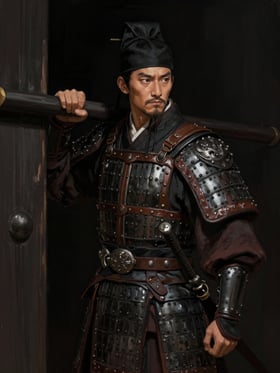
Liang Kuan, from Anding, helped Yang Fu fight Ma Chao and shut Jicheng's gates; the novel adds he killed Ma Chao's family.
Appearances
Novel 1 ch. · History 3 vols.
On the boards
Where this person ranks on each board.
Historical Record
Liang Kuan was from Anding and once took part, with Zhao Qu and others, in a plot to work from within against Ma Chao. Ma Chao led various Rong tribes in attacks on the commanderies and counties of Long, killed Wei Kang, the Inspector of Liang Province, and occupied Jicheng. He declared himself General Who Conquers the West, Acting Governor of Bingzhou, and Supervisor of Military Affairs in Liang Province. Wei Kang’s former officials and people—Yang Fu, Jiang Xu, Liang Kuan, Zhao Qu, and others—conspired to attack Ma Chao. Yang Fu and Jiang Xu raised troops at Luocheng, while Liang Kuan and Zhao Qu shut the gates of Jicheng, preventing Ma Chao from returning after he had left the city to engage the enemy. Unable to advance or retreat, Ma Chao eventually fled to Hanzhong and sought refuge with Zhang Lu. Historical accounts do not record Liang Kuan’s subsequent experience, nor do they give details of his specific role or actions in the closing of the gates.
In the Novel
Chapter 64 of Romance of the Three Kingdoms portrays Liang Kuan as a key agent planted by Yang Fu inside Jicheng. The novel says that when Ma Chao attacked the city, Wei Kang surrendered and was killed. Yang Fu, who had urged Wei Kang not to surrender, was instead retained by Ma Chao and later recommended Liang Kuan and Zhao Qu as military officers. Yang Fu took leave on the pretext of mourning his wife, secretly contacted Jiang Xu and the others, and explained that Liang Kuan and Zhao Qu would support the uprising. When Ma Chao left the city to engage the troops of Jiang Xu, Yang Fu, and the others, Liang Kuan and Zhao Qu seized control of Jicheng and refused to let Ma Chao back in. The novel goes on to say that they killed Ma Chao’s wife, children, and relatives, leaving Ma Chao with nowhere to turn after his defeat.
The core of this account accords with the historical record: Liang Kuan and Zhao Qu shut the gates of Jicheng, preventing Ma Chao from entering. The novel, however, elaborates on Wei Kang’s surrender, Yang Fu taking leave on the pretext of mourning his wife, Liang Kuan’s appointment as a military officer on Yang Fu’s recommendation, and the killing of Ma Chao’s wife and children inside the city. The specific scenes, including the killing of Ma Chao’s wife and children, are not described this way in the historical accounts and should be regarded as literary embellishments in the novel, rather than events that can be confirmed from the historical record.
Key Relationships
- Yang Fu: Plotter and coordinator. Historical accounts say Yang Fu conspired with Jiang Xu, Liang Kuan, Zhao Qu, and others to oppose Ma Chao. The novel portrays Yang Fu as coordinating the various parties, telling Jiang Xu that Liang Kuan and Zhao Qu had agreed to serve as agents within the city, and recommending the two as military officers.
- Zhao Qu: Fellow agent within the city. Both the historical accounts and the novel name Zhao Qu alongside Liang Kuan as one of those who shut Jicheng’s gates and cut off Ma Chao’s route back. In the novel, the two also stand together atop the city wall and rebuke Ma Chao.
- Jiang Xu: One of the leaders of the uprising. Historical accounts say Yang Fu and Jiang Xu raised troops at Luocheng; the novel says Jiang Xu and Yang Fu stationed troops at Licheng and joined the uprising with Yin Feng, Zhao Ang, and others.
- Ma Chao: The target of Liang Kuan’s opposition and efforts to block his return. Historical accounts say that after Ma Chao occupied Jicheng, the others conspired against him. The novel, in turn, presents Liang Kuan’s closing of the gates as the key reason Ma Chao could not enter the city after his defeat.
- The killing of Ma Chao’s wife and children: The novel says Liang Kuan and Zhao Qu killed Ma Chao’s wife, Lady Yang, his young son, and his relatives atop the city wall. This specific episode appears only in the novel; the historical accounts do not record such a scene.
Defining Scene
The scene that best sums up Liang Kuan’s actions is the closing of Jicheng’s gates by Liang Kuan and Zhao Qu after Ma Chao led his troops out of the city. The historical accounts simply note that “Kuan and Qu closed the gates of Jicheng,” and summarize the result by saying that Ma Chao could not enter and was left in a desperate position. This focuses Liang Kuan’s role on the joint action of cutting off Ma Chao’s retreat from within the city.
The novel expands this moment into a dramatic standoff at the city gates: after his defeat, Ma Chao rides back to Jicheng through the night, arrows rain down from the walls, and Liang Kuan and Zhao Qu appear to berate him and kill his wife and children. Liang Kuan thus becomes the character who personally drives the resistance to a decisive break, leaving Ma Chao without either his city or his family. The depiction of the killing of his wife and children is unique to the novel and should not be conflated with the brief historical account.
- Lord & vassal
- Enemies
Combat
On the field
Duels, kills and executions as the texts tell them, counted separately for the Records and the Romance.
- RomanceCh. 64ExecutionLady YangWon「將馬超妻楊氏從城上一刀砍了」

Continue
Ma Chao
Lord
Relationship timeline3 entries ▸
History · vol. 36
Novel · ch. 64
- Ma Chao§24
Lord
In the Romance, was first employed by Ma Chao as an officer, then rebelled against him