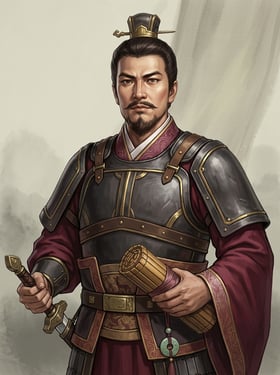
Historical Record
Zhong Hui, styled Shiji, was a native of Changshe in Yingchuan and the youngest son of the Grand Tutor Zhong Yao c:3943. From childhood he was quick-witted and precocious; at the age of five, the Central Protector of the Army Jiang Ji marveled at him, saying "this is no ordinary man" c:3943. By the time he reached adulthood, Zhong Hui was brimming with talent, broadly learned and finely versed in the study of names and principles, often pursuing his studies day and night, and his fame thus spread far and wide c:3943. During the Zhengshi era, he was appointed Gentleman of the Imperial Library, and later promoted to Imperial Secretary and Gentleman-Attendant of the Palace Writers c:6537. After the Duke of Gaogui Precinct, Cao Mao, ascended the throne, he was granted the rank of Marquis Within the Passes c:6537.
During the rebellion of Guanqiu Jian, Zhong Hui accompanied the Grand General, Prince Jing of Sima (Sima Shi), on the eastern campaign, taking charge of secret affairs c:3945. After Prince Jing, Sima Shi, died of illness at Xu Chang, his younger brother Prince Wen of Sima, Sima Zhao, took command of the six armies, while Zhong Hui devised plans behind the scenes c:3945. Together with Fu Gu he schemed to enable Sima Zhao to swiftly grasp military authority and be appointed Grand General and regent c:3945. Zhong Hui was therefore promoted to Gentleman of the Yellow Gate and enfeoffed as Marquis of Dongwu Precinct, with a fief of three hundred households c:3945.
In suppressing Zhuge Dan's Rebellion, Zhong Hui displayed his outstanding stratagems even further. Taking advantage of a quarrel among the nephews of the Wu general Quan Cong, he devised a stratagem of sowing discord, causing Wu generals such as Quan Yi to open the gates and surrender, hastening the fall of Shouchun c:3947. Zhong Hui therefore won Sima Zhao's deep trust, and people of the time called him "Zifang" c:3947. After the army returned, he was appointed Grand Coachman, but firmly declined and instead transferred to be a Gentleman of the Household, managing the records office in the Grand General's headquarters, becoming Sima Zhao's most trusted confidant c:3947. For his merit in suppressing Zhuge Dan, Zhong Hui was advanced to Marquis of Chen, but repeatedly declined and was ultimately appointed Colonel-Director of Retainers c:3947. Although he held an external post, he could oversee the gains and losses of current government, take part in the court's major decisions—even the execution of Ji Kang and others was all by Zhong Hui's design c:3947.
In the third year of Jingyuan (262 CE), Sima Zhao wished to mount a great campaign against Shu, and Zhong Hui too believed Shu could be taken; together with Sima Zhao he planned out the terrain and assessed the situation of affairs c:3948. In the autumn of the following year, Zhong Hui was appointed General Who Guards the West, holding the staff of authority and commanding the military affairs of Guanzhong, leading more than a hundred thousand troops to enter Shu by separate routes through the Xie Valley and the Luo Valley c:3948. He was strict in military discipline: he even beheaded the Garrison Gate General Xu Yi for failing to maintain the road, which had caused a bridge to break and a horse to fall, so that the armies were struck with awe c:3948. After entering Shu, Zhong Hui sent soldiers to offer sacrifices at Zhuge Liang's tomb, and strictly forbade the soldiers from grazing or cutting wood and fodder around the tomb c:6539.
After Deng Ai successfully crossed by stealth through Yinping, Zhong Hui secretly memorialized Sima Zhao, falsely accusing Deng Ai of harboring rebellion c:3950. Sima Zhao thereupon issued an edict to summon Deng Ai in a prison cart. Zhong Hui was ordered to advance on Chengdu, with Wei Guan going ahead, who successfully arrested Deng Ai and his son c:3950. After Deng Ai was captured, Zhong Hui alone commanded the great army, his might shaking the western land. Reckoning his fame and merit to surpass the age, and that he could no longer stand below others, he conceived the intent to rebel c:3950. He planned to join with the Shu Han surrendered generals such as Jiang Wei, having Jiang Wei lead the Shu troops out through the Xie Valley, while he himself would lead the main army behind, intending to seize Chang'an and Luoyang directly and then take all under Heaven c:3950.
On the fifteenth day of the first month of the first year of Xianxi (264 CE), Zhong Hui reached Chengdu. The next day, he falsely claimed a posthumous edict of Empress Dowager Guo, summoned the Protectors of the Army, commandery administrators, Garrison Gate Cavalry Supervisors and above, along with the former officials of Shu Han, and proclaimed the raising of troops to depose Sima Zhao c:3950. However, owing to the informing of Qiu Jian, the supervisor of his headquarters (a former subordinate of Hu Lie), and the counterattack of Hu Lie and his son and Wei Guan and others, Zhong Hui's rebellion swiftly failed c:3950. On the eighteenth day of the first month, the Wei army mutinied, and Zhong Hui and Jiang Wei were killed amid the chaos of the troops, at the age of forty c:15088.
In the Novel
The Zhong Hui of the *Romance of the Three Kingdoms* has his stratagems further embellished; he is praised by Sima Zhao as "my Zifang" c:15044, and many times offers counsel for Sima Zhao at critical moments. When Sima Shi was gravely ill, Zhong Hui advised Sima Zhao to return swiftly to Luoyang to forestall any upheaval in the court c:15042. In suppressing Zhuge Dan's Rebellion, Zhong Hui advised Sima Zhao to besiege the city on three sides, leaving open the main road of the south gate to let the enemy flee of their own accord, then pursue and strike them; this stratagem won the Wei army a great victory c:15044. He also advised Sima Zhao not to bury alive the surrendered Wu troops, but to release them back to Jiangnan to display the magnanimity of the Central States, which won Sima Zhao's deep approval c:15048.
In the campaign against Shu, Zhong Hui's stratagems run throughout. He presented Sima Zhao with a map and plan for the campaign against Shu, detailing the routes of march and strategic dispositions c:3955. To confuse Eastern Wu, he even, under the pretext of campaigning against Wu, built ships on a large scale, in reality preparing for the campaign against Shu c:15052. After entering Shu, Zhong Hui displayed his harsh military law: because the vanguard Xu Yi had failed to repair a bridge, causing him nearly to fall from his horse, he beheaded Xu Yi despite the pleas of the generals, striking awe into the three armies c:3956. In assaulting Yangping Pass, he threatened that if surrender were refused, then "jade and stone would burn alike," and, using the surrender of the Shu general Jiang Shu, successfully took the pass c:15057.
The novel also adds the detail of Zhong Hui sacrificing at Zhuge Liang's tomb, and an episode in which he dreamed of Zhuge Liang admonishing him to "by no means wantonly slay living beings" c:3957. Zhong Hui therefore issued an order through the army to raise white banners reading "protect the state, pacify the people," committing not the slightest offense, so that the people of Hanzhong were moved with gratitude c:3957.
In his relationship with Deng Ai, the novel emphasizes the conflict and mutual suspicion between Zhong Hui and Deng Ai. With the words that Deng Ai was a "mediocre talent," Zhong Hui lured Deng Ai into a surprise attack on Chengdu by the byways of Yinping, in reality wishing to use his hand to break Shu c:15065. After Deng Ai successfully destroyed Shu, Zhong Hui exploited Sima Zhao's suspicion of Deng Ai, forging Deng Ai's memorials to make their wording arrogant, ultimately succeeding in framing Deng Ai and his son c:15071.
Zhong Hui's interactions with Jiang Wei are likewise quite dramatic in the novel. Jiang Wei feigned surrender at Jianmen Pass, in reality wishing to use Zhong Hui's strength to restore the Han imperial house c:15070. Zhong Hui trusted him deeply, even sworn brothers with Jiang Wei, deliberating great affairs together each day c:3960. Jiang Wei also secretly wrote to Liu Shan, saying "endure a few days' humiliation, and I, Wei, will cause the altars of state, having been imperiled, to be restored to safety" c:3960. Zhong Hui, urged on by Jiang Wei, ultimately falsely claimed a posthumous edict of Empress Dowager Guo, wishing to raise troops to depose Sima Zhao, and planned to bury alive the Wei generals who would not comply c:6543. However, because Qiu Jian informed Hu Lie, the Wei army mutinied, and Zhong Hui and Jiang Wei were ultimately killed amid the chaos of the troops c:15084. The novel also describes the detail of Jiang Wei's gallbladder being "as large as a hen's egg" after his death c:6543.
Key Relationships
* Sima Zhao (enemy_of): Zhong Hui was Sima Zhao's trusted strategist; after Sima Shi died of illness, he helped Sima Zhao stabilize his military authority, and rendered great service in suppressing Zhuge Dan's Rebellion, being praised by Sima Zhao as "my Zifang" c:15044. However, after the destruction of Shu, Zhong Hui, his merits eclipsing his lord, conceived treacherous designs, and ultimately forged an edict to raise troops in rebellion against Sima Zhao c:3950.
* Deng Ai (betrayed_by): Zhong Hui and Deng Ai were both chief generals in the campaign against Shu, but the two had long been at odds. Zhong Hui exploited Sima Zhao's suspicion of Deng Ai, secretly memorializing to falsely accuse Deng Ai of harboring rebellion, and forged Deng Ai's memorials, ultimately causing Deng Ai and his son to be summoned in a prison cart c:3950 c:15071.
* Jiang Wei (commands_in): After the destruction of Shu, Zhong Hui treated Jiang Wei and the other Shu Han surrendered generals generously, riding in the same carriage and sitting on the same mat with Jiang Wei c:3952. When Zhong Hui plotted rebellion, he planned to have Jiang Wei lead the Shu troops as the vanguard c:3950. In the novel, Jiang Wei went further, feigning surrender to Zhong Hui to use his hand to restore the Han imperial house, and plotting rebellion together with Zhong Hui c:15070.
* Empress Guo of Mingyuan (witnesses): When Zhong Hui plotted rebellion, he falsely claimed a posthumous edict of Empress Dowager Guo, raising troops in her name to depose Sima Zhao c:3950 (unique to the novel; the historical record states he forged a posthumous edict of the Empress Dowager, without specifying which Empress Dowager).
* Hu Lie: Hu Lie was the former lord of Qiu Jian, the supervisor of Zhong Hui's headquarters. When Zhong Hui plotted rebellion, he imprisoned Hu Lie and other Wei generals. Qiu Jian informed Hu Lie, bringing about the mutiny of the Wei army, and ultimately Zhong Hui's failure c:3950 c:15084.
* Wei Guan: Wei Guan was the supervisor of the army sent by Sima Zhao to Zhong Hui's army. After Zhong Hui falsely accused Deng Ai, Wei Guan was ordered to arrest Deng Ai c:3950. When Zhong Hui plotted rebellion, Wei Guan, together with Hu Lie and others, counterattacked, ultimately putting down Zhong Hui's rebellion c:3950 c:15085.
Signature Scenes
* The Stratagem at Shouchun: In suppressing Zhuge Dan's Rebellion, Zhong Hui offered Sima Zhao the plan of besieging the city on three sides, leaving open the main road of the south gate to let the enemy flee of their own accord, then pursuing and striking them, winning the Wei army a great victory, for which Sima Zhao praised him as "my Zifang" c:15044.
* Beheading Xu Yi: On the campaign against Shu, because the vanguard Xu Yi had failed to maintain the road, causing Zhong Hui nearly to fall from his horse, Zhong Hui beheaded Xu Yi despite the pleas of the generals, thereby enforcing strict military discipline and striking awe into the three armies c:3956.
* Sacrificing at Zhuge Liang's Tomb: After entering Shu, Zhong Hui made a special point of going to offer sacrifices at Zhuge Liang's tomb, and strictly forbade the soldiers from grazing or cutting wood and fodder around the tomb c:6539. In the novel, he even dreamed of Zhuge Liang admonishing him to "by no means wantonly slay living beings," and therefore raised white banners reading "protect the state, pacify the people," committing not the slightest offense c:3957.
* Framing Deng Ai: Zhong Hui exploited Sima Zhao's suspicion of Deng Ai, secretly memorializing to falsely accuse Deng Ai of harboring rebellion, and forging Deng Ai's memorials to make their wording arrogant, ultimately succeeding in framing Deng Ai and his son and having them summoned in a prison cart c:3950 c:15071.
* The Chengdu Rebellion: After Zhong Hui alone commanded the great army, reckoning his merits to eclipse the age and that he could no longer stand below others, he falsely claimed a posthumous edict of Empress Dowager Guo, summoned the generals at Chengdu, and intended to raise troops to depose Sima Zhao and take all under Heaven c:3950. However, owing to the informing of Qiu Jian, the supervisor of his headquarters, and the counterattack of Hu Lie, Wei Guan and others, Zhong Hui's rebellion swiftly failed, and he was ultimately killed amid the chaos of the troops c:15088.
* Plotting with Jiang Wei (unique to the novel): In the novel, Jiang Wei feigned surrender to Zhong Hui and plotted with him, wishing to use Zhong Hui's strength to restore the Han imperial house. Jiang Wei presented Zhong Hui with the Marquis of Wu's bequeathed map and urged Zhong Hui to raise troops to depose Sima Zhao c:3960 c:15071.
Portrait file
Character profile
- Character
- Zhong Hui was refined in strategy and calculation, and his contemporaries likened him to Zifang; from boyhood he had daring and wits, loved to read books on war, and was deeply versed in strategy. He repeatedly offered ingenious schemes and was eager to press ahead, obstinate and unwilling to retire into idleness—both coveting the merit of subduing the realm, and suspicious and prone to jealousy.
- Manner of speech
- Zhong Hui spoke to the point, foreseeing upheaval at court, and was skilled at dissecting advantage and harm in terse phrases and at citing the maxims of the art of war and the ancients. His military orders were clipped and commanding, and in council he invoked ancient precepts, pressing others with the Son of Heaven's clear edicts and the Duke of Jin's solemn commands, while in private he mocked Deng Ai as a mediocrity.
- Life
- Zhong Hui was a native of Changshe in Yingchuan, the youngest son of the Grand Tutor Zhong Yao, quick and clever from his youth. He served as Gentleman of the Palace Library and as Attendant Gentleman of the Masters of Writing and Palace Secretariat, and in the reign of the Duke of Gaogui was granted the rank of Marquis Within the Passes. In the fourth year of Jingyuan he invaded Shu by way of the Luo Valley; after Shu was pacified he became Minister over the Masses; in the first year of Xianxi he rebelled in Shu and was suppressed, and finally, on the eighteenth day of the first month of the fifth year, he was killed by mutinous soldiers at the age of forty.
- Anecdotes
- Zhong Hui was once praised by Sima Zhao as 'truly my Zifang.' As commander-in-chief of the campaign against Shu, he raised a revolt at Chengdu in the first month of the first year of Xianxi, which led to Liu Xuan being killed by the mutinous soldiers.
Relationships
35 relationships
Family4
Lord & vassal3
Friends5
Enemies5
Other17
Quotes
48 recorded lines · 3 featured
「吾意決矣。事成則得天下,不成則退西蜀,亦不失作劉備也。」
These words reveal Zhong Hui's ambition to emulate Liu Bei and carve out a domain of his own, a turning point in his life.
「但取鄧艾,相國知我能獨辦之;今來大重,必覺我異矣,便當速發。事成,可得天下;不成,退保蜀漢,不失作劉備也。我自淮南以來,畫無遣策,四海所共知也。我欲持此安歸乎!」
This line is a genuine historical record of Zhong Hui's rebellion, reflecting his political ambition.
「蜀若聞我兵大進,必求救於東吳也:故先布聲勢,作伐吳之狀,吳必不敢妄動。一年之內,蜀已破,船已成,而伐吳,豈不順乎?」
This stratagem displays Zhong Hui's military cunning-feinting east while striking west-in preparation for the campaign against Shu.
Chapters16 回 ▸
- 史ch.4ch.13ch.21ch.28ch.33ch.35ch.44ch.45
- 演ch.107ch.110ch.112ch.115ch.116ch.117ch.118ch.119
Relationship timeline20 条 ▸
史 ch.4
- Sima Zhao§85
enemy_of
反于蜀,为众所讨
史 ch.28
- Deng Ai§57
betrayed_by
与胡烈、师纂等白艾所作悖逆,徵入槛车
- Zhong Yao§72
kin_of
太傅小子
- Jiang Ji§72
witnesses
五岁见之,济异之
- Sima Shi§74
advises_in
东征毌丘俭从行,典知密事
- Sima Zhao§74
advises_in
谋谟帷幄,转黄门侍郎,封东武亭侯;後封陈侯、司徒
- Zhuge Dan§76
advises_in
谋图全怿等开城出降;时人谓子房
- Xu Yi§77
enemy_of
以治道桥穿斩之
- Jiang Wei§77
fights_in
攻剑阁未克;後维降会,情好欢甚
- Sima Zhao§87
betrayed_by
灭蜀後自谓功盖世,谋反;为乱兵所杀
史 ch.44
演 ch.110
- Sima Shi§2
advises_in
进言"淮楚兵强,宜亲征"
演 ch.112
advises_in
屡献奇谋(以利诱吴、留南门、放归吴兵、赦文鸯)
演 ch.115
- Deng Ai§13
commands_in
合兵取蜀;会建议邓艾分兵各进
演 ch.116
- Zhuge Liang§12
witnesses
定军山遇异,至武侯墓前再拜致祭;得武侯托梦戒勿妄杀
演 ch.118
- Sima Zhao§34
serves
受诏进封司徒、县侯、增邑万户
演 ch.119
betrayed_by
表面投钟,实欲借其乱而复汉
commands_in
共谋反;钟会执掌钟会大军,姜维为先锋,密约成事同享富贵
- Deng Ai§2
enemy_of
以鞭挞艾之首而骂"養犢小兒",遣送洛阳
Inner monologues · AI-generated3 段 ▸
- I am Zhong Hui, courtesy name Shiji. Only now do I understand that, though one may devise plans in the command tent, one
- I have often believed that success and failure in this world are determined first by recognizing the situation, then by
- My name was Hui, and my courtesy name was Shiji. I was from Changshe in Yingchuan, the youngest son of Taifu You. Histor
Life events6 ▸
- 0263-01-01 · Jianmen PassJiang Wei's Retreat to Jiange· Commander
- 0263-01-01 · Jianmen PassJiang Wei Retreats to Defend Jiange Pass· Commander
- 0263-01-01 · YinpingDeng Ai's Surprise Attack Through Yinping· Commander
- 0264-01-01 · ChengduZhong Hui's Rebellion — Death of Zhong Hui and Jiang Wei in Chengdu· Instigator
- 0264-01-01 · ChengduZhong Hui's Rebellion· Instigator
- 0264-01-01 · ChengduRebellion of Zhong Hui and Jiang Wei· Instigator