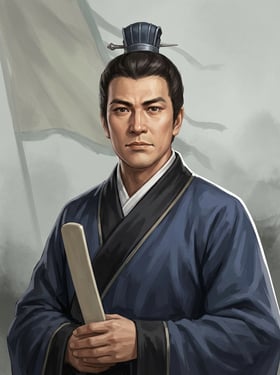
Historical Record
Deng Zhi, courtesy name Bomiao, was a native of Xinye in Yiyang and a descendant of the Han Minister over the Masses Deng Yu. At the end of the Han, Deng Zhi entered Shu but did not at first attain a distinguished position. According to the record, the Yi Province aide Zhang Yu was skilled in physiognomy, and when Deng Zhi went to consult him, Zhang Yu predicted that past the age of seventy he would rise to General-in-Chief and be enfeoffed as a marquis. Deng Zhi later went to attach himself to Pang Xi, Grand Administrator of Baxi, because he heard that Pang Xi valued men of talent. After Liu Bei pacified Yi Province, Deng Zhi was appointed supervisor of the Pi granary. When Liu Bei toured Pi and spoke with Deng Zhi, he was greatly impressed and promoted him to Prefect of Pi, later transferring him to Grand Administrator of Guanghan. During his tenure he was renowned for incorruptibility and strict justice, with outstanding achievements. He was thereafter summoned to court to serve as a Master of Writing.
After Liu Bei died at Yongan, Eastern Wu had sought peace with Shu Han, and during his lifetime Liu Bei had repeatedly dispatched Song Wei, Fei Yi, and others to make return visits to Wu. The Chancellor Zhuge Liang, deeply concerned that Sun Quan might harbor disloyal intentions upon learning of Liu Bei's death, dispatched Deng Zhi as envoy to Wu to reaffirm the friendly relations between Wu and Shu. At first Sun Quan adopted a wait-and-see attitude toward Deng Zhi and would not grant him an audience. Deng Zhi then requested an audience himself, declaring to Sun Quan that this mission was not only for Shu Han but also for Wu. When Sun Quan received him and voiced his worries about Shu Han being small and weak with a young ruler, Deng Zhi persuaded him with the reasoning that union would benefit both Wu and Shu while division would harm both, prompting Sun Quan at last to break off relations with Wei and re-establish the alliance with Shu Han.
During Zhuge Liang's Northern Expeditions, Deng Zhi, together with Zhao Yun, served as a decoy force holding Jigu to pin down the Wei General-in-Chief Cao Zhen. After Zhuge Liang's death, Deng Zhi was appointed Front Army Adviser and General of the Front, concurrently Inspector of Yanzhou, and was enfeoffed as Marquis of Yangwu Village; shortly afterward he was placed in command of Jiangzhou. Sun Quan maintained frequent correspondence with Deng Zhi and gave him lavish gifts.
In the sixth year of Yanxi (243 CE), Deng Zhi was promoted to General of Chariots and Cavalry, and later granted the staff of authority. In the eleventh year of Yanxi (248 CE), the subordinate-state people and tribesmen of Fuling Commandery rose in revolt, and Deng Zhi led troops to suppress them, swiftly executing the leaders of the rebellion so that the local populace could live in peace. According to the Record of the Lands South of Mount Hua, when Deng Zhi campaigned against Fuling he shot a black gibbon, and seeing its young draw out the arrow and stanch the wound for its mother, he lamented that he had violated the nature of living things; he then cast his crossbow into the water, sensing that he would not live long. In the fourteenth year of Yanxi (251 CE), Deng Zhi died. He had served as a general for over twenty years, was clear in reward and punishment, and treated his soldiers well. All his life he was incorruptible, relying on his official salary for food and clothing and never amassing private property, so that his wife and children often went hungry and cold, and at his death there was no surplus wealth in his household.
In the Novel
In Romance of the Three Kingdoms, Deng Zhi's image is further developed, especially his role in establishing the Wu-Shu alliance and in the northern campaigns. After Liu Bei's death, Zhuge Liang, to consolidate the Wu-Shu alliance, petitioned the Second Sovereign Liu Shan to dispatch Deng Zhi as envoy to Eastern Wu. Among all the officials, Kongming noticed that Deng Zhi wore an expression of joy, knew that he grasped the larger situation, and so selected him as envoy.
When Deng Zhi went as envoy to Eastern Wu, Sun Quan, to test his courage, deliberately set out a cauldron of oil and ordered warriors to stand in ranks bearing blades and axes. Deng Zhi showed no fear and entered with head held high, smiling faintly even at the sight of the boiling oil. Facing Sun Quan's angry rebukes, he insisted, "An envoy of a superior state does not bow to the lord of a lesser realm," and persuaded Sun Quan with the mutual interests of Wu and Shu, even making as if to leap into the cauldron to prove his sincerity. Sun Quan, won over by his integrity and eloquence, at last allied with Shu Han. This episode is not recorded in the histories; it is an artistic embellishment by the novel to highlight Deng Zhi's courage and eloquence.
On his second mission to Eastern Wu, Sun Quan asked whether, should Wei be destroyed and the realm at peace, it would not be pleasant for the two sovereigns to divide and rule it. Deng Zhi replied, "There are not two suns in the sky, nor two kings among the people," and declared that at that time "each ruler would cultivate his virtue and each minister exhaust his loyalty, and only then would warfare cease," showing his firm conviction in the unification of the Han house.
During the northern campaigns, Deng Zhi repeatedly accompanied the army. In Zhuge Liang's first northern expedition, Deng Zhi and Zhao Yun were sent to Jigu as a decoy force to pin down the Wei army. In the engagement with the Wei general Han De, Deng Zhi coordinated with Zhao Yun and routed the Wei forces. Deng Zhi also praised the aged Zhao Yun as "as valiant as ever," and together they reported the victory to Kongming. However, in one battle Deng Zhi advised Zhao Yun to beware a feigned retreat by the Wei army, but Zhao Yun did not heed him and was surrounded after penetrating deep into the enemy ranks. As Deng Zhi's troops were too few to rescue him, the crisis was only resolved when Zhuge Liang arrived in time. In another northern campaign, Deng Zhi set out through Jigu together with Wei Yan, Chen Shi, and others, but Chen Shi ignored Deng Zhi's warnings and insisted on advancing rashly, ultimately leading to defeat. These episodes enrich Deng Zhi's image in the novel, making him not only a diplomat but also a general of strategy.
Key Relationships
* Zhuge Liang: Deng Zhi was deeply trusted and valued by Zhuge Liang. After Liu Bei's death, deeply concerned about Sun Quan's possible disloyalty, Zhuge Liang specifically dispatched Deng Zhi as envoy to Eastern Wu to reaffirm Wu-Shu friendship. In the novel, Zhuge Liang praised Deng Zhi as the fitting envoy he had "long pondered but not yet found."
* Sun Quan: Deng Zhi established a deep mutual trust with Sun Quan. With his courage and rhetoric he persuaded Sun Quan to ally with Shu Han. Sun Quan once praised that "for harmonizing the two states, there is only Deng Zhi," and kept up frequent correspondence and generous gifts with him. In the novel, Sun Quan was even won over by Deng Zhi's integrity, exclaiming, "Such is your sincerity!"
* Zhao Yun: During the northern campaigns, Deng Zhi fought alongside Zhao Yun on several occasions, serving together as a decoy force and reporting victory to Zhuge Liang together.,
* Liu Bei: After settling Yi Province, Liu Bei spoke with Deng Zhi, was greatly impressed, and promoted him to Prefect of Pi.
* Zhang Yu: The Yi Province aide Zhang Yu read Deng Zhi's physiognomy and predicted he would rise to General-in-Chief and be enfeoffed as a marquis, a prediction later fulfilled.
* Pang Xi: Deng Zhi went to attach himself to Pang Xi because Pang Xi valued men of talent.
* Jiang Wei: Deng Zhi was upright in temperament, poor at flattery, and rarely admired anyone, esteeming only Jiang Wei.
Iconic Scenes
* Envoy to Eastern Wu, debating Sun Quan: After Liu Bei's death, Deng Zhi was dispatched by Zhuge Liang as envoy to Eastern Wu and successfully persuaded Sun Quan to renew good relations with Shu Han, bringing about the re-establishment of the Wu-Shu alliance. With his words—"Wu and Shu, two states holding four provinces; the great king is a hero of the age, and Zhuge Liang too is a man of singular excellence"—and his analysis of the consequences should Sun Quan submit to Wei, he ultimately moved Sun Quan. The novel further adds the episode in which Sun Quan sets out a cauldron of oil to test Deng Zhi's courage, where Deng Zhi shows no fear and even makes as if to leap into the cauldron, displaying extraordinary courage and eloquence.
* Serving as a decoy force in the northern campaigns: During Zhuge Liang's Northern Expeditions, Deng Zhi led troops out through Jigu together with Zhao Yun as a decoy force to pin down the main Wei army, creating favorable conditions for Zhuge Liang's main thrust.,
* Suppressing the Fuling revolt: In the eleventh year of Yanxi, when the subordinate-state people and tribesmen of Fuling rebelled, Deng Zhi led troops to swiftly pacify them, executing the leaders of the revolt and restoring local stability.
* Incorruptible and with no surplus wealth at home: Deng Zhi served as a general for over twenty years, always maintaining an incorruptible conduct and amassing no private property, so that at his death there was no surplus wealth in his household and his wife and children could not avoid hunger and cold—displaying his lofty character.
* Discussing the state of the realm with Sun Quan: On his second mission to Eastern Wu, when Sun Quan asked whether, after Wei was destroyed and the realm at peace, it would be pleasant for the two sovereigns to divide and rule, Deng Zhi replied, "There are not two suns in the sky, nor two kings among the people," declaring his firm stance on the unification of the Han house. (unique to the novel)
Portrait file
Character profile
- Character
- Deng Zhi was upright and plain in disposition, indifferent to sentiment; he did not mix easily with the gentry and held few in esteem. Facing danger he was unafraid, composed and eloquent in debate, and he was incorruptible, strict, and accomplished in governance.
- Manner of speech
- Deng Zhi stated his case plainly on its merits, holding forth confidently before Sun Quan, and was skilled at persuading others through the logic of advantage and circumstance. Neither servile nor arrogant, he made a deep bow without kneeling, cited precedents directly to rebut by irony, and spoke mostly through words of congratulation and pointed questioning.
- Life
- Deng Zhi was a man of Xinye in Yiyang, a descendant of the Han Minister over the Masses, Deng Yu. When he entered Shu at the end of the Han he was not employed to advantage; after the Former Lord secured Yi Province he served in turn as supervisor of the Pi granary depot, magistrate of Pi, and Grand Administrator of Guanghan, and later entered the court as a Master of Writing. After the Former Lord passed away, on Zhuge Liang's orders he went as envoy to Eastern Wu to restore the old amity. When Zhuge Liang encamped in the north at Hanzhong, Deng Zhi served as Central Army Supervisor and General Who Displays Martial Might. After Zhuge Liang died, he was promoted to Front Army Counselor and General of the Front, concurrently Inspector of Yanzhou, was enfeoffed as Marquis of Yangwu Village, and had command over Jiangzhou. In the sixth year of Yanxi he rose to General of Chariots and Cavalry, and later received the Staff of Authority. In the eleventh year of Yanxi he put down a rebellion at Fuling. He died in the fourteenth year of Yanxi, having been a general for more than twenty years. Clear in reward and punishment, he relied on the government for his food and clothing, kept no surplus wealth in his household, and esteemed Jiang Wei above all.
- Anecdotes
- Deng Zhi once went, on Zhuge Liang's orders, as envoy to Eastern Wu to restore the old amity, and together with Zhao Yun sortied through Ji Valley as a decoy force. He held the posts of Master of Writing of the Ministry of Revenue, Central Army Supervisor, and General Who Displays Martial Might, and later was promoted to General of Chariots and Cavalry.
Relationships
10 relationships
Family1
Lord & vassal1
Friends2
Enemies1
Other5
Quotes
24 recorded lines · 3 featured
「上國天使,不拜小邦之主。」
This line displays Deng Zhi's dignified, unservile diplomatic bearing, a classic portrayal of his character.
「大王乃命世之英豪,諸葛亮亦一時之俊傑;蜀有山川之險,吳有三江之固:若二國連和,共為脣齒,進則可以兼吞天下,退則可以鼎足而立。今大王若委贄稱臣於魏,魏必望大王朝覲,求太子以為內侍;如其不從,則興兵來攻,蜀亦順流而進取,如此則江南之地,不復為大王有矣。若大王以愚言為不然,愚將就死於大王之前,以絕說客之名也。」
This incisive analysis of the situation among Wu, Shu, and Wei helped forge the Sun-Liu alliance and carries great historical significance.
「『天無二日,民無二王。』如滅魏之後,未識天命所歸何人。但為君者,各修其德;為臣者,各盡其忠,則戰爭方息耳。」
'The heavens have no two suns; the people have no two kings' is a classic articulation of the political order of the Three Kingdoms era.
Chapters11 回 ▸
- 史ch.33ch.35ch.41ch.45
- 演ch.85ch.86ch.91ch.92ch.95ch.96ch.100
Relationship timeline9 条 ▸
Inner monologues · AI-generated3 段 ▸
- I am Deng Zhi, courtesy name Bimiao. Looking back on my life, the late emperor entrusted me with affairs of state, and C
- After the Former Lord died, the Later Lord had only just taken the throne. The people’s hearts within the realm were uns
- My name is Deng Zhi, and my courtesy name is B苗. There is little that can be confirmed from the historical record about
Life events4 ▸
- 0223-01-01 · WuchangWu and Shu Renew Their Alliance· Advisor
- 0223-01-01 · ChengduZhuge Liang Repels the Five Armies· Advisor
- 0223-01-01 · WuchangDeng Zhi's Mission to Wu to Renew the Alliance· Advisor
- 0228-01-01 · Mount QiFirst Northern Expedition· Warrior