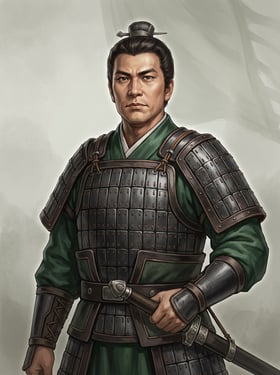
Historical Record
Liao Hua, courtesy name Yuanjian, whose dates of birth and death are unknown, was an important general of Shu Han during the Three Kingdoms period. His early deeds are unclear, but after the founding of Shu Han he served long in the army and held successive important posts. According to the historical materials, in the later period of Shu Han Liao Hua rose to be General of the Right Chariots of War, concurrently Inspector of Bing Province, and was enfeoffed as Marquis of Zhongxiang c:1596. This shows that he held a high position and considerable military authority within the Shu Han regime. Together with Zhang Yi, Jiang Wei, and others, he was an important part of Shu Han's military strength in its later years. After the fall of Shu Han, Liao Hua, along with Zong Yu and other former Shu Han officials, was relocated to Luoyang. In the spring of the first year of Xianxi (264 CE), Liao Hua died of illness on the journey of relocation c:1599.
In the Novel
In Romance of the Three Kingdoms, Liao Hua's image is endowed with more legendary color and dramatic flair. He first appears at the time of Guan Yu's thousand-li solo ride. At that time Liao Hua, as a remnant of the Yellow Turbans, was plundering in the mountains together with Du Yuan. Du Yuan abducted Liu Bei's two ladies, and when Liao Hua learned of it, he, deeply understanding righteousness, killed Du Yuan and wished to return the two ladies to Guan Yu. Although Guan Yu, because of his Yellow Turban background, declined to let him follow as a subordinate, Liao Hua's respect for Guan Yu and his protection of Liu Bei's ladies displayed his upright side c:1600.
Thereafter Liao Hua appears repeatedly in the novel and gradually becomes an important military officer in the Shu Han camp. Before Liu Bei's entry into Shu, he led his troops to come over and surrender, and Liu Bei thereupon had him assist Guan Yu in guarding Jing Province c:1602. During Guan Yu's northern campaign against Xiangyang and Fancheng, Liao Hua was appointed vanguard and went forth on campaign together with Guan Yu c:1603. In this campaign, he once crossed swords with Pang De, displaying his martial valor c:1604.
However, after Jing Province fell, when Liao Hua was besieged at Maicheng, he volunteered to break out of the encirclement and seek relief at Shangyong c:1605. He successfully broke through the Wu army's encirclement and sought aid from Liu Feng and Meng Da at Shangyong, only to be refused c:10391. Liao Hua grieved bitterly over this and hurried to Chengdu to sound the alarm to Liu Bei, recounting in detail how Liu Feng and Meng Da had looked on without saving them c:1606. This directly brought about Liu Bei's handling of Liu Feng and Meng Da. During Zhuge Liang's northern expeditions, Liao Hua repeatedly went on campaign with the army and won battle merits time and again. He once, together with Jiang Wei and under Kongming's stratagem, ambushed Cao Zhen and slew the Wei general Qin Liang c:1609. He also once pursued Sima Yi and slew the Wei general Zheng Lun c:5261, c:1113. During Jiang Wei's northern expeditions, Liao Hua likewise often served as vanguard or an important general c:5262. In the later period of Shu Han, Liao Hua held reservations about Jiang Wei's year-after-year campaigning, holding that "campaigning year after year leaves army and people unsettled," and admonished Jiang Wei that "to forcibly attempt what is hard to accomplish—this is why I dare not act on my own authority" c:1613. This showed his prudence as a veteran general and his concern for the strength of Shu Han. In the end, at the fall of Shu Han, Liao Hua, together with Zhang Yi, held firm at Jianmen Pass under Jiang Wei, and ultimately followed Jiang Wei in a feigned surrender to Zhong Hui, attempting to restore the House of Han c:1614, c:1616.
Key Relationships
* Guan Yu (Serves): In the novel, Liao Hua's connection with Guan Yu runs deep. He once rescued Guan Yu's two sisters-in-law c:1600, was later sent by Liu Bei to assist Guan Yu in guarding Jing Province c:1602, and served as vanguard during Guan Yu's northern campaign c:1603. When Guan Yu was besieged at Maicheng, Liao Hua braved death to break out and seek relief, embodying his loyalty and feeling toward Guan Yu c:1605.
* Liu Bei (Defected_to): In the novel, Liao Hua turned from a remnant of the Yellow Turbans to Liu Bei and long served the Shu Han regime. He once reported to Liu Bei that Liu Feng and Meng Da had failed to rescue Guan Yu c:1606, and Liu Bei therefore trusted him greatly.
* Shu Han (Serves): Liao Hua was an important military pillar of Shu Han in its later years, rising to General of the Right Chariots of War c:1596. In the novel he took part in many northern campaigns and was a veteran general loyal and devoted to Shu Han.
* Zhang Yi (Friend_of): Liao Hua and Zhang Yi often appear together in both the historical materials and the novel, especially in the later period of Shu Han, when the two often held important posts together and went on northern campaigns under Jiang Wei c:5262, c:1614. In the novel, they fought side by side many times, advancing and retreating together.
* Jiang Wei (Serves): In the later period of Shu Han, Liao Hua chiefly assisted Jiang Wei and took part in many northern campaigns. Although he held reservations about Jiang Wei's year-after-year campaigning c:1613, he still carried out the military orders with utter loyalty and, at the fall of Shu Han, joined Jiang Wei in the feigned surrender c:1616.
Signature Scenes
* The thousand-li solo ride, rescuing the two sisters-in-law (novel only): While Guan Yu was escorting his two sisters-in-law on the thousand-li search for his brother, Liao Hua killed Du Yuan, who meant to violate the two ladies, and returned them to Guan Yu. This scene displays Liao Hua's early chivalrous deed and lays the groundwork for his later defection to Liu Bei c:1600.
* Breaking out of Maicheng to seek relief (novel only): When Guan Yu was besieged at Maicheng, Liao Hua stepped forward and braved death to break out and seek relief at Shangyong. Although the appeal for aid came to nothing, this act fully embodied his loyalty to Guan Yu and his resolute, fierce character c:1605.
* Slaying generals and winning merit in the northern campaigns (novel only): In Zhuge Liang's and Jiang Wei's many northern campaigns, Liao Hua repeatedly served as vanguard, once slaying the Wei generals Qin Liang c:1609 and Zheng Lun c:1113, displaying his fierce martial skill and his important role on the battlefield. For example, in one northern campaign, he, together with Jiang Wei and Zhang Yi and under Kongming's stratagem, ambushed Cao Zhen's army, slew Qin Liang, and won battle merit c:1609.
* Admonishing Jiang Wei (novel only): During Jiang Wei's year-after-year northern campaigning, Liao Hua once admonished him bluntly, pointing out that "campaigning year after year leaves army and people unsettled," expressing his concern over the depletion of national strength c:1613. This embodied not only his foresight as a veteran general but also the situation of internal and external distress that beset Shu Han in its later years.
* Following Jiang Wei in the feigned surrender to Zhong Hui (novel only): At the fall of Shu Han, Liao Hua, together with Zhang Yi, Dong Jue, and other generals, followed Jiang Wei in a feigned surrender to Zhong Hui, attempting to seize the chance to restore the House of Han c:1616. This scene embodies Liao Hua's unwavering loyalty to the Han to the death and his longing to restore Shu Han.
Portrait file
Character profile
- Character
- Liao Hua was resolute and fierce by nature, knew the greater good, and revered Lord Guan. He once cited 'a general in the field need not always obey his sovereign's command' to urge Jiang Wei not to retreat, and he also argued that 'Baishui has narrow terrain and many roads—it is no place for battle,' advising a retreat to defend Jiange Pass.
- Life
- Liao Hua's original name was Chun, and he was a man of Xiangyang. He first served as a registrar under Guan Yu; after Guan Yu's defeat he went over to Eastern Wu, then feigned death, and taking his mother traveled westward day and night to return to Shu, where the First Ruler, Liu Bei, appointed him Grand Administrator of Yidu. After the First Ruler's death he held the offices of Military Adviser to the Chancellor, General of Chariots and Cavalry of the Right, Bearer of the Imperial Tally, and acting Inspector of Bing Province, and was enfeoffed as Marquis of Zhongxiang. In the end he was relocated eastward to Luoyang together with Zong Yu, and died of illness on the way.
- Anecdotes
- Liao Hua had once been a remnant of the Yellow Turbans; he later killed his companion Du Yuan to rescue the two ladies. He served under Guan Yu as vanguard, riding out to give battle and feigning defeat to lure the enemy, and once broke out of encirclement to reach Shangyong to seek relief, then hastened to Chengdu to report through tears that Liu Feng and Meng Da had sent no rescuing troops. He took the Ziwu Valley route, and in his last testament Kongming named him one of the 'loyal and righteous men fit to be entrusted with responsibility.'
Relationships
17 relationships
Quotes
14 recorded lines · 3 featured
「『將在外,君命有所不受。』今雖有詔,未可動也。」
This line reflects Liao Hua's understanding of military principle, and also reflects his cautious character.
「關公兵敗,見困於麥城,被圍至急。蜀中援兵,不能旦夕即至。特令某突圍而出,來此求救。望二將軍速起上庸之兵,以救此危。倘稍遲延,公必陷矣。」
This line is Liao Hua's crucial dialogue as the envoy sent to seek relief for Guan Yu, displaying his loyalty and righteousness.
「關公父子遇害,實劉封、孟達之罪。乞誅此二賊。」
This line reflects Liao Hua's indignation at Guan Yu's death and his loathing of Liu Feng and Meng Da.
Chapters19 回 ▸
- 史ch.45
- 演ch.27ch.60ch.63ch.73ch.74ch.76ch.77ch.79ch.99ch.100ch.103ch.109ch.113ch.114ch.115ch.116ch.117ch.118
Relationship timeline21 条 ▸
史 ch.45
演 ch.27
演 ch.60
- Liu Bei§31
friend_of
临行引一军来降,辅佐云长拒曹操
演 ch.73
- Guan Yu§20
serves
受命为先锋
演 ch.74
- Guan Yu§6
commands_in
部将;奉令攻樊城以使关公得抽身亲战庞德
演 ch.76
- Guan Yu§15
participation
突围至上庸求救;后径奔成都
演 ch.77
- Liu Bei§30
advises_in
哭奏刘封、孟达不发救兵之事
演 ch.79
- Liu Bei§20
advises_in
哭拜请诛刘封、孟达,归罪二人致关公遇害
演 ch.99
- Zhuge Liang§15
commands_in
与姜维同领锦囊
演 ch.100
friend_of
同为先锋;斩秦良于马下
enemy_of
一刀斩秦良于马下
演 ch.113
- Zheng Lun§16
enemy_of
山后伏兵,一刀斩郑伦于马下
演 ch.114
advises_in
进言劝姜维抗诏不退,引'"将在外,君命有所不受"'
演 ch.115
advises_in
劝阻姜维强欲伐魏,后受命守汉中
演 ch.116
- Jiang Wei§18
advises_in
接应姜维;进议退守剑阁'"白水地狹路多,非爭戰之所"'
演 ch.117
serves
随姜维入剑阁
演 ch.118
- Jiang Wei§22
serves
随姜维降钟会
Inner monologues · AI-generated3 段 ▸
- I am Liao Hua, courtesy name Yuanjian. On the road to Luoyang, I fell gravely ill. Looking back over my life, I could al
- I am a native of Xiangyang, and my courtesy name is Yuanjian. If you ask why, in my youth, I drifted among the outlaw ba
- I am Liao Hua, courtesy name Yuanjian. I remember when Lord Guan was defending Jing Province: Wu troops suddenly appeare
Life events7 ▸
- 0219-01-01 · MaichengRetreat to Mai Castle· Warrior
- 0228-01-01 · ChencangZhuge Liang's Second Northern Expedition· Warrior
- 0228-01-01 · ChencangBattle for Chencang· Warrior
- 0262-01-01 · Mount QiJiang Wei's Later Northern Expeditions· Warrior
- 0263-01-01 · Mount QiJiang Wei's Northern Expeditions· Warrior
- 0263-01-01 · Jianmen PassJiang Wei's Retreat to Jiange· Advisor
- 0263-01-01 · Jianmen PassJiang Wei Retreats to Defend Jiange Pass· Warrior