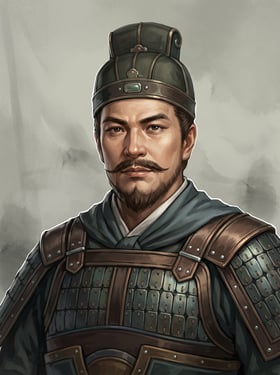
Historical Record
Jia Chong, courtesy name Gonglü, was the son of the late General Who Establishes Awe, Jia Kui. On the political stage of the late Wei and early Jin, Jia Chong played a role of decisive weight. He once served as Central Protector of the Army, holding this post during the Xianxi era. According to the Eulogies of the Eminent Lords of Jin, Jia Chong served as Chief Clerk to the General-in-Chief during the Ganlu era, and in the crisis of the Duke of Gaogui Township, Cao Mao, his resolute action enabled the Prince Wen of Jin (Sima Zhao) to escape his predicament, so that he was regarded as a founding minister of the house of Jin.
During Cao Mao's reign, he keenly resented the growing power of Sima Zhao. He once summoned the Palace Attendant Wang Chen, the Master of Writing Wang Jing, and the Cavalier Attendant-in-Ordinary Wang Ye, declaring bluntly, "Sima Zhao's heart is known to every passerby in the road," and stating that he was unwilling to sit and await his doom but wished to lead his men in person to chastise Sima Zhao. Although Wang Jing earnestly counseled against it, pointing out that the power of the Sima clan had long been entrenched, that court and country alike served them, that the palace guard was empty and their troops few and weak, and that it was unwise to act rashly, Cao Mao's mind was made up; he even flung the edict from his bosom to the ground, saying, "It is decided. Even if I die, what is there to fear? And besides, I need not necessarily die!".
Cao Mao then led several hundred household servants, raising a clamor as they went out. At the southern gate-tower Cao Mao encountered the Central Protector of the Army Jia Chong and engaged him in battle. When Cao Mao wielded his sword and fought fiercely, and the officers and men began to fall back, the Retainer of the Heir Apparent Cheng Ji asked Jia Chong, "The matter is urgent. What should we do?" Jia Chong answered sternly, "It is for this very day that the Sima clan raised and kept you. Of today's affair there is nothing to ask." Cheng Ji thereupon advanced and stabbed Cao Mao, the blade passing out through his back, and Cao Mao died on the spot. Afterward, when Sima Zhao heard the news, he feigned great alarm, threw himself to the ground, and wept, crying, "What will the world say of me!" while the Grand Tutor Sima Fu embraced the corpse and wailed bitterly, lamenting, "That Your Majesty was killed is my offense".
In the edict the Empress Dowager issued afterward, she described Cao Mao as "of a cruel and violent nature, growing worse by the day," who had even "raised a crossbow to shoot from afar at my palace" and intended to "secretly do me harm with poison." The edict further stated that Cao Mao wished to "raise troops to enter the Western Palace to kill me, and go out to seize the General-in-Chief," and that in the clash with Jia Chong's troops he was at last "slain by the vanguard." The Empress Dowager finally ordered that Cao Mao be buried with the rites of a commoner, and that the Master of Writing Wang Jing and his family be arrested and handed over to the Commandant of Justice. Through this affair, Jia Chong's standing in the Sima regime grew ever more secure; he rose to Grand Steward, was enfeoffed as Duke of Lu, and bore the posthumous title Duke Wu.
In the Novel
In the Romance of the Three Kingdoms, the image of Jia Chong is further embellished and intensified on the historical foundation, especially in his active participation and scheming in Sima Zhao's usurpation of the Wei throne. At the outset the novel depicts Jia Chong as Sima Zhao's confidant, serving as Chief Clerk of his office, who of his own accord laid plans for Sima Zhao, probing the sentiments of all quarters to pave the way for usurpation.
In the affair of Zhuge Dan's rebellion, Jia Chong played the key role of instigator. On Sima Zhao's orders, under the pretext of comforting the troops, he went to Huainan to sound out Zhuge Dan. Jia Chong bluntly raised with Zhuge Dan Sima Zhao's intention to receive the abdication of the Wei line, and though sternly rebuffed by Zhuge Dan, on returning to Luoyang he advised Sima Zhao that Zhuge Dan "will surely become a source of trouble in time and should be removed at once," directly bringing about Sima Zhao's military campaign against Zhuge Dan. To ensure that Luoyang would be secure during Sima Zhao's campaign, Jia Chong even advised Sima Zhao to invite the Empress Dowager and the Son of Heaven to go on campaign together, so as to "guarantee against trouble".
As for Cao Mao's death, the novel's account roughly accords with the historical record, but lays greater stress on Jia Chong's cold-bloodedness and his loyalty to Sima Zhao. When Cao Mao led his men charging out of the palace gate, and the guards dared not approach because of his status as Son of Heaven, Jia Chong sternly demanded of Cheng Ji, "For what does Lord Sima keep you? It is precisely for this day's affair," and expressly directed Cheng Ji to "only want him dead," directly bringing about Cao Mao's death. This episode is rendered more dramatically in the novel, highlighting Jia Chong's ruthlessness.
On the question of attacking Shu, the novel has Jia Chong at first take a cautious attitude; he advised Sima Zhao, "The Son of Heaven now suspects you, my lord; if you once go forth lightly, an inner calamity will surely arise," and cited the "Submerged Dragon Poem" composed by Cao Mao to hint at Cao Mao's discontent with Sima Zhao, thereby dissuading Sima Zhao from attacking Shu. Yet once Sima Zhao had resolved to attack Shu, Jia Chong actively joined in the planning, and in the process of Sima Zhao becoming a prince and Sima Yan supplanting Wei, he played the role of an important promoter. Together with Pei Xiu and others, he urged Sima Yan to follow the precedent of Cao Pi's receiving abdication and to build an Abdication Platform, finally bringing about Sima Yan's usurpation of Wei and the founding of Jin.
After the Jin dynasty was established, Jia Chong continued to serve Sima Yan. In the strategic discussions on Jin's conquest of Wu, Jia Chong at first held reservations about attacking Wu, holding that "our troops have long labored abroad and are unaccustomed to the climate and water, so that sickness will surely arise; it would be better to recall the army and plan again later". Yet after the Wu sovereign Sun Hao surrendered, Jia Chong, in the court, questioned the cruel punishments Sun Hao had carried out in the south; Sun Hao replied that "such punishments are inflicted upon ministers who murder their sovereign and upon the treacherous and disloyal," so that Jia Chong "fell silent in deep shame." This detail has no clear basis in the historical record and is the novel's further shaping of his character.
Key Relationships
* Cao Mao (enemy_of): Jia Chong was the key figure who directly brought about Cao Mao's death. When Cao Mao tried to resist Sima Zhao, Jia Chong led troops to bar his way and ordered Cheng Ji to stab Cao Mao.
* Jia Kui (kin_of): Jia Chong was the son of the late General Who Establishes Awe, Jia Kui.
* Sima Zhao (serves): Jia Chong was Sima Zhao's confidant and important counselor, scheming for Sima Zhao's cause of usurpation and carrying out his orders, playing a key role especially in Cao Mao's death and Zhuge Dan's rebellion.
* The Sima clan (member_of): Jia Chong was an important member of the Sima regime, called "a founding minister of the house of Jin" by the Eulogies of the Eminent Lords of Jin, and rose to Grand Steward and Duke of Lu.
* Cheng Ji (subordinate): Cheng Ji was Jia Chong's subordinate, who directly obeyed Jia Chong's order and stabbed Cao Mao.
* Zhuge Dan (enemy_of, unique to the novel): In the novel, Jia Chong, on Sima Zhao's orders, sounded out Zhuge Dan, and denounced Zhuge Dan to Sima Zhao as harboring rebellious intent, indirectly bringing about Zhuge Dan's rising in revolt.
* Sima Yan (serves): In the process of Sima Yan supplanting Wei and founding Jin, Jia Chong was an important promoter, actively urging Sima Yan to follow Cao Pi's precedent and accept the abdication.
Signature Scenes
* Regicide at the southern gate-tower: This is the most controversial and consequential event of Jia Chong's life. When the Duke of Gaogui Township, Cao Mao, tried to chastise Sima Zhao, Jia Chong led troops to intercept him at the southern gate-tower, and at the crucial moment ordered his subordinate general Cheng Ji to stab Cao Mao, directly causing Cao Mao's death. This scene is recorded in detail in both the sources and the novel, a concentrated embodiment of Jia Chong's cold ruthlessness and unswerving loyalty to Sima Zhao.
* Urging delay in attacking Shu and the "Submerged Dragon Poem" (unique to the novel): In the novel, Jia Chong once dissuaded Sima Zhao from attacking Shu, citing the "Submerged Dragon Poem" composed by Cao Mao to hint at the Son of Heaven's discontent with Sima Zhao, displaying his deep deliberation in political stratagem.
* Bringing about Sima Yan's supplanting of Wei: Jia Chong played a key role in the process of Sima Yan supplanting Wei and founding Jin. Together with Pei Xiu and others, he urged Sima Yan to follow the precedent of Cao Pi's receiving abdication, and personally took charge of building the Abdication Platform, finally bringing about Cao Huan's abdication of the throne to Sima Yan and the founding of the Jin dynasty.
* Questioning Sun Hao (unique to the novel): In the novel, after Jin conquered Wu, Jia Chong, in the court, questioned the cruel punishments the Wu sovereign Sun Hao had carried out in the south, only to be rebutted by Sun Hao with the words "such punishments are inflicted upon ministers who murder their sovereign and upon the treacherous and disloyal," so that Jia Chong "fell silent in deep shame". Though this scene has no clear basis in the historical record, it vividly portrays Jia Chong's complex state of mind facing a former adversary, and reflects, from another angle, his standing and influence after the founding of the Jin dynasty.
Portrait file
Character profile
- Character
- Jia Chong advised delaying the campaign against Shu, cited the poem "The Hidden Dragon" to slander Cao Mao, and personally led the palace guards, in armor and on horseback, ordering Cheng Ji to assassinate the sovereign. He was Sima Zhao's trusted intimate and a scheming counselor of the Duke of Jin.
- Manner of speech
- Jia Chong provoked Zhuge Dan with words, saying, "All the worthies of Luoyang regard the reigning sovereign as weak and feeble," and "You could abdicate and replace the Wei succession." He once gave the curt command, "Lord Sima has given an order: we want him dead, that is all," and he urged Cheng Ji on with, "What has Lord Sima raised you for?"
- Life
- Jia Chong, styled Gonglü, was the son of the late General Who Establishes Might, Jia Kui. He once served as Chief Clerk in Sima Zhao's headquarters. During the Xianxi era he was Central Protector of the Army.
- Anecdotes
- Jia Chong sounded out Zhuge Dan's rebellious intent and urged Sima Zhao to eliminate him swiftly; he later advised petitioning the Empress Dowager and the Son of Heaven to lead a personal campaign. He proposed sending an assassin to kill Jiang Wei, and advised enfeoffing Zhong Hui to check Deng Ai. Jia Chong entered Chengdu first and posted proclamations to reassure the populace, later urged Sima Zhao to install the elder heir, and oversaw the building of the Abdication Platform to force Cao Huan to yield the throne. He first recommended Yang Hu, then opposed the campaign against Wu, and afterward reprimanded and demoted Sun Hao.
Relationships
7 relationships
Family2
Lord & vassal1
Enemies1
Other3
Quotes
21 recorded lines · 3 featured
「司馬公養你何用?正為今日之事也。」
This line shows Jia Chong's ruthlessness and loyalty to the Sima clan, a classic portrayal of his character.
「天數盡矣,陛下不可逆天,當照漢獻帝故事,重修受禪臺,具大禮,禪位與晉王。上合天心,下順民情,陛下可保無虞矣。」
This line is pivotal to the Wei-Jin Dynastic Transition; as the driving force behind the Sima clan's supplanting of Wei, Jia Chong's words urging the throne carry great historical weight.
「自漢建安二十五年,魏受漢禪,已經四十五年矣。今天祿永終,天命在晉,司馬氏功德彌隆,極天際地,可即皇帝正位,以紹魏統。封汝為陳留王,出就金墉城居止。當時起程,非宣詔不許入京。」
This line directly proclaims the fall of Wei and the founding of the Jin dynasty, a landmark moment in the historical process of the Reunification of the Three Kingdoms under Jin.
Chapters8 回 ▸
- 史ch.4ch.15
- 演ch.111ch.114ch.115ch.118ch.119ch.120
Relationship timeline7 条 ▸
Inner monologues · AI-generated3 段 ▸
- I am Jia Chong, courtesy name Gonglu. During the Xianxi era, I served as Commandant of the Central Army. In terms of my
- My name is Jia Chong; my courtesy name is unknown. As I recall the upheaval at the palace gate, I can almost still hear
- I am Jia Chong, courtesy name Gonglu. My father, Jia Kui, once served as a general of Wei, and our family had received W
Life events5 ▸
- 0260-01-01 · LuoyangCao Mao Rides Out in His Chariot to Battle· Instigator
- 0260-01-01 · LuoyangGanlu Incident· Instigator
- 0266-01-01 · LuoyangWei-Jin Dynastic Transition· Advisor
- 0278-01-01 · XiangyangYang Hu's Garrison at Xiangyang· Advisor
- 0280-01-01 · JianyeJin's Six-Route Conquest of Wu· Commander