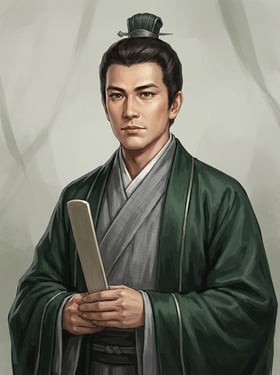
Historical Record
Fu Gu, styled Lanshi, came from a distinguished and prominent family. In the early Zhengshi era he was appointed Gentleman of the Imperial Secretariat, and later promoted to Yellow Gate Attendant c:136. At that time Cao Shuang held the reins of government and He Yan served as Director of the Bureau of Personnel. Fu Gu pointed out to Cao Shuang's brother Cao Xi that He Yan was "outwardly calm but inwardly sharp and cunning, fond of profit, and heedless of attending to fundamentals," predicting that he would surely lead the Cao brothers astray, drive away worthy men, and let the government fall into ruin c:136. Sure enough, He Yan and his clique fell out with Fu Gu over this and used a pretext to strip him of office. Afterward Fu Gu was appointed Grand Administrator of Xingyang, but he did not take up the post. The Grand Tutor Sima Yi (Lord Xuan of Sima) summoned him to serve as Attendant Officer of the Imperial Secretariat c:136.
After Cao Shuang was executed, Fu Gu became Intendant of Henan. The office of Intendant of Henan governed the imperial capital within and oversaw the metropolitan region without, administering the affairs of the capital and its surrounding districts—involving great clans and noble families, merchants and barbarian traders—a place where the empire's profits gathered and where wickedness was bred. During his tenure Fu Gu upheld the program of the Sima clan and, drawing on the experience of his predecessors, reformed and refined the official system. Facing more than seven hundred clerks in the commandery, half of whom were not old hands, and confronting the local Henan custom of preferring to employ natives in key posts such as Officer of the Five Bureaus and Merit Officer, Fu Gu disregarded such conventions, promoting worthy and able men regardless of locality, having each bureau divide its duties, and conducting assessments. He made moral instruction his foundation, applied the law with constancy, was concise yet not to be transgressed, could discern the truth of cases through reason, and could clarify the facts without resorting to punishment. He never bestowed petty favors; the talents he recommended and the policies that benefited the people he kept hidden, seeking no fame, so that at the time he had no resounding renown, yet clerks and commoners over time came to feel secure c:136.
Fu Gu was later promoted to Secretary of the Imperial Secretariat. He often held that when the First Emperor of Qin abolished the system of enfeoffment and established commanderies and counties, the official system differed from antiquity. The Han and Wei had followed it down to the present, yet Confucian scholars always wished to reform it by interweaving the rites of the Three Dynasties, holding the rites to be grand and profound—yet ill-suited to the times, causing affairs to clash with institutions and name to part from substance; this, he held, was why no age had achieved true good governance. He once wished to greatly reform the official system, returning to the ancient roots, but because the imperial house faced many troubles at the time, it could not be carried out c:136.
Fu Gu often discoursed on the similarities and differences of talent and nature, and Zhong Hui once collected his expositions into a book. Fu Gu had subtle insight into talent and nature, such as few could match. At the end of the Jiaping era he was granted the rank of Marquis Within the Passes. After the Duke of Gaogui District, Cao Mao, ascended the throne, he was advanced to Village Marquis of Wuxiang c:138. In the spring of the second year of Zhengyuan, Guanqiu Jian and Wen Qin rebelled. At the time some held that Sima Shi ought not to campaign in person and that the Grand Commandant Wang Fu could be sent instead, but Fu Gu and Wang Su strongly urged Sima Shi to campaign in person. Fu Gu firmly counseled Sima Shi: "The troops of Huai and Chu are strong, and Jian and the others rely on their strength to fight far from home; their edge is not easily withstood. Should the various generals meet with mixed fortunes and the overall situation be lost at a stroke, then your cause is ruined." c:138 Sima Shi had just had an eye ailment cut out, the wound not yet healed, but on hearing this he resolutely decided to "go east despite his illness." Fu Gu accompanied the campaign in the capacity of acting Vice Director of the Imperial Secretariat. Guanqiu Jian and Wen Qin were defeated, and Fu Gu contributed much in the planning. After Sima Shi died, Fu Gu and Sima Zhao went straight back to Luoyang, and Sima Zhao was thereby able to take up the regency c:138. For his merit Fu Gu was advanced to Marquis of Yangxiang, with an increase of six hundred households, making one thousand two hundred in all together with his earlier fief. He died that same year, aged forty-seven, was posthumously appointed Grand Master of Ceremonies, and given the posthumous title Marquis Yuan c:138.
In the Novel
In the Romance of the Three Kingdoms, Fu Gu's image is chiefly reflected in his strategic contributions to the Sima faction, especially in military decisions. He first appears after Sun Quan's death, when Sima Shi wishes to campaign against Wu. At the time, when Sima Shi proposes attacking Wu, Fu Gu takes a cautious stance, holding that "Wu has the barrier of the Yangtze; the late emperor repeatedly campaigned against it without achieving his aims. Better that each side guard its own borders—this is the superior course." c:7077 However, the Sima Shi and Sima Zhao brothers hold that "the way of Heaven changes once every thirty years," and that with Sun Quan newly dead and Sun Liang young and weak, this is a moment to be exploited; they finally decide on the Three-Pronged Campaign against Wu, with Sima Zhao in overall command, and Fu Gu's advice is not adopted.
Fu Gu's more important strategy in the novel is shown in quelling the revolt of Guanqiu Jian and Wen Qin. When Guanqiu Jian withdraws his troops, Sima Shi gathers his officers to deliberate. Fu Gu analyzes that Guanqiu Jian withdrew out of fear that Eastern Wu would attack Shouchun, and that he would surely return to Xiang and divide his forces to defend c:110. He advises Sima Shi to send one army to take Lejia, one to take Xiang, and one to take Shouchun, so that the troops of Huainan would surely withdraw. He specially recommends the Inspector of Yanzhou, Deng Ai, as "abundantly resourceful," advising that Deng Ai be sent to take Lejia directly while heavy forces support him, holding that "defeating the rebels will not be difficult." c:110 Sima Shi adopts Fu Gu's plan, hastily dispatching an envoy with a written order to move Deng Ai's troops to take Lejia, then leading troops himself to join up. Although the histories do record Fu Gu urging Sima Shi to campaign in person and accompanying the army, the detailed scheme of having Deng Ai take Lejia is a literary embellishment of the novel, unrecorded in history.
Key Relationships
* Cao Shuang (rival_of): Fu Gu had a deep insight into He Yan, the man holding power in Cao Shuang's faction, predicting that he would lead the Cao brothers astray and bring the government to ruin. He Yan and his clique fell out with Fu Gu over this, finally leading to Fu Gu's dismissal c:136.
* He Yan (rival_of): Fu Gu bluntly said that He Yan was "outwardly calm but inwardly sharp and cunning, fond of profit, and heedless of attending to fundamentals," foreseeing the harm he would do to the government, and so incurred He Yan's enmity and was pushed aside by him c:136.
* The Sima clan (serves): After Cao Shuang was executed, Fu Gu was summoned by Sima Yi as Attendant Officer of the Imperial Secretariat, and later held key posts during the regencies of Sima Shi and Sima Zhao, offering them strategy—an important strategist and official of the Sima regime c:136.
* Sima Shi (advises_in): During the revolt of Guanqiu Jian and Wen Qin, Fu Gu strongly urged Sima Shi to campaign in person and accompanied the army, playing an important role in quelling the rebellion c:138. In the novel he further offers Sima Shi strategy, pointing out that Deng Ai could take Lejia, helping him put down the revolt c:110 (novel only).
* Sima Zhao: After Sima Shi died, Fu Gu and Sima Zhao went straight back to Luoyang, bringing about the situation of Sima Zhao's regency c:138.
* Zhong Hui: Fu Gu was on good terms with Zhong Hui, and Zhong Hui once compiled Fu Gu's expositions on the similarities and differences of talent and nature c:138.
* Deng Ai: In the novel, Fu Gu recommends Deng Ai to Sima Shi to take Lejia, calling him "abundantly resourceful" c:110 (novel only).
Signature Scenes
* Warning of He Yan's Misgovernment: In the early Zhengshi era, Fu Gu pointed out to Cao Shuang's brother Cao Xi the cunning nature of He Yan, predicting he would lead the Cao brothers astray and bring the government to ruin. This warning not only displayed Fu Gu's discernment of men but also directly led to his falling out with He Yan and his clique, and to his dismissal—an important turning point in his political career c:136.
* Governing as Intendant of Henan: During his tenure as Intendant of Henan, facing the complex administration of the metropolitan region, Fu Gu made moral instruction his foundation, applied the law with constancy, refused to cling to old customs, and promoted worthy men, so that clerks and commoners came over time to feel secure. Though he sought no resounding fame, he genuinely governed the region well, displaying his outstanding administrative ability and political wisdom c:136.
* Strongly Urging Sima Shi to Campaign in Person: During the revolt of Guanqiu Jian and Wen Qin, when others hesitated, Fu Gu overrode all objections, resolutely urging Sima Shi to campaign in person, and moved him with the warning, "Should the various generals meet with mixed fortunes and the overall situation be lost at a stroke, then your cause is ruined" c:138, prompting him to campaign despite his illness and finally quell the rebellion—an act crucial to the stability of the Sima regime.
* Offering a Plan to Quell Guanqiu Jian's Revolt (novel only): In the novel, when Sima Shi quells Guanqiu Jian's revolt, Fu Gu precisely analyzes the enemy's situation and proposes the strategy of "one army to take Lejia, one to take Xiang, one to take Shouchun," and recommends Deng Ai to take Lejia; this plan is finally adopted by Sima Shi and successfully carried out, displaying Fu Gu's talent for military strategy c:110.
Portrait file
Character profile
- Character
- Of pure learning and clear insight, he was fond of discoursing on talent and nature, subtle and refined in his original arguments. Wang Ji recommended him as an upright gentleman fit to share in governance.
- Manner of speech
- He recommended Deng Ai as 'resourceful and full of stratagems,' and to take Lejia directly.
- Life
- A native of Niyang in Beidi, styled Lanshi, a descendant of Fu Jiezi. He was first recruited by the Minister of Works Chen Qun as an aide, then served as Gentleman of the Masters of Writing and Gentleman of the Yellow Gate; because of discord with Cao Shuang and He Yan he was dismissed from office. Later Sima Yi invited him to be Attendant Gentleman of the Bureau; after Cao Shuang was executed he served as Intendant of Henan and Master of Writing. At the end of the Jiaping era he was granted the rank of Marquis Within the Passes, and when the Duke of Gaogui Village ascended the throne he was advanced to Marquis of Wuxiang Village. In the second year of Zhengyuan he urged Sima Shi to campaign in person against Guanqiu Jian and Wen Qin; after the death of King Jing, he returned directly to Luoyang with Sima Zhao to assist him in the regency. For his merit he was advanced to Marquis of Yangxiang, and died in the same year at the age of forty-seven; he was posthumously granted the office of Grand Master of Ceremonies and given the posthumous name Marquis Yuan.
- Anecdotes
- The fifth of the principal subjects of this scroll's biographies. He once conferred with Zhong Hui and stayed behind at Xuchang as support both within and without. He once remonstrated against attacking Wu, and also offered a plan to divide the forces along three routes.
Relationships
5 relationships
Friends1
Enemies2
Other2
Lines
- 演 ch.108 §7
「吳有長江之險,先帝屢次征伐,皆不遂意;不如各守邊疆,乃為上策。」
- 演 ch.110 §4→ Sima Shi
「壽春若失,吾歸何處!」
Chapters3 回 ▸
- 史ch.21
- 演ch.108ch.110
Relationship timeline6 条 ▸
Inner monologues · AI-generated1 段 ▸
- I am Fu Gu, courtesy name Lanshi. In serving at court, what I valued was not winning praise in the moment, but understan
Life events3 ▸
- 0249-01-01 · LuoyangCao Shuang's Regency· Advisor
- 0252-01-01 · DongxingBattle of Dongxing· Advisor
- 0255-01-01 · ShouchunRebellion of Guanqiu Jian and Wen Qin· Advisor