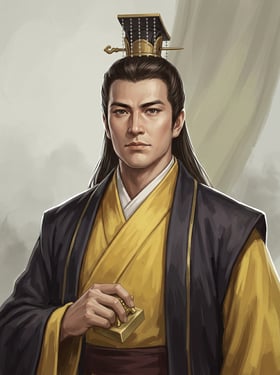
Historical Record
Sima Yan, styled Anshi, is much recorded in the official histories, especially in the course of his founding the Jin dynasty and unifying the realm. In the seventh month of the first year of Xianxi (264 CE), after the pacification of Shu Han, the army of Wu once garrisoned at Yongan, threatening the Wei frontier; Wei thereupon dispatched the various forces of Jing and Yu provinces to act in concert against it. On the gengyin day of the eighth month of that year, Sima Yan was appointed General Who Stabilizes the Center, deputy in charge of the affairs of the Chancellor of State, with the same treatment as the Duke of Lu.
In the first year of Taishi (265 CE), Sima Yan supplanted Wei and founded the Jin, becoming Emperor Wu of Jin. After ascending the throne, he issued edicts revisiting certain events of the former dynasty. For instance, regarding the Grand Commandant Wang Ling, who had once plotted to depose the Prince of Qi, and the General Who Conquers the West Deng Ai, who, though of outstanding merit, had lost his integrity, Sima Yan made mention of both. He held that although Deng Ai was guilty, his submitting himself to punishment with bound hands differed from those who did evil to seek survival, and so in the general amnesty he allowed his descendants to recover their status, so that his sacrifices would not be cut off. In the ninth year of Taishi (273 CE), Sima Yan again issued an edict; in view of Deng Ai's merit, and because his descendants had fallen to the status of bondservants, he specially appointed Deng Ai's eldest grandson Deng Lang as a Gentleman of the Interior.
In the course of unifying Wu, Sima Yan displayed his political foresight. In the fourth year of Xianning (278 CE), he appointed Du Yu General Who Guards the South and commander of the various military affairs of Jing Province, in preparation for the conquest of Wu. In the third month of the first year of Taikang (280 CE), Wang Jun's forces reached Jianye first and received the surrender of the ruler of Wu, Sun Hao. Sima Yan issued an edict treating Sun Hao with leniency, granting him the title Marquis Who Submits to His Destiny and providing generous material treatment, with his heir and other sons receiving corresponding offices. This marked the end of the Three Kingdoms era and showed Sima Yan's magnanimity in handling surrendered ministers and rulers.
In the Novel
In Romance of the Three Kingdoms, Sima Yan is cast as an intelligent, valiant, and exceptionally bold sovereign, his enthronement and unification of the realm given greater drama. In the novel, after the death of his father Sima Zhao, Sima Yan succeeded to the position of Prince of Jin. He asked Jia Chong and Pei Xiu about Cao Cao's old remark, "If the Mandate of Heaven rests with me, shall I be King Wen of Zhou?" and, using it as an opening, expressed his intention to supplant Cao Wei.
The scene of Sima Yan forcing the ruler of Wei, Cao Huan, to abdicate is especially vivid. He went straight into the inner palace and demanded of Cao Huan, "The realm of Wei—by whose strength was it won?" and said bluntly that Cao Huan "in letters cannot discourse on the Way, in arms cannot order the state," implying he was unfit to be sovereign. Faced with Cao Huan's terror and the protest of the Yellow Gate Attendant Zhang Jie, Sima Yan showed his hard side, even having Zhang Jie clubbed to death on the spot, and declared that he was avenging the house of Han and would carry on the realm of Wei. This episode has no detailed record in the official histories; it is the novel's literary creation to highlight his decisiveness and dominating air.
As for the conquest of Wu, the novel dwells on Sima Yan's trust in Yang Hu and Du Yu. When Yang Hu was gravely ill, Sima Yan visited him in person and heeded his advice on the conquest of Wu—that "Sun Hao's cruelty has reached its height; now he may be conquered without a fight." Although Jia Chong and others at court strongly opposed the invasion of Wu, Sima Yan finally adopted the views of Du Yu and Zhang Hua and resolutely decided to send troops. When Jia Chong again tried to dissuade him, Sima Yan declared firmly, "This is my own intent; Hua merely agrees with me—why need we argue?" showing his unwavering resolve. In the end Wu was pacified, and Sima Yan received Sun Hao at Luoyang, displaying the victor's bearing in a witty exchange.
Key Relationships
* Sima clan (member_of): As the son of Sima Zhao and grandson of Sima Yi, Sima Yan was the heir of the Sima clan and its ultimate unifier. He inherited the family's power and political legacy, finally supplanting Wei to found the Jin and completing the Sima clan's grand design. In the novel, Jia Chong and others also stressed the achievements of three generations of the Sima clan in aiding Wei, providing a basis of legitimacy for Sima Yan's usurpation.
* Cao Huan (enemy_of): As the last emperor of Cao Wei, Cao Huan was the object of Sima Yan's usurpation. In the novel, Sima Yan showed absolute dominance and pressure toward Cao Huan, finally forcing him to abdicate and completing the change of dynasty.
* Du Yu (commands_in): Du Yu was an important general in Sima Yan's conquest of Wu. In both history and the novel, Du Yu won Sima Yan's trust and was given important command, playing a key role in the campaign against Wu. In the novel, Du Yu's memorial and Zhang Hua's strong remonstrance finally moved Sima Yan to resolve on the invasion of Wu.,
* Sun Hao (enemy_of): Sun Hao was the last emperor of Eastern Wu and the final obstacle to Sima Yan's unification of the realm. Under Sima Yan's leadership, the Jin army finally took Wu, Sun Hao surrendered, and the Three Kingdoms era came to an end. In the novel, Sima Yan's lenient treatment of Sun Hao and their exchange display the magnanimity and humor of a victor.
* Yang Hu (advisor_to): Yang Hu was an important counselor to Sima Yan, providing key advice especially on the strategy for conquering Wu. In the novel, even when gravely ill, Yang Hu kept the affairs of state at heart, recommended Du Yu to Sima Yan, and stressed the importance of conquering Wu, having a profound influence on Sima Yan's decision.
Iconic Scenes
* Forcing Cao Huan to abdicate: Sima Yan went straight into the Wei palace, demanded answers of Cao Huan to his face, and had the dissenter Zhang Jie clubbed to death on the spot, finally forcing Cao Huan to abdicate. This scene is highly charged in the novel, fully displaying Sima Yan's nerve and decisiveness—a key step in his founding of the Jin dynasty. (novel only)
* Adopting the strategy to conquer Wu: Facing the opposition of Jia Chong and others at court, Sima Yan finally adopted the advice of Yang Hu, Du Yu, and Zhang Hua and resolutely decided to send troops against Wu. This decision reflected Sima Yan's strategic vision and firm will and laid the foundation for unifying the realm.,,,
* Receiving Sun Hao: After the fall of Wu, Sima Yan received the surrendered Sun Hao at Luoyang and granted him the title Marquis Who Submits to His Destiny. The exchange between them—Sima Yan's "I have set out this seat to await you for a long while now" and Sun Hao's "In the south I too set out such a seat to await Your Majesty"—became a celebrated anecdote, displaying Sima Yan's bearing and humor as a victor.
* Remembering Yang Hu's merit: After pacifying Wu, Sima Yan, raising his cup with tears flowing, sighed, "This is the merit of Grand Tutor Yang—what a pity he did not see it with his own eyes!" This act not only expressed his deep remembrance of Yang Hu but also showed Sima Yan's quality of knowing and employing men well and not forgetting his old ministers. (novel only)
* Treating Deng Ai's descendants with leniency: After the founding of the Jin, Sima Yan issued an edict revisiting Deng Ai's merit and allowed his descendants to recover their status, even appointing his eldest grandson a Gentleman of the Interior. This reflected Sima Yan's benevolence as a founding sovereign and his respect for the meritorious ministers of the former dynasty.,
Portrait file
Character profile
- Appearance
- Sima Yan was of imposing stature; when he stood, his hair hung to the ground, and his arms reached below his knees.
- Character
- Sima Yan was intelligent and valiant, of surpassing courage.
- Anecdotes
- Sima Yan was the son of Sima Zhao. After succeeding to the throne of the Prince of Jin, he compelled Cao Huan to abdicate, founded the Great Jin, and changed the era name to Taishi. He was the founding emperor of the Western Jin, who ultimately destroyed Wu and unified the realm. Jia Chong and others, knowing that Sima Zhao's attention rested on his son Sima Yan, therefore ceased to urge him onward. After the house of Jin ascended the throne, he issued an edict commending Wang Ji for his purity and simplicity, and in the first and ninth years of Taishi issued edicts to redress the case of Deng Ai.
Relationships
11 relationships
Quotes
22 recorded lines · 3 featured
「曹丕尚紹漢統,孤豈不可紹魏統耶?」
This line displays Sima Yan's ambition to supplant Wei and found Jin, along with his defense of its legitimacy.
「此社稷乃大漢之社稷也。曹操挾天子以令諸侯,自立魏王,篡奪漢室,吾祖父三世輔魏,得天下者,非曹氏之能,實司馬氏之力也。四海咸知,吾今日豈不堪紹魏之天下乎?」
With these words Sima Yan provided a historical and moral justification for the Sima family's usurpation of Wei.
「朕設此座以待卿久矣。」
This line is Sima Yan's classic remark to Sun Hao after conquering Wu, symbolizing the Reunification of the Three Kingdoms under Jin.
Chapters8 回 ▸
- 史ch.4ch.27ch.28ch.42ch.48
- 演ch.114ch.119ch.120
Relationship timeline3 条 ▸
Inner monologues · AI-generated3 段 ▸
- Since ascending the throne, I have come to understand that an imperial edict may establish a person’s status, but cannot
- With Jiangdong pacified, the assembled ministers offered their congratulations, yet I could not raise my cup and fully s
- My name is Sima Yan, and my courtesy name is Anshi. If you were to ask now what was on my mind in my early years, I coul
Life events5 ▸
- 0266-01-01 · LuoyangThe Sima Clan's Seizure of Power· Instigator
- 0266-01-01 · LuoyangWei-Jin Dynastic Transition· Instigator
- 0278-01-01 · XiangyangYang Hu's Garrison at Xiangyang· Instigator
- 0280-01-01 · JianyeReunification of the Three Kingdoms under Jin· Commander
- 0280-01-01 · JianyeJin's Six-Route Conquest of Wu· Instigator