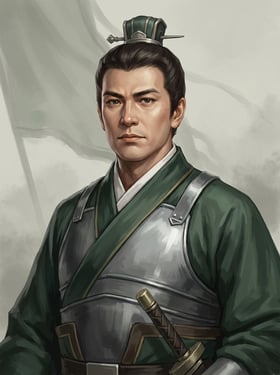
史载(Historical Record)
Chen Tai, courtesy name Xuanbo, was a composed, brave, decisive, upright, and incorruptible general and official of the Cao Wei period. He came from an illustrious family, his father being the Minister of Works Chen Qun. In the Qinglong era, Chen Tai was appointed Cavalier Attendant Gentleman. In the Zhengshi era, he was transferred to General of Roving Attack, and later went out as Inspector of Bing Province, with the additional title of General Who Spreads Awe, and held the staff of authority as Protector of the Xiongnu and Internuncio of the Central Gentlemen. While in office in Bing Province, Chen Tai won the hearts of the people by soothing the non-Chinese peoples with awe and kindness. At the time, many notables in the capital bought slave girls through Chen Tai and sent him precious goods, but Chen Tai hung all these treasures on the wall, never breaking the seals to use them. Only when he was summoned to be a Master of Writing did he return all the treasures intact, displaying his incorruptible character. c:4092
At the start of the Jiaping era, Chen Tai succeeded Guo Huai as Inspector of Yong Province, with the additional title of General Who Exerts Awe. At that time, the Shu Han Grand General Jiang Wei led his forces to build two cities at Qushan and sent the vanguard generals Ju An, Li Xin, and others to garrison them, while gathering the Qiang and Hu hostage levies and others to harass the Wei commanderies. The General Who Conquers the West, Guo Huai, consulted with Chen Tai on how to resist. Chen Tai proposed: "Although Qucheng is strong, it is far from Shu and must rely on long-distance grain transport. The Qiang and Yi peoples loathe Jiang Wei's labor demands and will not truly submit. If we besiege and take the city, we can capture it without a single soldier; and even if Jiang Wei comes to the rescue, the mountain roads are treacherous and no place for marching and fighting." Guo Huai adopted Chen Tai's plan and sent him leading the Protector of the Army for the Campaign against Shu, Xu Zhi, the Grand Administrator of Nan'an, Deng Ai, and others, to advance and besiege Qucheng, cutting off the Shu army's grain transport route and the water source outside the city. Ju An and the others came out of the city to give battle, but Chen Tai held firm and would not fight, so the Shu soldiers were reduced to dividing rations and gathering snow to slake their thirst, dragging out the days. Jiang Wei did indeed come to the rescue, marching out from Niutou Mountain to confront Chen Tai. Chen Tai said: "In the art of war, what is prized is subduing the enemy without battle. Now that we have cut off Niutou Mountain, Jiang Wei has no line of retreat and becomes our prisoner." He ordered all his armies to hold their fortified camps and not engage Jiang Wei, and sent an envoy to report to Guo Huai, saying that he himself would cross the Bai River from the south and proceed eastward along the water, while Guo Huai should advance to Niutou Mountain to cut off Jiang Wei's line of retreat—thus they could not only capture Jiang Wei but also deal with Ju An and the others at one stroke. Guo Huai admired Chen Tai's strategy and led all his armies to occupy the Tao River. When Jiang Wei learned of this he was greatly alarmed and fled in a panic, leaving Ju An and the others isolated and unsupported, so that they all finally surrendered. c:4092
After Guo Huai died, Chen Tai succeeded him as General Who Conquers the West, holding the staff of authority as Area Commander of all military affairs in Yong and Liang Provinces. The next year, the Inspector of Yong Province, Wang Jing, reported to Chen Tai that Jiang Wei and Xiahou Ba would attack Mount Qi, Shiying, and Jincheng in three columns, requesting reinforcements as support, with the Liang Province army going to Fuhan and the Protector of the Army for the Campaign against Shu going to Mount Qi. Chen Tai judged that the enemy could not possibly advance in three columns, that dividing their forces would be disadvantageous, and that the Liang Province army should not cross the border to fight; so he replied to Wang Jing: "Wait until the enemy's true intentions and direction are confirmed, then advance with combined force according to the situation on the eastern and western fronts." At that time, Jiang Wei and the others led tens of thousands of men to Fuhan and made straight for Didao. Chen Tai ordered Wang Jing to advance and occupy Didao, and to wait until the Wei main force arrived before seeking victory. Chen Tai himself led troops to occupy Chencang. However, the army Wang Jing commanded was defeated in battle against the enemy at Guguan, and Wang Jing then crossed the Tao River. Chen Tai judged that Wang Jing's failure to hold Didao would surely bring further trouble. He sent the five garrison battalions ahead and led the main force after them. By this time Wang Jing had already engaged Jiang Wei and been crushingly defeated, retreating with only over ten thousand men to hold Didao city, the rest of his forces having scattered. Jiang Wei, riding his victory, besieged Didao. Chen Tai led his army to Shanggui, dividing his forces to guard the key routes and advancing day and night. When Deng Ai, Hu Fen, and Wang Mi successively arrived, Chen Tai then divided his forces with Deng Ai, Wang Mi, and the others into three columns to advance to Longxi. Deng Ai and the others held: "Wang Jing's elite troops have been heavily defeated on the western front, the enemy's morale is high, and the army riding its victory is unstoppable; while the general's force is a motley host, coming after a defeated army, with low morale, and the Longyou region hangs in the balance. The ancients said: 'When a viper bites the hand, the bold man severs his wrist.' Sunzi said: 'There are armies that should not be attacked, and ground that should not be defended'—all to abandon the small to preserve the great. Now the danger to Longyou is far worse than a viper's bite, and the land of Didao is not such that it cannot be defended. Jiang Wei's army is at the height of its momentum. Better to abandon the strategic ground and preserve ourselves, observe the enemy's weaknesses, and wait until they are exhausted before advancing to the rescue—this is the best course." c:6624 Chen Tai, however, held that although Wang Jing's army had been defeated, the officers and men in the city had always been of one heart, and with the city strong, Jiang Wei could not take it at one blow. He memorialized to request a swift advance of relief forces. At the time, the general opinion held that Wang Jing had fled in defeat and the city could not defend itself, and that if Jiang Wei cut off the Liang Province route and joined with the non-Chinese peoples of the four commanderies to hold the strategic points of Guan and Long, he might swallow up Wang Jing's army and seize Longyou. They therefore advised waiting until the great army gathered from all sides before mounting an attack. But the Grand General Sima Wen Wang (Sima Zhao) said: "In former days Zhuge Liang often harbored this ambition and in the end could not achieve it. This matter is grand and far-reaching, beyond what Jiang Wei is capable of. Moreover, the city cannot be taken in haste, and Jiang Wei's shortage of grain is his pressing weakness; for the General Who Conquers the West (Chen Tai) to relieve it swiftly is the best course." Chen Tai, whenever there was fighting on any front, always feared that false reports of military intelligence would throw the realm into disorder; therefore he kept his reports of the situation concise, and the relay couriers transmitting his dispatches never exceeded six hundred li. Sima Wen Wang said to Xun Yi: "Xuanbo is composed, brave, and decisive, bearing the heavy charge of a whole region; relieving a city about to fall, yet he does not request reinforcements, and keeps his reports concise—he is sure to defeat the enemy. As an Area Commander and great general, ought he not to be just so!" c:4094
Later, Chen Tai was summoned to be Right Supervisor of the Masters of Writing, in charge of selection affairs, with the additional titles of Palace Attendant and Imperial Household Grandee. When the Wu general Sun Jun sent troops into the Huai and Si region, the Wei emperor appointed Chen Tai General Who Guards the Army, holding the staff of authority as Area Commander of all military affairs north of the Huai, with an edict ordering all generals from the Supervisor of the Army of Xu Province downward to receive Chen Tai's command. After Sun Jun withdrew, Chen Tai brought his army back to court and was transferred to Left Supervisor. When Zhuge Dan rebelled at Shouchun, Sima Wen Wang led the six armies to encamp at Qiutou, and Chen Tai took overall charge of the mobile secretariat affairs. Sima Jing Wang (Sima Shi) and Wen Wang (Sima Zhao) were both on intimate terms with Chen Tai, and Wu Gai of Pei State was also a good friend of his. Sima Wen Wang once asked Wu Gai: "How does Xuanbo compare with his father, the Minister of Works (Chen Qun)?" Wu Gai replied: "In refined breadth, broad learning, and taking the moral edification of the realm as his own charge, he falls short of his father; but in clarifying discipline, in efficiency and concision, and in establishing meritorious achievements, he surpasses his father." Chen Tai, through his merits over time, had his fief increased by two thousand six hundred households, with one of his sons and brothers enfeoffed as a Marquis of a Village and two as Marquises Within the Passes. c:4095
演中(In the Novel)
In Romance of the Three Kingdoms, Chen Tai's image is further embellished beyond the historical record, especially in his confrontations with Jiang Wei, where his strategy and valor are given prominence. He first appears after Sima Yi launched the Incident at the Gaoping Tombs, when, together with Xu Yun, he was ordered by Sima Yi to go and persuade Cao Shuang to give up his military power. c:4096
In the military confrontations with Jiang Wei, the novel gives a more detailed portrayal of Chen Tai. In the Battle of Qushan, when Li Xin broke out to report the emergency to Jiang Wei, Chen Tai analyzed for Guo Huai that Jiang Wei might seize the chance to attack Niutou Mountain. He advised Guo Huai to lead one force to the Tao River to cut off the Shu army's grain route, while he himself led the other half of the troops straight for Niutou Mountain. Guo Huai adopted his plan. At Niutou Mountain, Chen Tai clashed head-on with Jiang Wei; although in the novel "they fought fewer than three bouts and Tai fled in defeat," this serves more to highlight Jiang Wei's valor than Chen Tai's incompetence. Subsequently, Chen Tai joined forces with Guo Huai to successfully cut off Jiang Wei's grain route, forcing Jiang Wei into a crushing defeat and retreat. c:4097
In the Battle of Tielong Mountain, the novel again shows Chen Tai's strategy. When Guo Huai learned that Sima Zhao was trapped on Tielong Mountain, Chen Tai dissuaded Guo Huai from immediately going to the rescue, advising him first to deal with the threat of Jiang Wei and the Qiang troops. He proposed feigning surrender to the Qiang and personally led five thousand troops to the camp of the Qiang king Mi Dang, pretending to surrender. He cleverly exploited Mi Dang's credulity, luring the Qiang troops into a camp raid, and finally, with Guo Huai attacking from inside and outside, crushed the Qiang troops and captured Mi Dang alive. This episode has no clear basis in the histories and was created by the novel to enrich the character and the dramatic conflict. c:4098
In the Battle of Didao, the novel places Deng Ai alongside Chen Tai, jointly resisting Jiang Wei. When Jiang Wei besieged Didao, Chen Tai joined up with Deng Ai. Deng Ai proposed the plan of deploying troops at Xiangling and then striking the Shu army, and Chen Tai greatly praised it. By setting up decoy troops, beating drums and blowing horns, and lighting fires and firing signal cannon, they successfully confused Jiang Wei. After Jiang Wei retreated, Chen Tai and Deng Ai analyzed Jiang Wei's next move, and Deng Ai offered the penetrating insight that "the Shu troops are sure to come out for five reasons," which Chen Tai admired, forming a friendship across the generations with Deng Ai. In the novel, Deng Ai set ambushes at Wuchengshan and Duangu and crushed Jiang Wei, while Chen Tai was responsible for attacking the Shu army's camp and cutting off its retreat, reflecting the close coordination between the two. c:15313 c:15315
In the novel, Chen Tai's incorruptibility and loyal righteousness are also displayed. After Sima Zhao murdered the emperor Cao Mao, all the officials came to court, only Chen Tai did not. When his uncle Xun Yi summoned him, he wept loudly, saying: "People compare me with my uncle, but in truth my uncle is not the equal of me." He entered the hall in mourning garb, wept and bowed before the coffin, and bluntly stated that to quell the talk of the realm, the only way was to behead Jia Chong. When Sima Zhao asked for a lesser measure, Chen Tai firmly insisted, "There is only something beyond this; I know of nothing lesser," displaying his loyalty to Cao Wei and his commitment to justice. c:4100
关键关系
* Chen Qun (kin_of): Chen Tai was the son of the Cao Wei Minister of Works Chen Qun, born into an eminent family and receiving a good education and cultivation. c:4095
* Cao Wei (serves): Chen Tai served Cao Wei loyally all his life, holding important posts such as Cavalier Attendant Gentleman, Inspector of Bing Province, General Who Conquers the West, and Right Supervisor of the Masters of Writing, making important contributions to the stability and development of the Cao Wei regime. c:4092 c:4095
* Guo Huai (advises_in): In the Battle of Qushan, Chen Tai, as Inspector of Yong Province, together with the General Who Conquers the West Guo Huai, jointly planned the resistance against Jiang Wei and proposed the strategy of besieging Qucheng and cutting off Jiang Wei's line of retreat, which Guo Huai adopted and admired. c:4092
* Wang Jing (advises_in): When Jiang Wei besieged Didao, Chen Tai, as General Who Conquers the West, gave attention to and relieved Wang Jing's defeat and predicament. He judged that there was hope for Wang Jing to hold Didao city and swiftly led his army to the rescue. c:6624
* Jiang Wei (opponent): Chen Tai clashed many times with the Shu Han Grand General Jiang Wei, successfully resisting his attacks in both the Battle of Qushan and the Battle of Didao, displaying his outstanding military talent. c:4092 c:6624
* Deng Ai (colleague): In the Battle of Didao, Deng Ai and Chen Tai jointly resisted Jiang Wei. In the novel, the two formed a friendship across the generations, and Deng Ai's "godlike foresight in judging the enemy" won Chen Tai's admiration. c:15313 (novel only)
* Sima Shi, Sima Zhao (friend/superior): Both Sima Jing Wang (Sima Shi) and Sima Wen Wang (Sima Zhao) were on intimate terms with Chen Tai. Sima Zhao once highly praised Chen Tai as "composed, brave, and decisive" and trusted his military ability. c:4094 c:4095
标志性场景
* Refusing bribes through incorruptibility: While serving as Inspector of Bing Province, Chen Tai received precious goods sent by capital notables hoping to buy slave girls through him. Chen Tai hung all these treasures on the wall, never breaking the seals to use them, and only when summoned to be a Master of Writing did he return them all intact, displaying his incorruptible and upright character. c:4092
* Driving back Jiang Wei by strategy at Qushan: In the Battle of Qushan, Chen Tai offered Guo Huai the plan to besiege the Shu army and proposed the strategy of cutting off Jiang Wei's line of retreat. He successfully forced Jiang Wei to withdraw and made Ju An, Li Xin, and the others surrender; this battle fully reflects his military strategy. c:4092
* Relieving Wang Jing at Didao: When Jiang Wei besieged Didao, Chen Tai overrode the general opinion, firmly believing Wang Jing could hold out, and swiftly led his army to the rescue. He deployed his forces and, joining strength with Deng Ai and others, finally lifted the siege of Didao, displaying his composed, brave, and decisive judgment. c:6624 c:4094
* Defeating the enemy by feigning surrender to the Qiang: In the novel's Battle of Tielong Mountain, Chen Tai personally led five thousand troops to feign surrender to the Qiang king Mi Dang, successfully luring the Qiang troops into a camp raid, and, with Guo Huai attacking from inside and outside, crushed the Qiang troops and captured Mi Dang alive. Although this episode is unique to the novel, it vividly portrays Chen Tai as both wise and brave. c:4098 (novel only)
* Bluntly remonstrating with Sima Zhao: After Cao Mao was murdered, Chen Tai entered the hall in mourning garb and bluntly stated that Jia Chong should be beheaded to answer to the realm; faced with Sima Zhao's further questioning, he held firm to his view and would not change his resolve, displaying his loyal righteousness and unbending uprightness. c:4100 (novel only)
Portrait file
Character profile
- Character
- Chen Tai was steady and brave, decisive, and incorruptible. He once admitted that in guarding Longxi for twenty or thirty years he had never observed the terrain so clearly, and he marveled in admiration at Deng Ai's divine calculations. At an assembly of the officials he alone did not attend; he entered clad in mourning hemp to weep before the coffin, and strongly urged that 'only by beheading Jia Chong might one make some amends to the realm.'
- Manner of speech
- In speech Chen Tai analyzed situations with precise care, and his tone was impassioned. He spoke frankly without yielding, once saying, 'There is only the course that goes beyond this; I know of no lesser one.'
- Life
- Chen Tai, styled Xuanbo. During the Qinglong era he was a Cavalier Attendant (sanqi shilang); in the Zhengshi era he was promoted to General of Roving Attack, made Inspector of Bing Province, granted the additional title of General Who Rouses Might, given the Staff of Authority, and appointed Protector-General of the Xiongnu (huxiongnu zhonglangjiang). In the early Jiaping era he succeeded Guo Huai as Inspector of Yong Province and broke Jiang Wei's siege of Qucheng. Later he was made General Who Conquers the West, granted the Staff, and given command over all military affairs of Yong and Liang; he relieved the siege of Didao. Afterward he was summoned to be Right Vice Director of the Imperial Secretariat, in charge of appointments. He died in the first year of Jingyuan, was posthumously granted the office of Minister of Works, and given the posthumous title Marquis Mu.
- Anecdotes
- Chen Tai formed a friendship with Deng Ai that transcended their difference in age; he stormed Bao Su's stockade at Mount Qi and caught Jiang Wei in a pincer at Duangu. He joined Xu Yun in deceiving Cao Shuang, later followed Guo Huai in a pincer attack on Xiahou Ba, and attacked Niutou Mountain to defeat Jiang Wei. He devised a scheme of feigned surrender to the Qiang people, entering the Qiang stockade unarmored to plot the destruction of Ehesha'oge and the capture of Mi Dang alive.
Relationships
13 relationships
Quotes
14 recorded lines · 3 featured
「兵法贵在不戰而屈人。今绝牛头,维无反道,則我之禽也。」
This line embodies the essence of Chen Tai's military thinking, stressing the strategy of subduing the enemy without a fight.
「論者以泰比舅,今舅實不如泰也。」
This line shows Chen Tai's confidence and talent, indirectly reflecting the mediocrity of his uncle Cao Shuang.
「獨斬賈充,少可以謝天下耳。」
This line bluntly names Jia Chong's crime, reflecting Chen Tai's loyal, upright willingness to remonstrate, and carrying the weight of historical judgment.
Chapters7 回 ▸
- 史ch.22ch.26
- 演ch.107ch.109ch.110ch.111ch.114
Relationship timeline10 条 ▸
史 ch.22
演 ch.107
演 ch.109
- Guo Huai§11
advises_in
献诈降羌人之计于郭淮
- Ehesha'oge§11
fights_in
解甲入羌寨诈降,夜引羌兵劫魏寨设陷坑,与郭淮夹击;俄何烧戈跌入陷坑自刎而死
演 ch.114
- Sima Zhao§14
advises_in
力主'"独斩贾充少可以谢天下"',昭沉吟不许
Inner monologues · AI-generated3 段 ▸
- After the siege of Didao was lifted, Wang Jing came out to welcome me into the city and held a banquet to reward the tro
- I am Chen Tai, courtesy name Xuanbo. In the army, what I witnessed did not always match what was later recorded on paper
- My name is Chen Tai, and my courtesy name is Xuanbo. As for the foundations of my youth, the surviving records offer no
Life events3 ▸
- 0249-01-01 · QushanBattle of Qucheng· Commander
- 0255-01-01 · LuoyangBattle of Taoxi· Commander
- 0255-01-01 · DidaoBattle of Didao· Commander