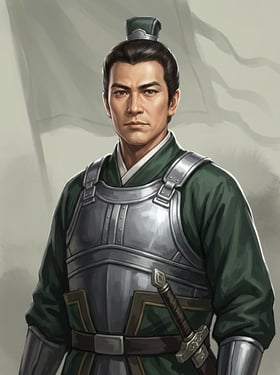
Historical Record
Wang Ji, styled Boyu, was a man of Qucheng in Donglai. He lost his father in childhood and was raised by his uncle, becoming known for his filial piety. At seventeen, the commandery office summoned him as a clerk, but Wang Ji's ambitions did not lie there, so he resigned his post and went to Langya to study. During the Huangchu era he was recommended as filial and incorrupt and appointed a gentleman of the interior.
When Qing Province was first pacified, the inspector Wang Ling specially memorialized to have Wang Ji serve as his aide-de-camp; later Wang Ji was summoned as a secretarial gentleman, but Wang Ling again insistently asked for his return. Before long, the Minister over the Masses Wang Lang recruited Wang Ji, but Wang Ling still would not release him. Wang Lang therefore wrote a letter impeaching the provincial office, pointing out that Wang Ji, a fine talent, ought to serve the state rather than be detained for long in the province. Even so, Wang Ling still refused to let him go, which shows the assisting role Wang Ji played in Wang Ling's governance of Qing Province.
The Grand General Sima Yi (the Imperial Counselor Sima) recruited Wang Ji, but before he could take up the post Wang Ji was promoted to gentleman attendant of the Secretariat. In the time of Emperor Ming, palace construction was undertaken on a great scale, and the people suffered greatly. Wang Ji submitted a memorial of forthright remonstrance, using the metaphor "water is what bears up the boat, but it is also what overturns it," urging Emperor Ming to have compassion for the people's circumstances and to restrain their labor service, and expressing his worry that with internal and external troubles besetting the state, if the evils were not removed in time, the descendants might find it hard to inherit.
Wang Ji often disputed with the cavalier attendant-in-ordinary Wang Su over the determination of classical learning and court ritual; Wang Su altered Zheng Xuan's old teachings, while Wang Ji held fast to the profound meaning and stood against him. Later Wang Ji was transferred to be Grand Administrator of Anping, and was removed from office over an official matter. The Grand General Cao Shuang requested him as a retainer gentleman, and later he was sent out as Grand Administrator of Anfeng. Anfeng commandery bordered the state of Wu; Wang Ji governed with integrity and strictness, combining kindness and authority, and arranged his defenses so tightly that the enemy did not dare lightly to invade, for which he was additionally enfeoffed as General Who Chastises Bandits.
Wu once massed troops on a large scale at Jianye, declaring it would attack Yang Province. The inspector Zhuge Dan ordered Wang Ji to analyze the enemy's situation. Wang Ji judged that Sun Quan and his old generals had all aged or died, and that Wu's putting troops in the field this time was merely to consolidate its factions and protect itself. Sun Quan indeed did not put troops in the field afterward. During Cao Shuang's monopoly of power, the affairs of state fell into neglect, and Wang Ji wrote his "Discourse on the Needs of the Times" to strike at the ills of the day. Later, summoned back to court because of illness, he began as Intendant of Henan, but before he could take up the post Cao Shuang was executed. Wang Ji, having been a subordinate official of Cao Shuang, was for that reason also dismissed.
That same year Wang Ji was appointed a master of writing, and later sent out as inspector of Jing Province, with the additional title General Who Spreads Valor, and joined the General Who Conquers the South Wang Chang in a campaign against Wu. Wang Ji separately led a force to raid Bu Xie at Yiling; Bu Xie shut his gates and held fast. Wang Ji feigned an attack on the city, but in fact divided his troops to capture the granary depot at Xiongfu, seizing over three hundred thousand bushels of rice, taking prisoner the General Who Guards the North Tan Zheng, and bringing several thousand to surrender. He resettled these surrendered people in Yiling county, and was granted the rank of Marquis Within the Passes.
Wang Ji further memorialized proposing to build a city in the upper reaches of the Yangtze and to move the seat of Jiangxia commandery to Shangchang, so as to press close to Xiakou; this made Wu not dare lightly to cross the river and invade. He clarified the institutions, put military administration and agriculture in order, and at the same time fostered schools, so that the southern region praised his achievements. At that time the court was discussing the matter of campaigning against Wu, and an edict ordered Wang Ji to weigh the advantages and disadvantages of advancing or holding back. Wang Ji held that without transport waterways, stored grain, and preparations for naval warfare, even massing heavy forces within the river there would be no certainty of victory. He proposed developing land and water agriculture at Jiangling and Anlu to build up military resources, then leading troops to garrison Jiangling and Yiling, dividing forces to hold Xiakou, and using the Ju and Zhang rivers to transport provisions. In this way, once Wu learned of Wei's intention to remain stationed for the long term, its will to resist would surely falter and those who came over would be all the more steadfast. Then by joining with the Man and Yi to attack from within and dispatching elite troops to campaign from without, the region above Xiakou could surely be taken, the commanderies and counties beyond the river could hardly be held, the communications between Wu and Shu would be severed, and Wu could be captured. Otherwise, the benefit of putting troops in the field would be hard to foresee. The court thereupon adopted his proposal and halted the campaign against Wu.
When Sima Shi (the King Jing of Sima) newly took charge of the government, Wang Ji submitted a memorial admonishing him to be diligent and prudent, and recommended upright men such as Xu Yun, Fu Gu, Yuan Kan, and Cui Zan to assist in government affairs. King Jing adopted his advice. After the Duke of Gaogui Township ascended the throne, Wang Ji was advanced to the rank of Marquis of Changle Pavilion. When Guanqiu Jian and Wen Qin rose in rebellion, Wang Ji was appointed acting army supervisor with the staff of authority, commanding the troops of Xu Chang, and rendezvoused with King Jing at Xu Chang. King Jing asked Wang Ji his view of Guanqiu Jian and the others; Wang Ji judged that the Huainan rebellion was not the true wish of the officials and people but a coercion by Guanqiu Jian and his fellows, and that if the great army pressed upon them they would surely crumble, and the heads of Guanqiu Jian and Wen Qin could before long be hung at the army gate.
King Jing approved on hearing this and ordered Wang Ji to take the van of the army. At the time many in council held that Guanqiu Jian and Wen Qin were fierce and hard to contend with, and an edict ordered Wang Ji to halt. But Wang Ji judged that Guanqiu Jian and the others were capable of pressing deep yet had long failed to advance, which showed their deceit had been exposed and the hearts of their followers were wavering and dispirited. If one did not display martial strength to meet the people's hopes, but instead halted the army behind high ramparts, it would seem timid and was no way to use troops. He strongly urged a swift advance to occupy Nandun, taking its strong city and stored grain as the key to suppressing the rebels. King Jing repeatedly heeded his requests and ordered him to advance and occupy the Yin River. After arriving, Wang Ji again advised, pointing out that "in warfare one hears of being clumsy but swift, but has never seen skill in long delay," stressing the importance of swift, decisive battle. He held that to hold a strong city and guard ramparts while one's accumulated stores supplied the enemy, and to transport grain from afar, was truly no good plan. King Jing wished to wait for the various armies to assemble, and still would not permit it. Wang Ji then, on the grounds that "when a general is in the field, there are orders of the sovereign he need not accept," advanced of his own accord and occupied Nandun. Guanqiu Jian and the others, from Xiang, also wished to contest Nandun, but after marching some ten li and hearing that Wang Ji had arrived first, they withdrew back to Xiang. At the time the inspector of Yanzhou Deng Ai was encamped at Lejia; Guanqiu Jian sent Wen Qin to raid Deng Ai. Learning that the enemy's forces were dispersed, Wang Ji advanced his troops to press close to Xiang, and Guanqiu Jian's army was thereupon defeated.
After Wen Qin and the others were pacified, Wang Ji was transferred to General Who Guards the South, with command over the military affairs of the various armies of Yu Province, concurrently inspector of Yu Province, and advanced to the rank of Marquis of Anle Township. He submitted a memorial requesting that two hundred households be set apart and that his uncle Wang Qiao be granted the rank of Marquis Within the Passes, to repay his uncle's care in raising him. The court granted this. When Zhuge Dan rebelled, Wang Ji, retaining his current office, acted as General Who Guards the East, with command over the military affairs of Yang and Yu Provinces. At the time the great army was at Xiang, and because the rebel troops were elite, an edict ordered Wang Ji to draw his army in and hold fast. Wang Ji repeatedly memorialized asking to give battle. It happened that Wu sent Zhu Yi to relieve Zhuge Dan, encamping at Ancheng. Wang Ji was again ordered by edict to lead the various armies to shift and occupy the northern hills, but Wang Ji judged that the encircling ramparts were already firm and the troops and horses gradually assembling, that he need only carefully perfect the defenses to await the enemy's attempt to break out, and that if he moved troops now to hold the heights it would instead unsettle men's hearts and greatly damage the position. He therefore acted as expediency required and submitted a memorial pointing out that in confronting the enemy one should be "as unmoving as a mountain," and that to shift and rely on the heights would shake men's hearts and greatly damage the position. With the various armies all holding deep moats and high ramparts, the hearts of the host would all be settled and could not be moved—this was the essence of commanding troops. After the memorial was submitted, the court heeded it. The Grand General Sima Zhao (the King Wen of Sima) advanced to garrison Qiutou, dividing the forces to encircle and guard, while Wang Ji commanded the twenty-six armies on the east and south sides of the city. When the city's food ran out and they attacked the ramparts day and night, Wang Ji repelled and defeated them all. After Shouchun was taken, King Wen wrote to Wang Ji, praising how he had deeply calculated advantage and harm, alone held firm to his resolve, above gone against the imperial edict and below resisted the counsel of the many, and in the end mastered the enemy and captured the rebels—so that even what the ancients recorded was no more than this.
King Wen wished to send the generals with light troops to press deep, to win over the sons and younger brothers of Tang Zi and the rest, and seize the chance to overturn Wu. Wang Ji remonstrated, saying that in former days Zhuge Ke and Jiang Wei had both met defeat through underestimating the enemy and pressing deep; now the rebel army was newly defeated, internal troubles not yet quelled, and it was precisely the time when they would repair their defenses and lay plans. Moreover, the Wei army had been in the field over a year, and the soldiers had a longing to return home. To have captured a hundred thousand this time and brought the guilty to justice was already an unprecedented success. He cited the example of Emperor Wu (Cao Cao), who after the Battle of Guandu did not pursue the fugitives, to urge King Wen to halt. King Wen thereupon halted. After Huainan was first pacified, Wang Ji was transferred to General Who Conquers the East, with command over the military affairs of Yang Province, and advanced to the rank of Marquis of Dongwu. Wang Ji submitted a memorial firmly declining, attributing the merit to his subordinate officers, and as a result seven men including the chief clerk and the marshal were all enfeoffed as marquises.
That same year Wang Ji's mother died; the court kept the death secret and brought the coffin of his father Wang Bao to be buried together at Luoyang, posthumously appointing Wang Bao Grand Administrator of Beihai. In the fourth year of Ganlu, Wang Ji was transferred to General Who Conquers the South, with command over the military affairs of Jing Province. After the Duke of Changdao Township ascended the throne, Wang Ji's fief was increased by a thousand households, totaling five thousand seven hundred households in all. His two sons were also enfeoffed respectively as a pavilion marquis and a Marquis Within the Passes. In the second year of Jingyuan, the Grand Administrator of Xiangyang Hu Lie memorialized that the Wu rebels Deng You and others wished to come over and surrender. Wang Ji received an edict to seize this chance to shake the lands south of the river. But Wang Ji suspected a feigned surrender, sent a fast courier to set out his doubts, and pointed out that since the Jiaping era there had been repeated internal troubles, and that the present task was to settle the altars of state and bring peace to the people, and that it was not fitting to stir up the masses in pursuit of external gain. King Wen wrote in reply expressing that, moved by his loyalty and care, he reverently followed his counsel each time he admonished. Deng You and the others indeed did not surrender afterward.
In the Novel
In the Romance of the Three Kingdoms, Wang Ji's image centers chiefly on his military stratagems and his loyalty, especially in the roles he played in suppressing the rebellion of Guanqiu Jian and Wen Qin and the rebellion of Zhuge Dan.
When Guanqiu Jian and Wen Qin rose in rebellion, Sima Shi, unable to lead the campaign in person because of an eye ailment, nonetheless insisted on going east despite his illness. He ordered Wang Ji to lead the vanguard troops and first take the region of Zhennan. In discussion with Sima Shi, the Superintendent of the Imperial Household Zheng Bao proposed deep moats and high ramparts to blunt the enemy's edge, but the army supervisor Wang Ji held that the Huainan rebellion was not the true wish of the soldiers and people but a coercion by Guanqiu Jian, and that once the great army arrived they would surely crumble. Sima Shi adopted Wang Ji's advice and advanced the troops to the Yin River. Wang Ji further advised Sima Shi to seize Nandun by a night march, holding that any delay would let Guanqiu Jian arrive first. Sima Shi thereupon ordered Wang Ji to lead the vanguard troops to make camp below Nandun city. This episode largely accords with the historical facts and highlights Wang Ji's strategic vision and decisiveness.
When Zhuge Dan rebelled, Sima Zhao wished to campaign in person, and Jia Chong proposed inviting the Empress Dowager and the Son of Heaven to go on campaign as well. Sima Zhao adopted this plan and ordered Wang Ji to be chief vanguard and the General Who Pacifies the East Chen Qian to be deputy vanguard, leading a great army of two hundred and sixty thousand on the campaign. The Eastern Wu vanguard Zhu Yi led troops to meet them in battle; Wang Ji rode out, and before three bouts Zhu Yi fled in defeat. Tang Zi rode out, and likewise was defeated before three bouts. Wang Ji drove his troops forward to cut them down, and the Wu troops were greatly defeated. This passage stresses Wang Ji's valor and military talent, making him stand out the more conspicuously on the battlefield.
When Shouchun was besieged, the hearts of those in the city had already turned. Zhong Hui advised Sima Zhao to seize the chance to attack the city; Sima Zhao was greatly pleased and roused the three armies to assault it on all four sides. The defending general Ceng Xuan offered up the north gate, and the Wei troops entered the city. Zhuge Dan broke out to the edge of the drawbridge and was cut down by Hu Zun. Wang Ji led troops to fight his way to the west gate, where he met the Wu general Yu Quan. Wang Ji shouted, demanding why he did not surrender; Yu Quan, enraged, vowed to die rather than surrender, and in the end fell in battle. Later men wrote a poem in praise. In the novel, Wang Ji is not merely a strategist but also a general who charges into the fray, his image more fully fleshed out.
Key Relationships
* Cao Wei (serves): Wang Ji served Cao Wei loyally all his life, contributing important strength to the stability and development of Cao Wei, especially in suppressing internal rebellions and resisting external foes.
* Wang Ling (serves): In his early years Wang Ji was esteemed by Wang Ling and served as his aide-de-camp; Wang Ling valued his talent so highly that he did not hesitate to stand against the Minister over the Masses Wang Lang in order to keep Wang Ji.
* Wang Su (rival_of): Wang Ji and Wang Su held differing views on the determination of classical learning and court ritual; Wang Ji held fast to Zheng Xuan's old teachings and often stood against Wang Su.
* Cao Shuang (serves): Wang Ji was once recruited by Cao Shuang as a retainer gentleman, but during Cao Shuang's monopoly of power Wang Ji wrote his "Discourse on the Needs of the Times" to strike at the ills of the day, showing his independent thought and upright character. After Cao Shuang was executed, Wang Ji, having been his subordinate official, was implicated and dismissed.
* Sima Yi (the Grand General, Imperial Counselor Sima) (serves): Sima Yi once recruited Wang Ji, affirming his talent.
* Sima Shi (the King Jing of Sima) (serves): Sima Shi trusted Wang Ji greatly and, in suppressing the rebellion of Guanqiu Jian and Wen Qin, adopted Wang Ji's military advice. In the novel, Sima Shi, though ill, campaigned in person and still made Wang Ji vanguard commander.
* Sima Zhao (the King Wen of Sima) (serves): Sima Zhao deeply admired Wang Ji's loyalty and strategy; in the Zhuge Dan rebellion Wang Ji repeatedly defied imperial edicts and held to his own view, ultimately pacifying the rebellion, and Sima Zhao greatly commended him. In the novel, Sima Zhao went so far as to make Wang Ji chief vanguard for the campaign against Zhuge Dan.
* Guanqiu Jian and Wen Qin (rival_of): Wang Ji played a key role in suppressing the rebellion of Guanqiu Jian and Wen Qin; his strategic vision and decisive action brought about the swift quelling of the rebellion.
* Zhuge Dan (rival_of): In the Zhuge Dan rebellion Wang Ji served as General Who Guards the East, with command over the military affairs of Yang and Yu Provinces, held his ground firmly, and in the end helped Sima Zhao pacify the rebellion. In the novel, Wang Ji directly took part in the encirclement and suppression of Zhuge Dan.
* Zhu Yi (rival_of): In the novel, Wang Ji fought the Eastern Wu vanguard Zhu Yi and defeated him (unique to the novel).
* Yu Quan (rival_of): In the novel, when Shouchun fell, Wang Ji met the Wu general Yu Quan, who vowed to die rather than surrender and in the end fell in battle (unique to the novel).
Iconic Scenes
* Memorial of forthright remonstrance to Emperor Ming: When Emperor Ming undertook palace construction on a great scale, wearing out the people and wasting wealth, Wang Ji submitted a memorial using the metaphor "water can bear up the boat and can also overturn it," urging Emperor Ming to have compassion for the people's circumstances and restrain their labor service, and expressing worry over the state's internal and external troubles—embodying his character of caring for state and people.
* As Grand Administrator of Anfeng overawing the Wu raiders: When Wang Ji served as Grand Administrator of Anfeng, with the commandery bordering the Wu raiders, he governed with strictness and authority and kindness, and clearly arranged his defenses, so that the enemy did not dare invade the frontier—displaying his outstanding local governance and military defense.
* Outwitting the enemy to take the Xiongfu granary depot at Yiling: When campaigning against Wu under the General Who Conquers the South Wang Chang, Wang Ji separately raided Bu Xie at Yiling, feigning an attack while in fact taking the granary, successfully seizing a great quantity of rice and bringing several thousand to surrender—displaying his military stratagem.
* Strongly advocating a swift advance to pacify the Guanqiu Jian rebellion: When Guanqiu Jian and Wen Qin rose in rebellion, Wang Ji overruled the counsel of the many and insisted on a swift advance to Nandun, in the end bringing about the rapid quelling of the rebellion—showing his distinctive strategic vision and decisive judgment. In the novel, he directly proposed this to Sima Shi and personally led the troops there.
* Defying the edict to hold firm in the Zhuge Dan rebellion: When Zhuge Dan rebelled, Wang Ji, faced with the court's edicts to "draw the army in behind firm ramparts" and to "shift troops to hold the heights," held to the strategy of "as unmoving as a mountain," in the end successfully besieging Shouchun and winning Sima Zhao's high praise.
* Remonstrating to halt Sima Zhao's rash campaign against Wu: After the Battle of Shouchun, Sima Zhao wished to press the victory and drive deep against Wu with light troops; Wang Ji, taking history as a mirror, strongly remonstrated to halt him, averting a possible military setback—embodying his deep foresight.
* Seeing through Deng You's feigned surrender: In the second year of Jingyuan, when the Grand Administrator of Xiangyang reported that the Wu rebel Deng You wished to come over, Wang Ji suspected a feint, sent a fast courier to set out the situation, and strongly argued that it was not fitting to stir up the masses in pursuit of external gain; in the end Deng You indeed did not surrender, showing his keen insight.
* Defeating Zhu Yi below Shouchun: In the novel, when Zhuge Dan rebelled, Wang Ji as chief vanguard fought the Eastern Wu vanguard Zhu Yi below Shouchun and defeated him, displaying his valiant general's image (unique to the novel).
* Cutting down Yu Quan at the west gate: In the novel, when Shouchun fell, Wang Ji met at the west gate the Wu general Yu Quan, who vowed to die rather than surrender and in the end fell in battle—a scene that highlights Wang Ji's dignity as a Wei general and the loyal valor of the Wu general (unique to the novel).
Portrait file
Character profile
- Character
- Wang Ji was of unblemished learning and conduct, weighing gain and loss deeply, holding firm to his resolve alone, and daring to defy imperial edicts. As Grand Administrator of Anping he had Guan Lu divine strange portents, all of which proved true. As a minister of Wei he held such posts as Inspector of Jing Province, General Who Conquers the South, and Minister of Works.
- Manner of speech
- Wang Ji's manner of speech drew on the classics and precedents, and his discussion of military affairs was clearly reasoned. He once refuted Zheng Bao's argument for "deep moats and high ramparts," holding instead that "once the main army arrives, they will surely fall apart."
- Life
- Wang Ji was a man of Qucheng in Donglai. Orphaned young, he relied on his uncle Weng and was known for filial piety. He once went to study at Langya, and in the Huangchu period was recommended as Filial and Incorrupt and made a Gentleman of the Palace, later being promoted by Sima Yi to Gentleman Attendant of the Central Secretariat. He once submitted a memorial remonstrating with Emperor Ming against building palaces, debated the classics with Wang Su, and served as Grand Administrator of Anping and Anfeng. Wang Ji went out as Inspector of Jing Province, followed Wang Chang in striking Wu and raiding Yiling. In the revolt of Guanqiu Jian and Wen Qin, he commanded the Xuchang army and advanced to hold Nandun, defeating them. When Zhuge Dan rebelled, he acted as General Who Guards the East, commanding the military affairs of Yang and Yu Provinces, and broke Shouchun. In the fourth year of Ganlu he was promoted to General Who Conquers the South, commanding Jing Province, and in the second year of Jingyuan he memorialized suspicions that Deng You's surrender was a ruse. After Wang Ji died, he was posthumously granted the title of Minister of Works, with the posthumous name Marquis Jing.
- Anecdotes
- Before the ranks Wang Ji won successive victories over Zhu Yi and Tang Zi, driving his troops to cut down the Wu soldiers. He attacked and defeated Wu, assaulted Xiling, and besieged Zhuge Dan at Shouchun.
Relationships
13 relationships
Quotes
14 recorded lines · 3 featured
「臣聞古人以水喻民,曰『水所以載舟,亦所以覆舟』。故在民上者,不可以不戒懼。夫民逸則慮易,苦則思難,是以先王居之以約儉,俾不至於生患。昔顏淵云東野子之御,馬力盡矣而求進不已,是以知其將敗。今事役勞苦,男女離曠,願陛下深察東野之弊,留意舟水之喻,息奔駟於未盡,節力役於未困。昔漢有天下,至孝文時唯有同姓諸侯,而賈誼憂之曰:『置火積薪之下而寢其上,因謂之安也。』今寇賊未殄,猛將擁兵,檢之則無以應敵,乆之則難以遺後,當盛明之世,不務以除患,若子孫不競,社稷之憂也。使賈誼復起,必深切於曩時矣。」
This admonition likens the people to water to warn the ruler, reflecting Wang Ji's political foresight and his concern for the hardships of the common folk.
「將在軍,君令有所不受。彼得則利,我得亦利,是謂爭城,南頓是也。」
'A general in the field need not always accept the sovereign's orders' is a classic principle of military command, embodying Wang Ji's military wisdom and decisiveness.
「嘉平以來,累有內難,當今之務,在於鎮安社稷,綏寧百姓,未宜動衆以求外利。」
This remark stresses the importance of stabilizing the state and pacifying the people, reflecting Wang Ji's deep thinking about the nation's lasting stability in an age of chaos.
Chapters8 回 ▸
- 史ch.11ch.27ch.28ch.29ch.64
- 演ch.110ch.111ch.112
Relationship timeline11 条 ▸
史 ch.27
- Wang Ling§32
serves
青州刺史王凌特表请基为别驾,后又请还秘书郎
- Wang Su§34
rival_of
王肃改易郑玄旧说,基据持玄义常与抗衡
- Cao Shuang§34
serves
曹爽请为从事中郎,出为安丰太守;后爽伏诛,基随例罢
- Zhuge Dan§34
fights_in
扬州刺史诸葛诞使基策吴动;后诞反,基行镇东将军督讨之
- Wang Chang§35
fights_in
出为荆州刺史,随征南王昶击吴;别袭步协于夷陵有功
- Sima Shi§36
advises_in
司马景王新统政,基书戒之;景王纳其言;用基于讨毌丘俭
- Guanqiu Jian§37
fights_in
进据南顿,破毌丘俭、文钦
- Sima Zhao§38
fights_in
文王督围寿春,基督城东城南二十六军,破之;文王赞其独秉固志
史 ch.28
- Sima Zhao§28
commands_in
督诸军围寿春
演 ch.110
- Sima Shi§3
advises_in
反驳郑袤;力主大军一临则瓦解;建议星夜取南顿
演 ch.112
- Yu Quan§7
fights_in
西门相遇喝其早降,被于诠拒绝死战而亡
Inner monologues · AI-generated3 段 ▸
- After my mother died, an edict ordered that her death be kept secret and the mourning not announced. My father, Wang Bao
- As our forces reached Huainan, opinions were divided. Some feared the valor and ferocity of Guanqiu Jian and Wen Qin, an
- My courtesy name was Boyu, and I was from Qucheng in Donglai. I lost my father when I was young and lived with my uncle,
Life events3 ▸
- 0252-01-01 · JianglingWang Chang's Campaign at Jiangling· Commander
- 0257-01-01 · ShouchunZhuge Dan Raises Shouchun in Rebellion· Commander
- 0258-01-01 · LuoyangZhuge Dan's Rebellion· Commander