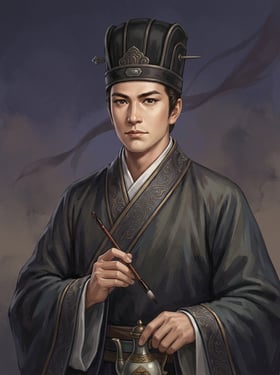
史载(Historical Record)
Cao Zhi, styled Zijian, was the third son of Cao Cao, the Martial Emperor of Wei, borne by Empress Dowager Bian c:2298. From an early age he displayed exceptional talent, especially excelling in literature. In the sixteenth year of Jian'an (211 CE), Cao Zhi was enfeoffed as Marquis of Pingyuan, and three years later was reassigned as Marquis of Linzi c:2296. Cao Cao once placed high hopes on his talent, even, while campaigning against Sun Quan, leaving the twenty-three-year-old Cao Zhi to guard Ye, encouraging him with the example of his own youth c:2296.
Cao Zhi's talent once made him a candidate Cao Cao considered for heir apparent, forming a rivalry with his elder brother Cao Pi. At that time, Ding Yi, Ding Yi, Yang Xiu, and others were all supporters of Cao Zhi c:2296. However, Cao Zhi's character was "self-willed in conduct, not disciplining himself, drinking without restraint" c:2296, which gradually cost him favor in the contest for the succession. For example, in the twenty-fourth year of Jian'an (219 CE), when Cao Ren was besieged by Guan Yu, Cao Cao originally wished to send Cao Zhi to relieve him and summoned him to give him instructions in person, but Cao Zhi, drunk, was unable to receive the command, and Cao Cao, disappointed in him, finally gave up sending him c:5595.
After Cao Pi succeeded to the throne, his treatment of Cao Zhi grew daily more severe. In the second year of Huangchu (221 CE), the Inspector-Overseer of the State, Guan Jun, fabricated charges and reported that Cao Zhi was "drunkenly insolent and arrogant, coercing the envoy" c:5596. Cao Pi originally wished to punish him severely, but owing to the pleading of Empress Dowager Bian, he finally demoted his rank to Marquis of Anxiang, and that same year reassigned him as Marquis of Juancheng c:5596. In the third year of Huangchu (222 CE), Cao Zhi was made King of Juancheng, with a stipend of two thousand five hundred households c:5596. Later, he was reassigned as King of Chen, with a stipend of three thousand five hundred households c:5597.
During Cao Pi's reign, Cao Zhi repeatedly sought an audience, hoping to take part in state affairs and realize his ambitions, but never succeeded. The laws of the vassal states placed severe restrictions on the imperial clan; Cao Zhi's subordinates were mostly mediocre men, and his soldiers were mostly old and weak, numbering no more than two hundred. Coupled with his earlier faults, his various allowances were halved. Over eleven years, he was thrice moved to different fiefs, living in gloom and discontent, and finally died of illness at the age of forty-one c:5597. Before his death he left instructions calling for a frugal burial, and hoped that his son Cao Zhi could carry on the family enterprise c:5597.
演中(In the Novel)
In Romance of the Three Kingdoms, Cao Zhi's image is endowed with greater literary color and tragedy. He displays exceptional talent from his first appearance; for instance, when Cao Cao built the Bronze Sparrow Terrace, Cao Zhi proposed building three lofty terraces with flying bridges connecting them, which greatly delighted Cao Cao c:12036. His literary gift is repeatedly emphasized in the novel; for example, Kongming recited Cao Zhi's "Rhapsody on the Bronze Sparrow Terrace" before Zhou Yu to provoke him, helping bring about the Sun-Liu alliance c:5598.
The novel particularly depicts the contest over the succession between Cao Zhi and Cao Pi. Cao Cao once, on account of Cao Zhi's ability to "complete a composition at the lift of the brush," briefly considered making him heir apparent c:2299. However, under the guidance of Jia Xu, Cao Pi, through such means as feigning respect and modesty and buying off attendants, led Cao Cao to think that Cao Zhi was "too clever, his sincerity not the equal of Pi's" c:2299. Yang Xiu, as a supporter of Cao Zhi, also played an important role in the novel. He once devised schemes for Cao Zhi; for instance, when Cao Cao tested his sons' abilities, Yang Xiu instructed Cao Zhi, "Going out by the king's command, if any obstruct you, you may simply behead them," allowing Cao Zhi to leave the city smoothly, but in the end this aroused Cao Cao's displeasure when someone reported it c:12037. Cao Pi also used Yang Xiu's cleverness to turn it back against Cao Zhi; for example, in the matter of Wu Zhi entering his residence, Cao Pi followed Wu Zhi's advice and used a large hamper packed with silk to deceive Cao Cao, instead causing Cao Cao to suspect that Yang Xiu was "slandering Cao Pi" c:2300.
At Cao Cao's deathbed, the novel has him plainly state, "the third son I have most loved all my life, Zhi, is by nature ostentatious and lacking in sincerity, addicted to drink and unrestrained, and for this reason I did not establish him" c:2301, echoing the historical episode of Cao Zhi losing favor through drunken dereliction, but placing more stress on the decisive influence of his character flaws on his political prospects. After Cao Pi succeeded to the throne, his persecution of Cao Zhi reached a climax in the novel. Through Empress Dowager Bian's intervention, Cao Pi could not directly kill Cao Zhi, but on Hua Xin's advice he demanded that Cao Zhi "compose a poem within seven paces," on pain of death if he could not c:12038. Within seven paces Cao Zhi composed the famous "Quatrain of Seven Steps," astonishing Cao Pi and all the assembled ministers c:12038. Then Cao Pi ordered him to compose on the theme of "brothers" without using the two characters "brothers," and Cao Zhi again extemporized the lines "boiling beans by burning the beanstalks," once more displaying his exceptional talent, and only thereby escaped death, though he was demoted to Marquis of Anxiang c:12039. Though this episode is unique to the Romance, it greatly enriches Cao Zhi's tragic color.
关键关系
* Cao Cao (father and son): Cao Cao greatly admired Cao Zhi's talent and once considered making him heir apparent, but in the end gave it up because he was "self-willed in conduct, not disciplining himself, drinking without restraint" c:2296. In the Romance, Cao Cao on his deathbed also expressed his fondness for Cao Zhi's talent, but did not establish him because he was "ostentatious and lacking in sincerity, addicted to drink and unrestrained" c:2301.
* Cao Pi (brothers): Cao Zhi and Cao Pi were brothers of the same mother, but became political rivals in the contest over the succession. After Cao Pi succeeded to the throne, he placed many guards and restraints upon Cao Zhi, making it hard for him to realize his political ambitions c:5597. In the Romance, Cao Pi even devised episodes such as the "poem in seven paces," intending to do Cao Zhi harm c:12038.
* Cao Zhang (brothers): Cao Zhang was Cao Zhi's elder brother by the same mother, Prince Wei of Rencheng c:2298. In the Romance, Cao Cao appraised Cao Zhang as "brave but lacking strategy" c:2301.
* Empress Dowager Bian (mother and son): Empress Dowager Bian was Cao Zhi's birth mother. When Cao Pi wished to punish Cao Zhi, Empress Dowager Bian came forward to plead for him, sparing Cao Zhi the death penalty c:5596 (novel only).
* Cui Yan (kin): Cui Yan was the husband of Cao Zhi's elder brother's daughter c:2293. When Cao Cao was considering establishing an heir, Cui Yan plainly supported Cao Pi and remonstrated at the risk of death c:2293.
* Su Ze (friend): Su Ze and Cao Zhi once wept together over the Wei clan's replacement of the Han, but Su Ze conducted himself more cautiously before Emperor Wen c:2294.
* Ding Yi, Ding Yi, Yang Xiu (supporters): These men were Cao Zhi's wings, supporting his bid for the position of heir apparent c:2296. In the Romance, Yang Xiu repeatedly devised schemes for Cao Zhi, but thereby drew Cao Cao's displeasure c:12037.
标志性场景
* Drunken dereliction, losing military authority: In the twenty-fourth year of Jian'an (219 CE), Cao Ren was besieged, and Cao Cao wished to send Cao Zhi to relieve him, but Cao Zhi, drunk, was unable to receive the command, and Cao Cao, greatly disappointed in him, canceled the plan to send him c:5595. This event directly cost Cao Zhi an important political opportunity and reflected the character flaw of "drinking without restraint."
* "Rhapsody on the Bronze Sparrow Terrace" and the contest over the succession: Cao Zhi's literary talent is displayed in Romance of the Three Kingdoms through the "Rhapsody on the Bronze Sparrow Terrace." In the novel, Cao Zhi made proposals during the building of the Bronze Sparrow Terrace and composed the "Rhapsody on the Bronze Sparrow Terrace," whose literary brilliance won Cao Cao's delight c:12036. Kongming even used this rhapsody to provoke Zhou Yu, helping bring about the Sun-Liu alliance c:5598. This not only highlights Cao Zhi's literary gift but also hints at his advantage in the contest over the succession.
* "Composing a poem in seven paces": In Romance of the Three Kingdoms, after Cao Pi succeeded to the throne, in order to do Cao Zhi harm he ordered him to compose a poem within seven paces, on pain of death otherwise. Cao Zhi extemporized the "Quatrain of Seven Steps," so moving that Cao Pi had no choice but to spare him c:12038. Though unique to the Romance, this episode has become a signature symbol of Cao Zhi's literary talent and tragic fate, profoundly shaping his image in popular culture.
* Life in the vassal state and a gloomy death: Under Cao Pi's rule, Cao Zhi was tightly confined to his vassal state, unable to realize his political ambitions, living in gloom and discontent, and finally dying of illness at the age of forty-one c:5597. The "Song of the Drifting Tumbleweed" he composed before his death expressed his bitter feelings of drifting and rootlessness and his longing to return to his roots c:5597. This scene displays the tragic end of Cao Zhi as a member of the imperial clan after his defeat in the political struggle.
Portrait file
Character profile
- Character
- Cao Zhi was easygoing by nature, indifferent to dignified bearing, acting as he pleased without polishing his self-presentation, and drinking without restraint. Quick-witted and skilled at composition, he was once greatly loved by Cao Cao, but later Cao Cao came to distrust his cleverness; moreover he was addicted to wine, wild and unrestrained, and presumed upon his talent to indulge himself. He often nursed resentment, feeling that he held a keen instrument yet had no place to wield it.
- Manner of speech
- Cao Zhi's literary talent was rich and splendid; he could answer as soon as spoken to and complete a composition the moment his brush touched paper. His memorials mostly used parallel prose in ornate array, citing the classics and pleading his own loyalty. Words flowed from his mouth ready-formed; he once used the image of "boiling beans by burning the beanstalks" to figure the mutual persecution of flesh and blood.
- Life
- In his youth Cao Zhi could already recite the Odes, the Analects, and rhapsodies and poems amounting to hundreds of thousands of words, and was skilled at composition. Cao Cao several times nearly made him his heir, but in the twenty-fourth year of Jian'an, drunk with wine, he failed to accept the command to relieve Cao Ren. After Emperor Wen ascended the throne, Cao Zhi was repeatedly re-enfeoffed, and finally died in the sixth year of Taihe, at the age of forty-one.
- Anecdotes
- Cao Zhi's writings were peerless; he once climbed the Bronze Bird Terrace and composed a rhapsody on the spot, and authored more than a hundred rhapsodies, hymns, poems, inscriptions, and miscellaneous discourses. He was Cao Cao's beloved son, and Empress Dowager Bian loved him most. He contended with Emperor Wen for the position of heir, and when the House of Wei supplanted the Han he put on mourning garb and wept in grief.
Relationships
19 relationships
Family8
Lord & vassal2
Friends5
Enemies2
Teacher & student1
Other1
Quotes
4 recorded lines · 2 featured
「願乞題目。」
This line leads into The Quatrain of Seven Steps, the concentrated expression of Cao Zhi's talent, celebrated through the ages.
「願即命題。」
This line, together with the preceding one, forms the opening of The Quatrain of Seven Steps, showing his composure and quick wit in the face of danger.
Chapters13 回 ▸
- 史ch.2ch.5ch.12ch.16ch.19ch.20ch.23
- 演ch.34ch.44ch.68ch.72ch.78ch.79
Relationship timeline10 条 ▸
Inner monologues · AI-generated3 段 ▸
- Now I am made Prince of Chen, with an estate of 3,500 households. I have the title and the households, but whenever I as
- I once believed that a torrent of inspiration was enough to reveal my heart, and that my writing, which could win my fat
- I often think back to my youth. Within our household, my father, Cao Gong, grew ever more esteemed, while I was merely o
Life events9 ▸
- 0210-01-01 · Ye (Bronze Sparrow Terrace site)Cao Cao Builds the Bronze Bird Terrace· Advisor
- 0210-01-01 · YeBronze Bird Terrace Inauguration Ceremony· Witness
- 0213-01-01 · YeCui Yan Publicly Endorses Cao Pi as Heir· Witness
- 0217-01-01 · YeCao Zhi's Sima Gate Incident· Victim
- 0217-01-01 · YeCao Pi Named Heir Apparent
- 0219-01-01 · YeExecution of Yang Xiu· Victim
- 0220-01-01 · YeExecution of Ding Yi and Ding Yi· Witness
- 0220-01-01 · YeThe Quatrain of Seven Steps· Victim
- 0220-01-01 · YeSuccession Struggle Between Cao Pi and Cao Zhi· Victim