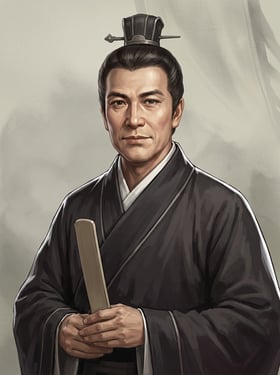
Historical Record
Xu Jing, styled Wenxiu, was a native of Pingyu in Runan. In his youth he was famed alongside his younger cousin Xu Shao, both renowned for appraising men, though the two were on poor personal terms. Xu Shao once squeezed Xu Jing out, preventing him from entering office, so that Xu Jing for a time supported himself by milling wheat. Later, through the recommendation of Liu Yi, Grand Administrator of Yingchuan, Xu Jing was able to serve as an accounts clerk and as a filial-and-incorrupt candidate, and was appointed a Gentleman of the Imperial Secretariat in charge of selection affairs c:3392.
After the death of Emperor Ling, Dong Zhuo monopolized power. Xu Jing, together with Zhou Bi, the Master of Writing for the Bureau of Personnel, jointly planned to select worthy men from across the realm, to weed out the corrupt and promote the reclusive. They recommended Xun Shuang, Han Rong, Chen Ji and others as ministers and commandery governors, and appointed Han Fu as Governor of Jizhou, Liu Dai as Inspector of Yanzhou, and so on. Xu Jing himself was appointed Grand Administrator of Ba Commandery, but he did not take up the post, and was later appointed Palace Aide to the Censor-in-Chief c:3392. When Han Fu and the others reached their posts, each raised troops against Dong Zhuo. Dong Zhuo, enraged, executed Zhou Bi. Because Xu Jing had conspired with his elder cousin Chen Yang and feared execution, he fled to Kong Zhou, the Inspector of Yu Province. After Kong Zhou died, Xu Jing then attached himself to Chen Yi, the Inspector of Yang Province. After Chen Yi died, Xu Jing went to take refuge with Xu Gong, the Commandant of Wu Commandery, and Wang Lang, the Grand Administrator of Kuaiji, with whom he had old ties. During this period, Xu Jing took in and provided for relatives and friends, giving generous aid, showing the benevolent side of his character c:3392.
After Sun Ce crossed the Yangtze, Xu Jing, to escape the warfare, fled to Jiaozhou. Sitting at the edge of a cliff, he first let his attendants and distant kin depart, and only went last himself, leaving all present sighing in admiration. After reaching Jiaozhi, the Grand Administrator of Jiaozhi, Shi Xie, treated him with great courtesy. At the time, Yuan Hui, who was also sojourning in Jiaozhou, wrote to Xun Yu, the Director of the Imperial Secretariat, praising Xu Jing as "a man of outstanding talent, whose wisdom and strategy were ample for planning affairs," and noting that in his wanderings and displacement, whenever he met urgent peril he always put others before himself, sharing weal and woe with kin and friends, his acts of benevolence and compassion too numerous to recount c:3395.
Later, Liu Zhang sent an envoy to recruit Xu Jing, and Xu Jing then entered Shu, where he was appointed Grand Administrator of Ba Commandery and of Guanghan. In the sixteenth year of Jian'an he was transferred to be Grand Administrator of Shu Commandery c:6278. In the nineteenth year of Jian'an, Liu Bei conquered Yi Province and Liu Zhang surrendered. Liu Bei appointed Xu Jing as Chief Clerk to the General of the Left, and later, when Liu Bei proclaimed himself King of Hanzhong, Xu Jing was appointed Grand Tutor c:6278. After Liu Bei proclaimed himself Emperor, Xu Jing was appointed Minister over the Masses, and Liu Bei charged him in his commission to "reverently spread the five teachings, in a spirit of leniency," and exhorted him to "uphold virtue without slackening" c:6276. Although Xu Jing was past seventy, he still delighted in befriending men of talent, promoting the younger generation, and conversing tirelessly. The Chancellor Zhuge Liang also treated him with the courtesy due a teacher. In the second year of Zhangwu, Xu Jing died c:3396.
In the Novel
In the Romance of the Three Kingdoms, Xu Jing's image differs somewhat from historical fact, especially at the crucial moment of Liu Bei's entry into Shu. He first appears in Chapter 65, when Liu Bei besieged Chengdu; Xu Jing, the Grand Administrator of Shu Commandery, is depicted as "climbing over the city wall to surrender" before the city fell c:3400. This episode has no clear basis in the histories, which only mention that Liu Zhang recruited Xu Jing into Shu and appointed him Grand Administrator of Ba Commandery and of Guanghan, later transferring him to Grand Administrator of Shu Commandery c:6278. In the novel, after Liu Bei took control of Yi Province, Xu Jing was appointed Chief Clerk to the General of the Left, in accord with historical fact c:6280.
When Liu Bei proclaimed himself King of Hanzhong, Chapter 73 of the novel records that Xu Jing, together with Fa Zheng, invited Liu Bei to ascend the altar and presented him with the crown, cap, and seal-cords; after Liu Bei received the homage, he enfeoffed Xu Jing as Grand Tutor c:6281. This episode accords with the historical record of Liu Bei appointing Xu Jing as Grand Tutor after proclaiming himself King of Hanzhong c:6278.
In the novel, Xu Jing also took part in the process of urging Liu Bei to assume the imperial title. In Chapter 80, Kongming and Xu Jing together led the civil and military officials in submitting a memorial requesting that Liu Bei take the imperial throne. Liu Bei at first declined, whereupon Xu Jing advised: "Now the Han Son of Heaven has been murdered by Cao Pi. If Your Highness does not assume the imperial throne and raise an army to punish the traitor, you cannot be deemed loyal and righteous. Now there is no one in the realm who does not wish Your Highness to become sovereign and avenge the Filial and Compassionate Emperor. If you do not follow what your servants propose, you will lose the people's hopes." c:3402 At last, persuaded by the assembly, Liu Bei accepted the throne and enfeoffed Xu Jing as Minister over the Masses c:6282. This episode also has a historical counterpart: after proclaiming himself Emperor, Liu Bei did indeed appoint Xu Jing as Minister over the Masses c:6276.
In addition, in Chapter 77 of the novel, Xu Jing secretly reported to Kongming the news of Guan Yu's death, and Kongming replied that he had already foreseen it by observing the heavens at night c:3401. This episode is added by the novel to shape Kongming's image of divine foresight, and has no basis in historical fact.
Key Relationships
* Xu Shao (kin_of): Xu Jing's younger cousin; both were renowned for appraising men, yet were on poor personal terms, and Xu Shao once squeezed Xu Jing out c:3392.
* Liu Zhang's faction (serves): Xu Jing was once recruited into Shu by Liu Zhang and served as Grand Administrator of Ba Commandery and of Guanghan, later transferred to Grand Administrator of Shu Commandery c:6278.
* Liu Bei's faction (defected_to): After Liu Bei conquered Yi Province, Xu Jing submitted to Liu Bei and was appointed Chief Clerk to the General of the Left and Grand Tutor c:6278. In the novel he is depicted as "climbing over the city wall to surrender" c:3400.
* Shu Han (serves): After Liu Bei proclaimed himself Emperor, Xu Jing was appointed Minister over the Masses, becoming a senior minister of Shu Han c:6276.
* Zhuge Liang (colleague): Xu Jing and Zhuge Liang were both senior ministers of Shu Han, and Zhuge Liang treated Xu Jing with the courtesy due a teacher c:3396. In the novel, the two together urged Liu Bei to assume the imperial throne c:3402.
* Shi Xie (benefactor): When Xu Jing was in exile in Jiaozhou, Shi Xie, the Grand Administrator of Jiaozhi, treated him with great courtesy c:3395.
* Wang Lang (friend): Xu Jing had old ties with Wang Lang and took refuge with him during his exile c:3392. In the early years of Wei, Wang Lang wrote to Xu Jing renewing their old friendship c:3396.
Iconic Scenes
* Putting others before himself in flight: While fleeing to Jiaozhou, Xu Jing sat at the cliff's edge and first let his attendants and distant kin depart, going last himself, showing his benevolent character of placing others before himself c:3395.
* Joint management of selection under Dong Zhuo's rule: After Emperor Ling's death, Xu Jing, together with Zhou Bi, jointly planned to select worthy men from across the realm, to weed out the corrupt and promote the reclusive, displaying his aspiration to bring talent to the service of the state in a troubled age c:3392.
* Liu Bei's entry into Shu and submission to a new lord: After Liu Bei conquered Yi Province, Xu Jing submitted to him and was entrusted with high office. In the novel he is depicted as "climbing over the city wall to surrender" before the city fell c:3400, an episode highlighting his choice to assess the situation and act accordingly in a chaotic age.
* Urging Liu Bei to assume the imperial throne: Before Liu Bei proclaimed himself Emperor, Xu Jing, together with Zhuge Liang and others, urged him on, ultimately prompting Liu Bei to ascend the throne and becoming one of the founding ministers of Shu Han c:3402.
* Past seventy yet still delighting in men of talent: Although Xu Jing was past seventy, he still delighted in befriending men of talent, promoting the younger generation, and conversing tirelessly, and Zhuge Liang treated him with the courtesy due a teacher, displaying his noble character and care for the younger generation c:3396.
* Secretly reporting Guan Yu's death (novel-only): In the novel, Xu Jing secretly reported to Kongming the news of Guan Yu's death; although Kongming said he already knew, this episode reflects Xu Jing's concern, as a senior minister of the court, for the great affairs of state c:3401.
* Wang Lang's letter renewing old friendship: In the early years of Wei, Wang Lang wrote to Xu Jing renewing their old friendship with deep and sincere feeling, which not only reflects Xu Jing's profound friendship with the noted men of his time but also indirectly mirrors his renown and influence in a chaotic age c:3396.
Portrait file
Character profile
- Character
- Xu Jing was sincere and generous, loving to appraise men of talent, drawing in and nurturing the rising generation, and tireless in refined discourse. In times of upheaval and displacement he always put others before himself, being benevolent, forgiving, and compassionate. In his youth he and his younger cousin Xu Shao were both renowned, and together they were known for their judgment and appraisal of men.
- Manner of speech
- Xu Jing excelled at pure discourse and the appraisal of men; his letter to Lord Cao was earnest in tone and elegant in style. He once said, "Now the Han Son of Heaven has been murdered by Cao Pi; if Your Highness does not at once ascend to the imperial throne and raise an army to punish the traitor, it cannot be called loyal and righteous."
- Life
- Xu Jing was a native of Pingyu in Runan. In the time of Emperor Ling of Han, he was recommended as an accounts officer and appraised as filial and incorrupt by Liu Yi of Yingchuan, and was appointed a Gentleman of the Masters of Writing, in charge of selecting officials. When Dong Zhuo held power, he and Zhou Bi together deliberated on the promotion and dismissal of the empire's scholars; later, after Zhou Bi was executed, he wandered from place to place, and at last entered Shu to depend on Liu Zhang. After Liu Bei conquered Shu, he was appointed Chief Clerk to the General of the Left; when Liu Bei became King of Hanzhong, he was made Grand Tutor; and after Liu Bei became emperor, he was appointed Minister over the Masses. He died in the second year of Zhangwu, aged over seventy.
- Anecdotes
- Xu Jing was a renowned scholar of Shu Han. After entering Shu he said of Zhang Yi, "Quick and capable in managing affairs, he is of the same order as Zhong Yuanchang of the Central Plains." He had once been Liu Zhang's Grand Administrator of Shu Commandery, and later submitted to Liu Bei.
Relationships
17 relationships
Quotes
3 recorded lines · 2 featured
「某適聞外人傳說,東吳呂蒙已襲荊州,關公已遇害,故特來密報軍師。」
This line reveals the death of Guan Yu, a major turning point in the Romance of the Three Kingdoms with far-reaching consequences.
「今漢天子已被曹丕所弒,王上不即帝位,與師討逆,不得為忠義也。今天下無不欲王上為君,為孝愍皇帝雪恨。若不從臣等所議,是失民望矣。」
This line urges Liu Bei to proclaim himself emperor, a pivotal moment in the founding of Shu Han that embodies Xu Jing's political stance.
Chapters8 回 ▸
- 史ch.32ch.37ch.38ch.39
- 演ch.65ch.73ch.77ch.80
Relationship timeline11 条 ▸
史 ch.38
演 ch.65
- Liu Zhang§19
defected_from
段19踰城出降
演 ch.77
- Zhuge Liang§29
advises_in
密报东吴呂蒙袭荆州、关公遇害
演 ch.80
- Liu Bei§25
advises_in
与孔明同主劝进
Inner monologues · AI-generated3 段 ▸
- I am Xu Jing, courtesy name Wenxiu. In my youth, I befriended Chen Ji of Yingchuan, whom I treated as an elder brother,
- My name is Jing, and my courtesy name is Wenxiu. I am from Pingyu in Runan. In my youth, my cousin Xu Shao and I were bo
- I recall that when Liu Zhang held Shu, I was based in Shu Commandery. I saw that the realm was beset by troubles. Though
Life events5 ▸
- 0214-01-01 · ChengduLiu Zhang's Surrender· Witness
- 0219-01-01 · MianyangLiu Bei Proclaims Himself King of Hanzhong· Witness
- 0219-01-01 · MianyangLiu Bei's Elevation to King of Hanzhong· Advisor
- 0221-01-01 · ChengduLiu Bei's Proclamation as Emperor· Advisor
- 0221-01-01 · Wudan HillLiu Bei Proclaims Himself Emperor· Advisor