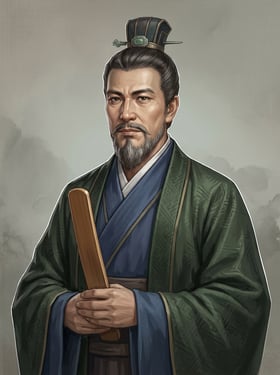
Historical Record
Zhong Yao, styled Yuanchang, was a native of Changshe in Yingchuan. In his early years he once traveled to Luoyang together with his clan uncle Zhong Yu; along the way a physiognomist said he had a noble countenance but would meet calamity by water. Soon after, Zhong Yao indeed fell into the water when his horse bolted as he crossed a bridge, and nearly lost his life. Zhong Yu thereupon esteemed him all the more and funded him to devote himself to study c:6549.
Zhong Yao was nominated as Filial and Incorrupt, later serving as Secretariat Gentleman and Magistrate of Yangling, but resigned office due to illness. Afterward he was summoned as an official of the Three Excellencies' offices, serving as Justice Rectifier of the Commandant of Justice and Gentleman of the Yellow Gate. When Emperor Xian of Han was in the Western Capital, Li Jue, Guo Si, and others created disorder at Chang'an, cutting it off from the region east of the passes. Cao Cao sent an envoy with a memorial, but Li Jue and Guo Si doubted his loyalty. Zhong Yao persuaded Li Jue and Guo Si, pointing out that Cao Cao was loyal at heart to the royal house and that they should not rebuff his sincere loyalty, thereby allowing Cao Cao's mission to proceed c:6549.
During the period when Emperor Xian was coerced by Li Jue, Zhong Yao, together with the Secretariat Gentleman Han Bin, jointly devised plans that finally enabled the Son of Heaven to escape from Chang'an, with Zhong Yao playing an important role in this affair. He was thereupon appointed Palace Aide to the Censor-in-Chief, later promoted to Attendant and Supervisor of the Secretariat, and, for his earlier merit, enfeoffed as Marquis of Dongwu Village c:6549.
At that time, in the Guanzhong region, Ma Teng, Han Sui, and others held troops and asserted their own power. Because Cao Cao had affairs in Shandong and was anxious about the situation in Guanyou, he memorialized to have Zhong Yao, in the capacity of Attendant, superintend the Colonel-Director of Retainers and, with authority of the staff, oversee the armies of Guanzhong, granting him the special privilege of acting outside the regular statutes. After Zhong Yao reached Chang'an, he wrote to Ma Teng, Han Sui, and others, laying out the advantages and disadvantages, and finally caused them each to send sons and brothers to attend at court. When Cao Cao was confronting Yuan Shao at Guandu, Zhong Yao once sent him more than two thousand warhorses, for which Cao Cao specially wrote to praise Zhong Yao's merit, saying that his guarding of Guanzhong, providing ample provisions and forming the army, freed Cao Cao from worries to the west, comparable to Xiao He c:3971.
Later, when the Xiongnu Chanyu created disorder at Pingyang, Zhong Yao led troops to encircle and suppress him. Guo Yuan, the Administrator of Hedong installed by Yuan Shang, led his followers to come to his aid, with great force. The generals at one point debated whether they should withdraw, but Zhong Yao rejected the consensus, holding that the Yuan clan's power was strong and that Guo Yuan's arrival was secretly supported within Guanzhong, and that to withdraw at this time would show weakness to the enemy and cause the people's hearts to defect. He judged that Guo Yuan was self-willed and would surely underestimate the enemy, and that if they struck while Guo Yuan was crossing the Fen River, before he had completed the crossing, they could win a great victory. In the end, Zhong Yao adopted the counsel of Zhang Ji, joined forces with Ma Teng's son Ma Chao, greatly defeated Guo Yuan's army, slew Guo Yuan, and subdued the Xiongnu Chanyu c:3971.
Thereafter, Wei Gu of Hedong created disorder, raiding together with Zhang Sheng, Zhang Yan, Gao Gan, and others. Zhong Yao again led the generals to campaign and pacified the rebellion. Since Emperor Xian's westward migration, the population of Luoyang had been decimated; Zhong Yao relocated the people of Guanzhong, took in fugitives and rebels, and over several years gradually filled out the households. When Cao Cao campaigned against Guanzhong, these measures of Zhong Yao's provided important material support, and he was therefore memorialized as Army Counselor of the Front c:3971.
After the founding of the state of Wei, Zhong Yao served as Grand Justice, later promoted to Chancellor of State. When Cao Pi was in the Eastern Palace, he bestowed on Zhong Yao a five-flavored cauldron and composed an inscription for it, praising his merit and virtue c:3974. Later, Zhong Yao was implicated in the conspiracy case of the Western Bureau Aide Wei Feng and was dismissed and sent home. After Cao Pi ascended as King of Wei, Zhong Yao was reinstated as Grand Justice. After Cao Pi proclaimed himself emperor, he was transferred to Commandant of Justice and advanced to Marquis of Chonggao District. Later he was promoted to Grand Commandant and transferred to Marquis of Pingyang District. Cao Pi once appraised Zhong Yao, Hua Xin, and Wang Lang as "the great men of an age," holding that later generations could scarcely match them c:6549.
After Emperor Ming ascended the throne, Zhong Yao was advanced to Marquis of Dingling, with an increase of five hundred households, totaling one thousand eight hundred households, and promoted to Grand Tutor. Because of an ailment in his knees, Zhong Yao found it difficult to bow and rise, and at audience often rode a carriage up to the hall to take his seat. Thereafter it became customary for the Three Excellencies, when ill, to ride a carriage up to the hall c:6549.
Zhong Yao once advocated restoring corporal punishment in place of the death penalty, holding that this would reduce the number of executions and accord with the ancient way. However, this proposal was deferred because it did not please the people's hearts. In the Taihe era, Zhong Yao again submitted a memorial, expounding in detail the benefits of restoring corporal punishment, holding that it would save three thousand lives each year. Although the Minister over the Masses Wang Lang and others held objections, Zhong Yao's proposal reflected his deep reflection on penal law c:3976.
In the fourth year of Taihe (230), Zhong Yao died. Emperor Ming, in plain mourning garments, attended the funeral, with the posthumous title Marquis Cheng c:3977.
In the Novel
In Romance of the Three Kingdoms, Zhong Yao's image revolves chiefly around his identity as a senior minister of Cao Wei, especially during the periods of Cao Cao's founding of the state of Wei and of Cao Pi and Cao Rui. He is portrayed as a loyal and resourceful civil official.
In chapter fifty-six, when Cao Cao wished to advance to the rank of Duke of Wei, Zhong Yao, together with Wang Lang, Wang Can, Chen Lin, and other civil officials, presented poems extolling Cao Cao's merit and virtue and hinting that he ought to receive the Mandate of Heaven. Cao Cao expressed modesty about this, yet his words also revealed his grasp of power and his profound insight into the state of the realm c:6555.
In chapter fifty-eight, when Ma Chao and Han Sui led a great army to attack Chang'an, Zhong Yao, as administrator of Chang'an, hastily reported to Cao Cao and personally led troops out of the city to meet the enemy. However, in fighting Ma Dai, Zhong Yao "in less than a bout was utterly routed and fled," showing that his martial skill was unrefined and that he appeared more as a civil official than a military general c:6556. This differs from the historical image of Zhong Yao overseeing the armies of Guanzhong, devising strategies, and greatly defeating Guo Yuan; here the novel lays more stress on highlighting Ma Chao's valor.
In chapter sixty-nine, after Cao Cao pacified the rebellion of Geng Ji and Wei Huang, he reorganized the government, appointing Zhong Yao as Chancellor of State and Hua Xin as Grandee Secretary, and re-established the system of ranks, marking the further consolidation of the Cao Wei regime c:6557.
In chapter ninety-one, when Cao Pi was gravely ill, before his death he summoned Cao Zhen, Chen Qun, and Sima Yi to assist the young lord Cao Rui. After Cao Pi died and Cao Rui ascended the throne, Zhong Yao was enfeoffed as Grand Tutor, ranking among the Three Excellencies, further consolidating his high position in the Cao Wei regime c:6558.
In chapter ninety-four, when Zhuge Liang campaigned in the north and Cao Zhen was repeatedly defeated, the Wei ruler Cao Rui gathered his ministers to deliberate on a plan to repel the enemy. The Grand Tutor Zhong Yao strongly recommended Sima Yi, saying, "Formerly, when Zhuge Liang wished to raise an army to invade our borders, he feared only this man, and so spread rumors to make Your Majesty suspect him and remove him, and only then dared to drive deep and advance boldly. If he is now employed again, Liang will withdraw of his own accord." He held that Sima Yi was the only one who could oppose Zhuge Liang, and successfully persuaded Cao Rui to reinstate Sima Yi c:6559. This shows Zhong Yao's keen political insight and his ability to recommend talent.
In addition, the novel mentions Zhong Yao from the side through the story of his son Zhong Hui. In chapter one hundred and seven, when Jiang Wei spoke with Guo Xun (a fictional figure in the novel; in historical fact Guo Xiu), Guo Xun mentioned that Zhong Hui was the son of the Grand Tutor Zhong Yao and related the story of Zhong Hui in his childhood meeting Emperor Wen (Cao Pi) together with his elder brother Zhong Yu, in order to show Zhong Hui's surpassing cleverness. This story is recorded in the historical source Weilüe, but is not a direct episode of Zhong Yao himself c:3981.
Key Relationships
* Cao Wei regime (serves): Zhong Yao served the three generations of rulers Cao Cao, Cao Pi, and Cao Rui all his life, an important founder and pillar minister of the Cao Wei regime. He began serving from the early days of Cao Cao's founding, and after the establishment of Cao Wei held important posts such as Chancellor of State and Grand Tutor, taking part in Cao Wei's political, military, and legal construction c:6546, c:6548.
* Ma Teng (commands_in): Zhong Yao once, with authority of the staff, superintended the armies of Guanzhong, successfully persuading the Guanzhong generals Ma Teng, Han Sui, and others to send their sons to attend at court, stabilizing the situation in Guanyou. Later he joined forces with Ma Teng's son Ma Chao to greatly defeat Guo Yuan and slay the Chanyu c:3971.
* Tian Chou (advises_in): Tian Chou, unwilling to accept rewards, resigned office, and Cao Cao wished to enfeoff him as marquis by force. The Heir Apparent (Cao Pi), the Director of the Secretariat Xun Yu, the Colonel-Director of Retainers Zhong Yao, and others all held that Tian Chou's aspiration should be respected, and advised heeding his declination c:3967.
* Wang Xiu (advises_in): Zhong Yao once exchanged views with Wang Xiu when Cao Cao deliberated implementing corporal punishment. Wang Xiu held that the time had not yet come, and Cao Cao adopted his view. Later, when there was an upheaval in the capital, the Chancellor of State Zhong Yao held that the Nine Ministers should each remain in their offices, while Wang Xiu insisted on rushing to the danger, saying, "Having eaten his stipend, how can one avoid his peril?" c:3968
* Sima Yi (advises_in): In the novel, Zhong Yao is an important recommender of Sima Yi. When Cao Zhen was repeatedly defeated by Zhuge Liang during the northern campaign, Zhong Yao rejected the consensus and strongly recommended Sima Yi to the Wei ruler Cao Rui, saying he was the only one who could repel the Shu troops, bringing about Sima Yi's reinstatement c:6559 (novel only).
* Xun You (friend): Zhong Yao was close to Xun You. After Xun You's early death, Zhong Yao looked after his family affairs and wished to find a new marriage for his concubine, his words revealing his deep affection for Xun You c:3980.
Signature Scenes
* Persuading Li Jue and Guo Si (historical): During the period when Emperor Xian of Han was held by Li Jue and Guo Si, Zhong Yao, with his outstanding eloquence and political wisdom, successfully persuaded Li Jue and Guo Si, restoring the link between Cao Cao and the court and laying the foundation for Cao Cao's later reception of the Son of Heaven c:6549.
* Overseeing the armies of Guanzhong, pacifying Guo Yuan (historical): Zhong Yao was commissioned to superintend the armies of Guanzhong, and facing the powerful onslaught of Guo Yuan, the Administrator of Hedong installed by Yuan Shang, he rejected the consensus and insisted on a decisive battle, finally joining forces with Ma Chao to greatly defeat Guo Yuan and stabilize the situation in Guanyou, freeing Cao Cao from worries to the west c:3971. Cao Cao specially wrote to praise him for this, saying his merit was comparable to Xiao He c:3971.
* Advocating the restoration of corporal punishment (historical): Zhong Yao repeatedly submitted memorials, vigorously setting forth the benefits of restoring corporal punishment in place of some death penalties, holding that this would reduce executions and save lives. Although it was ultimately never fully implemented, this act reflects his deep reflection on penal law and his concern for the people's livelihood c:3976.
* Routed by Ma Dai beneath Chang'an (novel only): In Romance of the Three Kingdoms, when Ma Chao and Han Sui attacked Chang'an, Zhong Yao, as administrator, went out of the city to meet Ma Dai in battle, but "in less than a bout was utterly routed and fled" c:6556. This scene highlights Ma Dai's valor and Zhong Yao's want of martial strength as a civil official, forming a contrast with the historical image of Zhong Yao devising strategy.
* Recommending Sima Yi to repel the Shu troops (novel only): When Zhuge Liang campaigned in the north and Cao Zhen was repeatedly defeated, Zhong Yao strongly recommended Sima Yi at court, holding that he was the only one who could repel Zhuge Liang, and successfully persuaded Cao Rui to reinstate Sima Yi c:6559. This episode displays Zhong Yao's image in the novel as a senior minister who knew men and employed them well and who planned far ahead.
Portrait file
Character profile
- Character
- Zhong Yao excelled at strategy and decision, and his authority and renown were long established. He loved antiquity and set store by the debate over corporal punishment. He was close to Xun You, and once managed Xun You's household affairs and arranged for his concubine to be married off.
- Manner of speech
- Zhong Yao was skilled at quoting the arts of war—for instance, 'Sunzi says: know the enemy and know yourself, and in a hundred battles you will be victorious a hundred times'—and his recommendations were well grounded.
- Life
- Zhong Yao was a man of Changshe in Yingchuan, styled Yuanchang. In his youth he was nominated as filial and incorrupt, and he served successively as Gentleman of the Masters of Writing, Prefect of Yangling, Justice of the Commandant of Justice, and Yellow Gate Attendant. He took part in the plan to escort the Son of Heaven eastward out of Chang'an, and as Palace Attendant and acting Colonel Director of Retainers, holding the imperial tally, he oversaw the armies of Guanzhong, pacified Ma Teng and Han Sui, and quelled uprisings in several places. When the state of Wei was first established he was made Grand Judge and then promoted to Chancellor, but was dismissed on account of the case of Wei Feng's conspiracy. After Emperor Wen ascended the throne he was reinstated as Grand Judge, transferred to Commandant of Justice, advanced in fief as Marquis of Chonggao District, and promoted to Grand Commandant. After Emperor Ming took the throne he was advanced in fief as Marquis of Dingling and promoted to Grand Tutor. He died in the fourth year of the Taihe era, with the posthumous title of Marquis Cheng.
- Anecdotes
- Zhong Yao was a senior minister of Cao Wei, serving as Grand Tutor, Commandant of Justice, and Chancellor, and is one of the subjects of this biography. He and his kinsman-uncle Zhong Yu once encountered a physiognomist who foretold that they would 'come to grief by water,' a prophecy that was borne out. Xu Jing once compared Zhang Yi to Zhong Yao, and he was the father of Zhong Hui and Zhong Yu.
Relationships
20 relationships
Family3
Friends5
Enemies4
Other7
Quotes
11 recorded lines · 3 featured
「凡為將者,知過於人,則能制人。孫子云:『知彼知己,百戰百勝。』臣量曹真雖久用兵,非諸葛亮對手。臣以全家良賤保舉一人,可退蜀兵。未知聖意准否?」
This line quotes Sun Tzu's Art of War, reflecting Zhong Yao's military insight and his ability to judge men.
「古之肉刑,更歷聖人,宜復施行,以代死刑。」
Zhong Yao advocated restoring corporal punishment, reflecting his Legalist thought and his distinctive views on penal law.
「吾與公達曾共使朱建平相,建平曰:『荀君雖少,然當以後事付鍾君。』吾時啁之曰:『惟當嫁卿阿騖耳。』何意此子竟早隕沒,戲言遂驗乎!今欲嫁阿騖,使得善處。追思建平之妙,雖唐舉、許負何以復加也!」
This line reveals the deep friendship between Zhong Yao and Xun Yu, as well as his faith in physiognomy.
Chapters17 回 ▸
- 史ch.1ch.2ch.3ch.10ch.11ch.12ch.13ch.15ch.24ch.28ch.29
- 演ch.56ch.58ch.69ch.91ch.94ch.107
Relationship timeline16 条 ▸
Inner monologues · AI-generated3 段 ▸
- I am Zhong Yao, courtesy name Yuanchang. Looking back on my life, much of it was spent amid the laws of the court and th
- I am Zhong Yao, courtesy name Yuanchang. Whenever I recall the military upheaval in Chang'an and the Son of Heaven drive
- My name is Yao, and my courtesy name is Yuanchang. Looking back on my early years, the realm was in turmoil, and neither
Life events7 ▸
- 0195-01-01 · Chang'anZhong Yao Helps the Emperor Flee Chang'an· Advisor
- 0202-01-01 · PingyangZhong Yao Defeats Guo Yuan and Receives the Xiongnu Chanyu's Submission· Commander
- 0208-01-01 · Chang'anZhong Yao Superintends Guanzhong· Commander
- 0210-01-01 · YeBronze Bird Terrace Inauguration Ceremony· Witness
- 0216-01-01 · YeCao Cao Created King of Wei· Advisor
- 0216-01-01 · YeCao Cao Elevated to King of Wei· Advisor
- 0219-01-01 · YeWei Feng's Conspiracy· Victim