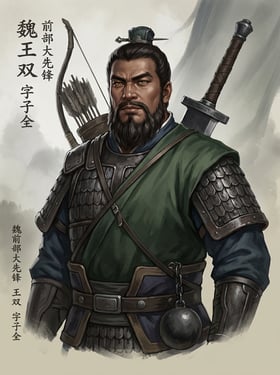
Historical Record
Wang Shuang was a Cao Wei general of the Three Kingdoms period. According to the Records of the Three Kingdoms, he took part in military action against Shu Han. In 228 CE, Zhuge Liang sent out troops a second time in winter and besieged Chencang, but, his provisions running short, was forced to withdraw. At this point the Wei general Wang Shuang led troops to pursue Zhuge Liang. In the ensuing engagement, Zhuge Liang defeated Wang Shuang's forces and beheaded Wang Shuang, then returned to Hanzhong. c:2740
The record in Records of the Three Kingdoms, scroll 35, further confirms this event. That scroll, describing how Zhuge Liang came out through San Pass to besiege Chencang and withdrew his troops when provisions ran out, again mentions that the Wei general Wang Shuang led cavalry in pursuit and was finally defeated and beheaded by Zhuge Liang. c:5884 Thereafter, in the edict in which Zhuge Liang submitted a memorial requesting restoration to the office of Chancellor, Emperor Ming of Wei, Cao Rui, also mentioned the achievement of "displaying the army the year before last and beheading Wang Shuang," indicating that the slaying of Wang Shuang was regarded at the time as an important military victory for Shu Han. c:5884 The historical material describes Wang Shuang rather briefly, focusing mainly on his role in the military action and his eventual end, without detailed record of his life, character, or specific military talent.
In the Novel
In Romance of the Three Kingdoms, Wang Shuang's image is greatly enriched and exaggerated, making him an exceptionally valiant great general of Wei. He first appears during Zhuge Liang's second Northern Expedition. At the time, the Grand General Cao Zhen recommended Wang Shuang to Emperor Ming of Wei, Cao Rui, describing how he "wields a great saber of sixty catties, rides a thousand-li dapple horse, draws a two-stone iron-cored bow, and secretly carries three meteor hammers, hitting the mark every time; he has the valor to stand against ten thousand men," and introducing him as a native of Didao in Longxi. c:2741 After Cao Rui summoned Wang Shuang and saw that he was "nine chi tall, with a black face and yellow eyes, the waist of a bear and the back of a tiger," he was greatly delighted and bestowed on him a brocade robe and golden armor, enfeoffing him as General of Tiger Might and Vanguard Grand Commander of the Front. c:2741
In the novel, Wang Shuang displays his extraordinary martial skill. He once pursued the retreating Shu army on Cao Zhen's orders and fought with Wei Yan. In one pursuit, Wang Shuang chased for more than twenty li and was on the point of catching up with Wei Yan. However, Wang Shuang's end in the novel differs from the historical record. In chapter 98 of the novel, Wei Yan laid a scheme to entice Wang Shuang into pursuit. When Wang Shuang realized he had fallen into the trap and hastily reined in his horse to retreat, Wei Yan suddenly burst out from the woods and, catching him off guard, cut him down from his horse with a single stroke of the saber. c:12642 Compared with the vague historical record of Zhuge Liang's "defeating and beheading Shuang," this episode is more dramatic and detailed, but the slayer is Wei Yan rather than Zhuge Liang himself, and the manner of the killing is more of an ambush than a head-on clash—plainly a literary invention of the novel (novel only).
Key Relationships
* Zhuge Liang: In the historical record, Wang Shuang was Zhuge Liang's opponent during the Northern Expeditions, and was finally defeated and beheaded by Zhuge Liang. c:2740 In the novel, Wang Shuang, as a Cao Wei great general, likewise directed his military action against Zhuge Liang's Northern Expeditions, but was in the end killed by Zhuge Liang's subordinate Wei Yan (novel only).
* Cao Wei: Wang Shuang was a general of the Cao Wei camp who served Cao Wei. He was enfeoffed by Emperor Ming of Wei, Cao Rui, as General of Tiger Might and Vanguard Grand Commander of the Front, and was under the command of the Grand General Cao Zhen. c:2741
* Cao Zhen: In the novel, Cao Zhen was Wang Shuang's direct superior and the one who recommended him. Cao Zhen recommended Wang Shuang to Cao Rui and appointed him vanguard, jointly resisting Zhuge Liang's Northern Expeditions. c:2741
Signature Scenes
* Pursuing Zhuge Liang and being beheaded: This is the most central event concerning Wang Shuang in the historical material. In 228 CE, when Zhuge Liang withdrew from Chencang because his provisions ran out, Wang Shuang led troops in pursuit, only to be defeated and beheaded by Zhuge Liang. c:2740 This event was mentioned by Emperor Ming of Wei, Cao Rui, in an edict as one of Zhuge Liang's important achievements. c:5884
* Recommended by Cao Zhen, enfeoffed as vanguard: In Romance of the Three Kingdoms, Cao Zhen strongly recommended Wang Shuang to Emperor Ming of Wei, Cao Rui, praising his superb martial skill and his valor to stand against ten thousand men. After seeing Wang Shuang's mighty and imposing figure, Cao Rui was greatly pleased and at once enfeoffed him as General of Tiger Might and Vanguard Grand Commander of the Front, making him an important general for Cao Wei against Shu Han. c:2741 (novel only)
* Falling into a trap and being slain by Wei Yan: In the novel, while pursuing the Shu army, Wang Shuang fell into Wei Yan's scheme to entice the enemy. When he discovered fire breaking out in the camp and hastily retreated, Wei Yan, lying in ambush, suddenly burst out and cut him down from his horse with a single saber stroke. c:12642 This scene displays Wang Shuang's valor but also highlights his rashness without strategy, ultimately becoming a ghost under Wei Yan's saber (novel only).
Portrait file
Character profile
- Appearance
- Nine chi tall, with a black face and yellow eyes, a bear's waist and a tiger's back.
- Character
- Possessed of valor no ten thousand men could withstand, and unerring in his aim.
- Weapons
- He wielded a great saber of sixty jin, drew a two-dan iron-cored bow, and secretly carried three meteor hammers.
- Anecdotes
- Chief Vanguard of the Front of Wei, he rode a thousand-li fine steed. He once followed Chang Diao in attacking Ruxu, later guarded the mouth of the Chencang road, and, pressing hard after the Shu troops, fell into an ambush and was cut down from his horse by a single stroke of Wei Yan's blade.
Relationships
7 relationships
Lines
- 演 ch.98 §10
「魏延休走!」
Chapters5 回 ▸
- 史ch.33ch.35ch.56
- 演ch.97ch.98
Relationship timeline2 条 ▸
史 ch.33
dies_in
王双率军追亮,亮与战破之,斩双
演 ch.97
- Cao Zhen§19
serves
曹真荐为先锋;归曹真大都督节度
Inner monologues · AI-generated1 段 ▸
- The situation in Guanzhong was tense, Chencang held fast behind its walls, and after besieging the city for many days, t
Life events3 ▸
- 0222-01-01 · RuxuBattle of Ruxu· Killed in action
- 0228-01-01 · ChencangZhuge Liang's Second Northern Expedition· Killed in action
- 0228-01-01 · ChencangSiege of Chencang· Killed in action