Historical Record
Pang De, courtesy name Lingming, was a man of Huandao in Nan'an. In his youth he served in the commandery, later becoming a provincial attendant clerk. During the Chuping era he followed Ma Teng in campaigns against the rebellious Qiang and Di peoples, repeatedly winning merit and gradually rising to the rank of colonel. In the Jian'an era, when Cao Cao chastised Yuan Tan and Yuan Shang, Yuan Tan sent Guo Yuan, Gao Gan, and others to harass Hedong. Cao Cao ordered Zhong Yao to lead the various generals of Guanzhong in a punitive campaign, and Pang De, together with Ma Teng's son Ma Chao, resisted Guo Yuan and Gao Gan at Pingyang. Pang De served as the army's spearhead, charging into the fray and routing the enemy, and with his own hand took the head of Guo Yuan.
Afterward, when Zhang Baiqi rebelled in the Hongnong region, Pang De again followed Ma Teng to chastise him, defeating Zhang Baiqi between the two Xiao passes. In every battle Pang De took the lead, charging into the fray, and his valor was without equal in Ma Teng's army. Later, when Ma Teng was summoned to be Commandant of the Guards, Pang De remained under Ma Chao. After Cao Cao defeated Ma Chao at Weinan, Pang De followed Ma Chao in flight into Hanyang, holding fast to Jicheng. He then followed Ma Chao to Hanzhong, submitting to Zhang Lu. After Cao Cao pacified Hanzhong, Pang De surrendered along with the rest. Cao Cao had long heard that Pang De was brave and skilled in battle, and so appointed him General Who Establishes Righteousness and enfeoffed him as Marquis of Guanmen Village, with a fief of three hundred households.
In the twenty-fourth year of Jian'an, Hou Yin and Wei Kai rebelled at Wancheng. Pang De led his troops together with Cao Ren to take Wancheng, slaying Hou Yin and Wei Kai, and then marched south to garrison Fancheng to prepare a campaign against Guan Yu. At that time the generals at Fancheng, because Pang De's elder brother was in Hanzhong, harbored doubts about him. Pang De said in response: "I have received the kindness of the state, and in duty I should repay it with my death. I wish to fight Guan Yu in person; if I cannot kill him this year, he will surely kill me." He then fought Guan Yu in person and struck him in the forehead with an arrow. Pang De habitually rode a white horse, and Guan Yu's army called him the "White Horse General," holding him in considerable dread. Cao Ren ordered Pang De to garrison a point ten li north of Fancheng. It happened that in autumn heavy rain fell for more than ten days, the Han River overflowed, and the flat ground lay under several zhang of water. Pang De and the other generals climbed onto a high embankment to escape the flood. Guan Yu came by great boats to attack, shooting arrows at the embankment from all sides. Pang De, clad in armor and grasping bow and arrow, never loosed a shaft in vain. When the generals Dong Heng and the subordinate commander Dong Chao and others intended to surrender, Pang De seized and beheaded them all. He fought hard from dawn until past noon; as Guan Yu's assault grew ever fiercer and his arrows ran out, he turned to close combat. Pang De said to the supervising officer Cheng He: "I have heard that a good general does not cling to life for fear of death, and a man of honor does not ruin his integrity to seek life. Today is the day I shall die." The fighting grew ever more intense and morale ever higher, but the floodwaters rose ever higher, and the officers and men surrendered in droves. Pang De, with one general and two attendants under his command, bent their bows and, taking a small boat, sought to return to Cao Ren's main camp. But the current was swift, the small boat capsized, the bows and arrows were all lost, and Pang De alone, clinging to the boat, drifted in the water, until he was at last captured by Guan Yu. He stood without kneeling, and Guan Yu asked him: "Your brother is in Hanzhong, and I had meant to make you a general—why did you not surrender sooner?" Pang De cursed Guan Yu in fury: "Whelp, what is this talk of surrender! The King of Wei commands a million armored men and his might shakes the realm. Your Liu Bei is but a mediocrity—how can he be a match? I would rather be a ghost of the state than a rebel's general!" He was thereupon slain by Guan Yu. When Cao Cao heard of it, he wept for him and posthumously enfeoffed his two sons as full marquises.
In the Novel
In Romance of the Three Kingdoms, Pang De's image is further shaped and intensified, especially in regard to his loyalty, righteousness, and valor. He first appears after Ma Chao dreams that he "lay on snowy ground while a pack of tigers came to bite him," which Pang De interpreted as an ill omen, foretelling that some calamity had befallen Ma Teng at Xuchang. Ma Dai then brought word that Ma Teng had been killed by Cao Cao, and Pang De followed Ma Chao in raising troops for revenge. In the assault on Chang'an, Pang De offered a scheme: exploiting the weakness of Chang'an, where "the soil was hard and the water brackish, scarcely fit to drink," he feigned a withdrawal to lure out the defending general Zhong Jin, then seized the chance to break into Chang'an, slaying Zhong Jin and helping Ma Chao take the city.
In the Battle of Weinan, Pang De again displayed his valor. He led iron cavalry in a charge and fell into a horse-pit trap set by Cao Cao, yet was able to "leap up with a bound, spring out of the pit, stand on level ground, slay several men on the spot, and hack his way out of the encirclement on foot." He also rescued the surrounded Han Sui and seized the warhorse of Cao Yong, cutting a bloody path out. In the night raid on Cao Cao's camp, Pang De and Ma Dai acted as the rear support, coordinating with Ma Chao's movements.
The episode of Pang De's surrender to Cao Cao also differs in the novel. In the novel, Pang De was a great general under Zhang Lu who, because Ma Chao had gone into Shu, lay ill and did not accompany him. When Cao Cao attacked Hanzhong, Yan Pu recommended Pang De to Zhang Lu. When Pang De went out to battle, Cao Cao ordered Xu Chu to feign defeat, luring Pang De in pursuit, then sprang a trap and captured him alive. Cao Cao personally untied Pang De's bonds, and Pang De, resenting Zhang Lu's lack of benevolence, thereupon surrendered to Cao Cao. Thereafter Pang De slew Sun Quan's subordinate general Chen Wu at the Battle of Hefei, and at the Battle of Xiegu rescued Cao Cao, who had been wounded by an arrow from Wei Yan, further cementing his standing in Cao Cao's camp.
The Battle of Fancheng is Pang De's high point in the novel. When Cao Cao wished to send Yu Jin to relieve the siege of Fancheng, Pang De volunteered to serve as vanguard and won Cao Cao's praise. But Dong Heng, Dong Chao, and others cast doubt on Pang De, holding that since his elder brother Pang Rou was in Shu and Ma Chao was also in Shu, they feared he would prove disloyal. Yu Jin, on this account, advised Cao Cao accordingly. Hearing this, Pang De removed his cap and knocked his head on the ground until blood covered his face, declaring that he had broken all bonds of duty with his brother, that he and Ma Chao each served his own lord, and that he would serve the King of Wei to the death. To show his resolve, Pang De even had a wooden coffin made, swearing, "If I cannot kill him, I shall surely be killed by him; and if he does not kill me, I shall kill myself: therefore I have prepared this coffin in advance, to show that there is no question of my returning empty-handed." He fought Guan Ping for thirty bouts without a decision, and then fought a great battle of more than a hundred bouts with Guan Yu, again without a decision, leaving the soldiers of both armies "dumbstruck with amazement." In the water, he beheaded Dong Heng and Dong Chao to steady the army's morale, fought to the very last, and was at last taken alive by Zhou Cang. After his capture, Pang De would rather die than surrender, cursing Guan Yu in fury, and at last stretched out his neck to receive the blade. In the novel, when Cao Cao learned that Yu Jin had surrendered while Pang De had been beheaded, he lamented, "Yu Jin followed me for thirty years—who would have thought that in the face of peril he would prove inferior to Pang De!" once more highlighting Pang De's loyalty and valor.
Key Relationships
* Ma Teng: In his early years Pang De followed Ma Teng as a colonel under his command, repeatedly winning merit, his valor foremost in the army. In the novel he was likewise a trusted general of Ma Teng, and after Ma Teng's death he followed Ma Chao in raising troops for revenge.
* Xiliang Army: Pang De was an important general of the Xiliang Army; under Ma Chao he often charged into the fray and repelled the enemy, surpassingly brave.
* Guo Yuan: At the Battle of Pingyang, Pang De served as the army's spearhead, routing the allied forces of Guo Yuan and Gao Gan and slaying Guo Yuan with his own hand, a great achievement.
* Cao Cao: After surrendering to Cao Cao, Pang De was greatly valued and appointed General Who Establishes Righteousness. Cao Cao deeply admired his loyalty and valor, and on learning of his death wept and lamented that Yu Jin was inferior to Pang De. In the novel, Cao Cao repeatedly praised Pang De and trusted utterly in his loyalty.
* Guan Yu: Pang De and Guan Yu were the chief adversaries in the Battle of Fancheng. The histories record that Pang De fought Guan Yu, struck him in the forehead with an arrow, and was called the "White Horse General" by Guan Yu's army. In the novel the two waged several splendid single combats, more than a hundred bouts without a decision, displaying Pang De's superb martial skill. In the end Pang De was captured and killed by Guan Yu, yet his loyal and unyielding integrity was thereby made manifest.
* Yu Jin: At the Battle of Fancheng, Yu Jin was the commander and Pang De the vanguard. The histories record that Yu Jin surrendered after the flooding of the seven armies, while Pang De would rather die than yield. In the novel, Yu Jin harbored much suspicion of Pang De, even sounding the gongs to recall the troops after Pang De had struck Guan Yu, preventing Pang De from winning merit, and ultimately bringing about the destruction of the seven armies.
* Dong Heng, Dong Chao: The histories record that the two were subordinate generals of Pang De who intended to surrender during the flooding of the seven armies and were beheaded by Pang De to enforce military law. In the novel, the two likewise were slain by Pang De's own hand for urging him to surrender.
* Pang Rou (novel only): Pang De's elder brother in the novel, who held office under Shu Han. This was the reason Yu Jin, Dong Heng, and others doubted Pang De's loyalty. Pang De declared that he had broken all bonds of duty with his brother, to show his loyalty.
* Zhou Cang (novel only): In the novel, Zhou Cang, by virtue of his familiarity with the water, captured Pang De alive after he had fallen into the water during the flooding of the seven armies.
Iconic Scenes
* Slaying Guo Yuan to establish his prestige: At the Battle of Pingyang, Pang De served as the army's spearhead, charging valiantly into the fray and taking the head of Guo Yuan with his own hand, making his name in a single battle and displaying his surpassing valor.
* The White Horse General: At the Battle of Fancheng, Pang De habitually rode a white horse in battle against Guan Yu and struck him in the forehead with an arrow, so that Guan Yu's army called him the "White Horse General" and held him in considerable dread.
* Flooding of the Seven Armies, unyielding unto death: At the Battle of Fancheng, when the Han River overflowed and the Wei army was inundated, Pang De, in desperate straits, beheaded the subordinate generals who intended to surrender, fought to the last, and even after capture still cursed Guan Yu in fury, choosing death over surrender, and was finally slain—his loyal and steadfast integrity passing down through the ages. This scene is depicted in the novel with even greater tragic and impassioned grandeur.
* Setting out with a coffin (novel only): Before the Battle of Fancheng, to show his loyalty and his resolve to die, Pang De had a wooden coffin made and carried it with him on campaign, swearing that he would kill himself if he could not kill Guan Yu. This act stunned the whole army and became a symbol of his loyal and valiant image.
* Great battle of a hundred bouts with Guan Yu (novel only): In the novel, Pang De fought several single combats with Guan Yu, in one of which they battled more than a hundred bouts without a decision, displaying Pang De's martial prowess as a match for Guan Yu and adding drama to the Battle of Fancheng.
* Rescuing Cao Cao from danger (novel only): At the Battle of Xiegu, when Cao Cao was wounded by an arrow from Wei Yan and fell from his horse, Pang De stepped forward at the critical moment, drove off Wei Yan, and rescued Cao Cao, further cementing his standing in Cao Cao's heart.
* Slaying Chen Wu (novel only): At the Battle of Hefei, Pang De slew Sun Quan's subordinate general Chen Wu, displaying his martial merit in the Cao Wei camp.
Portrait file
Character profile
- Appearance
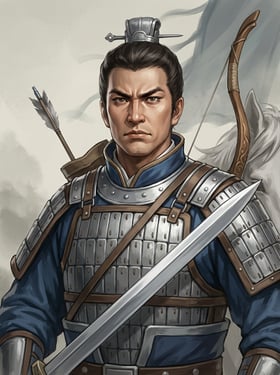
- Pang De wore a green robe and silver armor, rode a white horse, wielded a steel blade, and was skilled with a carved bow and stealthy arrows.
- Character
- Pang De's valor was foremost among all the armies; he broke enemy lines and drove back foes, unafraid of death, loyal and steadfast, swearing by the words, "A good general does not shrink from death to save himself; a man of honor does not betray his principles to preserve his life." Resourceful and decisive, loyal and brave unto death, he would not bend his integrity.
- Manner of speech
- Pang De's speech was impassioned and decisive, terse and heroic, customarily opening with "I have received the King of Wei's generous favor" and closing with an oath to fight to the death, as in "If I do not kill Yu this year, Yu will kill me" and "I would rather be a ghost of the state than a general of the rebels."
- Life
- In his youth Pang De was a commandery clerk. During the Chuping era he followed Ma Teng in striking rebellious Qiang and Di tribes, and later followed Ma Chao to resist Guo Yuan and Gao Gan, beheading Guo Yuan himself. After Ma Teng was summoned to be Commandant of the Guards, Pang De remained under Ma Chao, later followed Ma Chao in joining Zhang Lu, and finally surrendered to Cao Cao, who appointed him General Who Establishes Righteousness and enfeoffed him as Marquis of Guanmen Precinct. He once joined Cao Ren in attacking Wan and beheaded Hou Yin; later, at Fancheng, he campaigned against Guan Yu, but after being struck by an arrow he fell into the water and was captured, and because he would not submit, he was killed by Guan Yu.
- Weapons
- The weapons Pang De used included bow and arrows, short arms, a treasured blade, a steel blade, and a carved bow with stealthy arrows.
- Anecdotes
- Pang De's son Pang Hui was brave and fierce, bearing his father's spirit, rising to General of the Capital Guard and being enfeoffed as a full marquis. Pang De once carried a coffin as he went forth to fight to the death; after being captured he "glared with raised brows and furious eyes, standing and refusing to kneel," and Emperor Wen ordered his likeness of wrath to be painted.
Relationships
29 relationships
Quotes
27 recorded lines · 3 featured
「吾受魏王厚恩,誓以死報。今去樊城,與關某決戰,我若不能殺彼,必為彼所殺;即不為彼所殺,我亦當自殺:故先備此櫬,以示無空回之理。」
This line's allusion to 'carrying his coffin to fight to the death' displays Pang De's loyal valor and has circulated widely.
「吾奉魏王旨,特來取汝首!恐汝不信,備櫬在此。汝若怕死,早下馬受降!」
This line is the classic scene of Pang De bearing his coffin into battle against Guan Yu, shaping his image of loyalty and courage.
「吾寧死於刀下,豈降汝耶!」
This line displays Pang De's loyal and righteous integrity in choosing death over surrender, a core trait of his character.
Chapters12 回 ▸
- 史ch.17ch.18ch.36
- 演ch.58ch.59ch.65ch.67ch.68ch.72ch.73ch.74ch.75
Relationship timeline22 条 ▸
Inner monologues · AI-generated3 段 ▸
- The sound of the water still seems to ring in my ears. For more than ten days, unrelenting rain swelled the Han River un
- I am Pang De, courtesy name Lingming, from Huandao in Nanan. In my youth, I served as a commandery clerk and then as an
- My name is Pang De, and my courtesy name was Lingming. The records at hand do not go into detail about my family backgro
Life events5 ▸
- 0211-01-01 · Tong PassCao Cao Cuts His Beard and Discards His Robe· Warrior
- 0211-01-01 · Tong PassXu Chu Fights Ma Chao Bare-Chested· Warrior
- 0214-01-01 · Jiameng PassMa Chao's Surrender to Liu Bei· Witness
- 0219-01-01 · FanchengExecution of Pang De· Killed in action
- 0219-01-01 · FanchengFlooding of the Seven Armies· Killed in action