Yuan Shu's Faction · Commissioner for Urging the Advance
Li Feng
–197
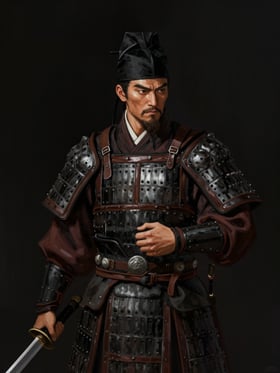
Records say Cao Cao defeated and killed Yuan Shu's general Li Feng; the novel has Lü Bu wound him before his capture and execution at Shouchun.
In the sources
Where the books name Li Feng
History · vol. 1Records of the Three Kingdoms
…術聞公自來,棄軍走,留其將橋蕤、李豐、梁綱、樂就;公到,擊破蕤等,皆斬之。…
Read the whole paragraph
袁術欲稱帝於淮南,使人告呂布。布收其使,上其書。術怒,攻布,爲布所破。秋九月,術侵陳,公東征之。術聞公自來,棄軍走,留其將橋蕤、李豐、梁綱、樂就;公到,擊破蕤等,皆斬之。術走渡淮。公還許。
Novel · ch. 17Romance of the Three Kingdoms
…術自引軍三萬,使李豐、梁剛、樂就為催進使,接應七路之兵。
Read the whole paragraph
遂建號仲氏,立臺省等官,乘龍鳳輦,祀南北郊,立馮方女為后,立子為東宮。因命使催取呂布之女為東宮妃。卻聞布已將韓胤解赴許都,為曹操所斬,乃大怒;遂拜張勳為大將軍,統領大軍二十餘萬,分七路征徐州:第一路大將張勳居中,第二路上將橋蕤居左,第三路上將陳紀居右,第四路副將雷薄居左,第五路副將陳蘭居右,第六路降將韓暹居左,第七路降將楊奉居右。各領部下健將,剋日起行。命兗州刺史金尚為太尉,監運七路錢糧。尚不從,術殺之,以紀靈為七路都救應使。術自引軍三萬,使李豐、梁剛、樂就為催進使,接應七路之兵。
Novel · ch. 17Romance of the Three Kingdoms
…術將李豐挺槍來迎;戰不三合,被布刺傷其手,豐棄槍而走。呂布麾兵衝殺,術軍大亂。…
Read the whole paragraph
布怒,挺戟向前。術將李豐挺槍來迎;戰不三合,被布刺傷其手,豐棄槍而走。呂布麾兵衝殺,術軍大亂。呂布引軍從後追趕,搶奪馬匹衣甲無數。袁術引著敗軍,走不上數里,山背後一彪軍出,截住去路。當先一將,乃關雲長也。大叫:「反賊!還不受死!」袁術慌走,餘眾四散奔逃,被雲長大殺了一陣。袁術收拾敗軍,奔回淮南去了。
Life
Novel 1 ch. · History 1 vol.
- Yuan Shu's Faction
- Hatched: dated by chapter
- Life event
- Death
Portrait file
Character profile
- Anecdotes
- Li Feng was a general under Yuan Shu and once served as Yuan Shu’s advance envoy. After three exchanges in battle with Lü Bu, he was wounded in the hand by a stab. While defending Shouchun, he was captured alive and executed.
Historical Record
The Records of the Three Kingdoms records that Li Feng was a general under Yuan Shu. Yuan Shu plotted to proclaim himself emperor in Huainan and then invaded Chen. Cao Cao marched east, and upon hearing the news, Yuan Shu abandoned his army and fled, leaving Qiao Rui, Li Feng, Liang Gang, Yue Jiu, and other generals to resist. When Cao Cao arrived, he defeated these generals; Qiao Rui and the others were all executed, while Yuan Shu crossed the Huai River and left. The historical account includes Li Feng among the generals under Yuan Shu who were defeated and executed, but gives no separate account of his specific office, the course of the battle, or his personal deeds.
Thus, in the historical biographies, Li Feng is not the subject of an independent biography, but a general in Yuan Shu’s army who was defeated and killed during Cao Cao’s eastern campaign. The existing accounts of his connection to Yuan Shu’s Faction and his fate are confined to the description of this military campaign; they do not warrant adding details about his origins, character, or earlier life.
In the Novel
The Romance of the Three Kingdoms portrays Li Feng as a military officer under Yuan Shu who repeatedly led troops. When Yuan Shu styled himself ruler of Zhongshi and prepared to divide his forces to campaign against Xu Province, Li Feng, Liang Gang, and Yue Jiu were appointed commissioners to hasten the advance and tasked with coordinating the seven armies. In the novel, then, he is not only a battlefield commander but also performs the duty of directing troop movements.
The novel then has Li Feng face Lü Bu: Lü Bu advances with his halberd raised, and Li Feng meets him with his spear. In fewer than three bouts, Lü Bu wounds Li Feng in the arm, forcing him to abandon his spear and flee. Li Feng’s swift defeat in this battle highlights Lü Bu’s valor and shows how Yuan Shu’s army struggles to stand against a powerful foe.
When Shouchun was in danger, Yuan Shu accepted the advice to avoid the enemy’s full force and left Li Feng, Yue Jiu, Liang Gang, and Chen Ji to divide their forces and defend the city, while he crossed the Huai with the other officers, soldiers, and valuables. Cao Cao’s army besieged the city for more than a month, and Li Feng and the others stayed behind closed gates. After the city fell, all four were captured, and Cao Cao ordered them executed in the marketplace. This full account of the city’s defense, their capture, and their execution is the novel’s detailed portrayal of Li Feng’s experience; the existing Records of the Three Kingdoms material only says that he was defeated and executed along with Yuan Shu’s other generals, without mentioning his wound, the defense of Shouchun, or his capture.
Key Relationships
Li Feng’s central connection was to Yuan Shu and his army: the historical account describes him as one of the generals Yuan Shu left behind, while the Romance further assigns him the roles of commissioner to hasten the advance and city defender. His military actions are consistently framed within the rise and fall of Yuan Shu’s power.
His encounter with Lü Bu appears only in the Romance: Li Feng goes out to fight, is wounded in the hand in fewer than three bouts, and flees after abandoning his spear. The historical account does not record this duel, so it cannot be treated as an established fact. (Unique to the Romance)
His relationship with Cao Cao points to defeat and death in both accounts. The historical record says that Cao Cao’s eastern campaign defeated and executed Li Feng and Yuan Shu’s other generals; the Romance expands the ending into the fall of the defenders of Shouchun, with Li Feng captured and then executed in the marketplace. The detailed siege and execution scenes are part of the novel’s elaboration.
Signature Scenes
The scene that most clearly identifies Li Feng in the historical account is Cao Cao’s eastern campaign against Yuan Shu: Yuan Shu abandons his army and flees, leaving Li Feng and the others to meet the enemy; Cao Cao’s army defeats them and executes them. The account is brief, but clearly establishes Li Feng’s allegiance, the campaign in which he fought, and his fate.
The Romance gives Li Feng two signature scenes. The first is his battle against Lü Bu: Li Feng raises his spear to meet him, but is wounded and flees before three bouts are complete, serving as a moment in the novel that demonstrates Lü Bu’s martial prowess. (Unique to the Romance) The second is the fall of Shouchun: Li Feng and three other defending generals are captured, and Cao Cao orders their execution, marking the collapse of Yuan Shu’s regime. The novel expands the historical account’s brief “defeated” and “all were executed” into a sequence of scenes involving the siege, the defenders’ resistance, the fall of the city, their capture, and their execution. These details should be understood as literary invention, not as facts explicitly recorded in the historical biographies.
Combat
On the field
Duels, kills and executions as the texts tell them, counted separately for the Records and the Romance.
Events
Events (1)
Battles and events the texts place this person in, by date.
Other events
- 197Cao Cao's Campaign Against Yuan ShuKilled in action

Continue
Last scene: Cao Cao's Campaign Against Yuan Shu
Inner monologues · AI-generated1 monologue ▸
- I accompanied Yuan Gonglu as he personally led thirty thousand troops, and was ordered, together with Liang Gang and Yue