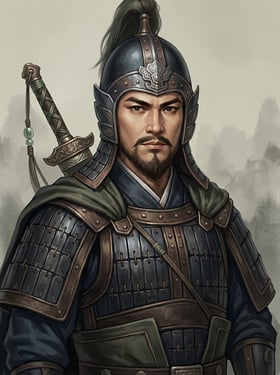
Historical Record
Ma Dai was a general of Shu Han during the Three Kingdoms period. His life and deeds are little recorded in the official histories, centering mainly on his beheading of Wei Yan on Yang Yi's orders after Zhuge Liang's death. According to the Records of the Three Kingdoms, when Zhuge Liang was gravely ill he secretly arranged for the army's withdrawal, ordering Wei Yan to cover the rear and Jiang Wei to follow, noting in particular that if Wei Yan would not obey, the army could withdraw on its own. After Zhuge Liang died, his death was kept secret, and Yang Yi sent Fei Yi to probe Wei Yan's attitude. Wei Yan held that, though the Chancellor had passed, he himself remained, and that the affairs of the realm should not be abandoned because of one man's death; he refused to be subordinate to Yang Yi and wished to lead the army northward on his own. Fei Yi feigned agreement with Wei Yan and slipped away when Wei Yan was off guard. When Wei Yan realized this he gave chase but could not catch up, so he sent men to scout the movements of Yang Yi and the others. On learning that Yang Yi and the rest were withdrawing according to Zhuge Liang's posthumous instructions, Wei Yan flew into a rage and, without waiting for Yang Yi's order, led his troops to return south first, burning the plank roads along the way c:4209.
Wei Yan and Yang Yi each submitted memorials accusing the other of rebellion, and the feathered dispatches arrived together within a single day. The Latter Ruler Liu Shan asked the Palace Attendant Dong Yun and the Chief Clerk of the resident office Jiang Wan; both held Yang Yi to be trustworthy and doubted Wei Yan. Yang Yi and the others cut through mountains and opened roads, marching day and night close behind Wei Yan. Wei Yan reached Nangukou first and sent troops to block Yang Yi. Yang Yi ordered He Ping to resist in front. He Ping rebuked Wei Yan, pointing out that the Chancellor's body was not yet cold, yet Wei Yan dared to act thus. Wei Yan's followers, knowing that Wei Yan was in the wrong, scattered. Wei Yan was left to flee toward Hanzhong with only a few close followers. In the end Yang Yi sent Ma Dai to pursue and behead Wei Yan, and his head was sent to Yang Yi. Yang Yi personally trod on Wei Yan's head and exterminated his three branches of kin c:4209. From the sources, Ma Dai played the role of the key executor in this affair, his action directly causing Wei Yan's death.
In the Novel
In Romance of the Three Kingdoms, Ma Dai's image is fuller: he is not only the executor who beheads Wei Yan after Zhuge Liang's death, but also a general who fought alongside Ma Chao and Ma Teng, father and son, and repeatedly distinguished himself on the battlefield. He shows loyalty to his family and insight into the times from his very first appearance. When Ma Teng was summoned by Cao Cao to the capital, Ma Dai remonstrated with his uncle Ma Teng, pointing out that Cao Cao harbored unfathomable intentions and that the trip might bring disaster, but Ma Teng did not heed him c:4210. After Ma Teng and his sons were killed by Cao Cao, Ma Dai escaped in disguise and brought the dire news back to Xiliang, prompting Ma Chao to raise troops in revenge c:15496.
In the novel Ma Dai went on campaign with the army many times, showing both valor and cunning. In the assault on Jiameng Pass he fought Wei Yan and, feigning defeat, wounded Wei Yan with an arrow c:4214; he later faced Zhang Fei and, though no match for him, still displayed the courage to stand against a powerful foe c:15498. During Zhuge Liang's Southern Campaign against Meng Huo, Ma Dai performed remarkable feats repeatedly. On Zhuge Liang's orders he led troops across the Lu River, penetrated deep into the barbarian caves to cut off Meng Huo's supply lines, and coordinated with the inside agents Dongtuna and A Huinan c:4215. In the fighting against Meng Huo, Ma Dai slew Mang Yazhang c:4216 and, with a feigned-defeat stratagem, lured and captured Lady Zhurong c:4219. He also disguised himself as a barbarian soldier, set an ambush by the Lu River, and successfully captured Meng Huo alive c:4217. In the last of Zhuge Liang's Seven Captures of Meng Huo, Ma Dai, following the plan, laid an ambush in Panshe Valley and at last took Meng Huo alive c:4221.
During the Northern Expeditions, Ma Dai also went into battle with the army many times. He once campaigned together with Guan Xing and Zhang Bao to resist a Qiang invasion, and took part in the battle in which Zhuge Liang cleverly broke the Qiang iron-chariot formation, capturing the chancellor Yadan alive c:4223. After the Battle of Jieting, Ma Dai joined Jiang Wei in pursuing Cao Zhen and slew the vanguard Chen Zao c:4224. When Zhuge Liang devised the fire attack at Shangfang Valley, Ma Dai was ordered to set an ambush at the rear of Hulu Valley, ready to burn Sima Yi, but the plan failed because of a sudden downpour c:4226.
The novel's most important treatment of Ma Dai is undoubtedly the episode in which, after Zhuge Liang's death, he beheads Wei Yan according to a posthumous plan. In the novel, before his death Zhuge Liang had foreseen Wei Yan's intent to rebel and deliberately passed a sealed stratagem to Yang Yi, while secretly instructing Ma Dai to behead Wei Yan unawares the moment Wei Yan shouted "Who dares to kill me?" c:4228. This episode casts Ma Dai as a forbearing and adaptable figure loyal to Zhuge Liang's dying command, and—compared with the bare record in the sources that "Yang Yi sent Ma Dai to pursue and behead him"—gives the event greater drama and character depth.
Key Relationships
* Ma Teng: Ma Dai's uncle. When Ma Teng was summoned to the capital by Cao Cao, Ma Dai remonstrated; after Ma Teng was killed, Ma Dai brought the dire news back to Xiliang c:4210.
* Ma Chao: Ma Dai's cousin. After Ma Teng was killed, Ma Dai brought the news to Ma Chao, prompting Ma Chao to raise troops in revenge c:15496. As Ma Chao's kinsman and subordinate, Ma Dai also served Liu Bei after Ma Chao entered Shu.
* Zhuge Liang: Ma Dai's direct superior and commander. In the novel, Ma Dai repeatedly carried out important missions on Zhuge Liang's orders, such as cutting supply lines and capturing Meng Huo during the Southern Campaign c:4215 c:4217 c:4221, and setting a fire-attack ambush against Sima Yi during the Northern Expeditions c:4226. Above all, after Zhuge Liang's death, Ma Dai faithfully carried out Zhuge Liang's posthumous plan and beheaded Wei Yan c:4228.
* Yang Yi: In history, Ma Dai pursued and beheaded Wei Yan on Yang Yi's orders c:4209. In the novel, Yang Yi was one of those privy to and executing Zhuge Liang's posthumous plan, and together with Ma Dai completed the task of beheading Wei Yan c:4228.
* Wei Yan: In both history and the novel, Wei Yan was Ma Dai's ultimate target. The histories record that Ma Dai pursued and beheaded Wei Yan on Yang Yi's orders c:4209. In the novel, Ma Dai was the key figure in Zhuge Liang's posthumous plan to behead Wei Yan, slaying him unawares the moment Wei Yan shouted "Who dares to kill me?" c:4228. The two also clashed in the novel, where Ma Dai once wounded Wei Yan with an arrow c:4214 (novel only).
Signature Scenes
* Remonstrating against Ma Teng's journey to the capital (novel only): At his very first appearance Ma Dai shows his caution and insight into the times, remonstrating with his uncle Ma Teng not to go lightly to the capital, foreshadowing Ma Teng's tragic fate c:4210.
* Bringing word of Ma Teng's death to Ma Chao (novel only): Ma Dai escaped in disguise and brought the dire news of the deaths of Ma Teng, Ma Xiu, and Ma Tie back to Xiliang, directly prompting Ma Chao to raise troops in revenge, an important prompt for Ma Chao's storyline c:15496.
* Southern Campaign against Meng Huo, clever captures (novel only): During Zhuge Liang's Southern Campaign, Ma Dai repeatedly displayed wit and valor. He led troops across the Lu River and penetrated deep behind enemy lines to cut supply routes c:4215; disguised as a barbarian soldier by the Lu River, he set an ambush and captured Meng Huo alive c:4217; and he laid an ambush in Panshe Valley, finally taking Meng Huo alive to round off Zhuge Liang's Seven Captures of Meng Huo c:4221. These episodes fully display Ma Dai's adaptability and capacity to execute orders.
* The fire at Shangfang Valley during the Northern Expeditions (novel only): During Zhuge Liang's Northern Expeditions, Ma Dai was ordered to set a fire-attack stratagem in Hulu Valley (Shangfang Valley), intending to burn Sima Yi to death. Although it failed because of a sudden downpour, the arrangement of the plan and Ma Dai's participation reflect his important position in military operations c:4226.
* Beheading Wei Yan on Zhuge Liang's posthumous plan: This is Ma Dai's best-known signature event in both history and the novel. After Zhuge Liang's death, Ma Dai pursued and beheaded Wei Yan on Yang Yi's orders (in history) or on Zhuge Liang's posthumous plan (in the novel) c:4209. In the novel especially, Ma Dai beheaded Wei Yan unawares the moment he arrogantly shouted "Who dares to kill me?", a scene that vividly displays Ma Dai's forbearing and adaptable character and makes him the final executor of Zhuge Liang's strategy c:4228.
Portrait file
Character profile
- Character
- Ma Dai was forbearing yet resourceful and adaptable. A general of Shu Han, he had been a subordinate commander of Ma Chao, and later became General Who Pacifies the North and Marquis of Chencang.
- Manner of speech
- His words were terse and decisive, as in "I dare to slay you!"
- Weapons
- Ma Dai habitually used a treasured saber, or a saber.
- Anecdotes
- Ma Dai was Ma Chao's younger cousin, and inherited his title for his merit in the campaign against Wei Yan. He once carried out Kongming's secret plan to slay Wei Yan.
Relationships
16 relationships
Quotes
16 recorded lines · 3 featured
「吾敢殺汝!」
This is Ma Dai's iconic line as he slays Wei Yan, brimming with dramatic conflict and a striking reversal of character.
「將軍之言,不智甚也。大丈夫何不自圖霸業,乃輕屈膝於人耶?吾觀將軍智勇足備,兩川之士,誰敢抵敵?吾誓同將軍先取漢中,隨後進攻兩川。」
This is Ma Dai's key line luring Wei Yan into rebellion, revealing his cunning and his undercover role.
「叔父與侍郎黃奎同謀殺操,不幸事泄,皆被斬於市。二弟亦遇害。惟岱扮作客商,星夜走脫。」
This line recounts the tragic end of Ma Teng and his sons, an important part of Ma Dai's background.
Chapters17 回 ▸
- 史ch.36ch.40
- 演ch.57ch.58ch.59ch.65ch.88ch.89ch.90ch.92ch.94ch.95ch.98ch.100ch.103ch.104ch.105
Relationship timeline18 条 ▸
史 ch.40
- Wei Yan§51
enemy_of
杨仪遣马岱追斩魏延,致首于仪
演 ch.57
- Ma Teng§52
kin_of
马腾兄子;从马腾入京押后
演 ch.58
- Ma Chao§3
kin_of
兄子来报,痛诉马腾父子皆死许昌;后随超南下围长安
演 ch.59
- Ma Chao§17
commands_in
与庞德救出马超走临洮
演 ch.65
演 ch.88
commands_in
自蜀中至,受命渡泸断粮、扮蛮诱擒
fights_in
阵前一合斩忙牙长于马下
- Meng Huo§16
fights_in
扮蛮兵驾舟,岸边诱缚孟获
演 ch.89
commands_in
受令拆桥移流,渡赵云魏延接应;又袭孟获
演 ch.90
fights_in
以绊马索埋伏擒之
- Zhuge Liang§13
commands_in
受计于盘蛇谷两头布黑油柜车、地雷、断谷口
- Meng Huo§18
fights_in
山凹拦路生擒孟获
演 ch.92
- Ma Chao§1
kin_of
马岱乃马超之弟,奉孔明令挂孝祭墓
演 ch.94
- Yadan§6
enemy_of
阵中活捉雅丹丞相
演 ch.95
- Chen Zao§18
fights_in
斩魏先锋陈造
演 ch.98
commands_in
受令引三千军于上风头放火烧魏车
演 ch.103
commands_in
受密计造木栅、伏地雷、塞断葫芦谷后路埋伏
Inner monologues · AI-generated3 段 ▸
- After the Chancellor’s death, the army’s orders remained in force. How could one person’s death be allowed to leave the
- I carried out the prime minister’s orders, leading troops through Nanzhong. What I saw was not all clashes of banners an
- My surname is Ma, and my given name is Dai. The records I rely on do not mention my courtesy name. As a member of the Ma
Life events9 ▸
- 0211-01-01 · Tong PassXu Chu Fights Ma Chao Bare-Chested· Warrior
- 0212-01-01 · XuchangExecution of Ma Teng· Witness
- 0214-01-01 · Jiameng PassMa Chao's Surrender to Liu Bei· Warrior
- 0231-01-01 · Mount QiZhuge Liang's Fifth Northern Expedition· Warrior
- 0234-01-01 · Shangfang ValleyFire Attack at Shangfang Valley· Warrior
- 0234-01-01 · Mount QiGrain Transport by Wooden Ox and Flowing Horse· Warrior
- 0234-01-01 · Mount QiZhuge Liang's Six Expeditions to Mount Qi· Warrior
- 0234-01-01 · NanzhengRebellion of Wei Yan· Warrior
- 0234-01-01 · NanzhengDeath of Wei Yan· Warrior