Background
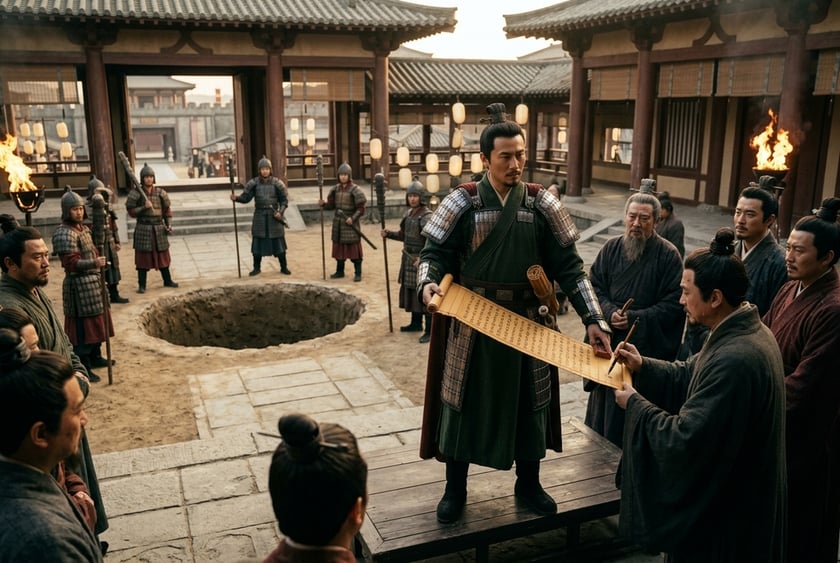
In the Romance of the Three Kingdoms, the completion ceremony of the Bronze Sparrow Terrace is set at a pivotal moment two years after the defeat at Chibi, and carries deep political significance. The setback at Chibi in the thirteenth year of Jian'an severely damaged Cao Cao's northern main force and postponed the timetable for reunification indefinitely. In the fourteenth year, military reorganization took place in succession at Hefei and Qiaojun; in the spring of the fifteenth year, the Bronze Sparrow Terrace was completed — the timing is remarkably telling. This was a gesture of responding to military defeat with a "cultural symbol." Yecheng had been Cao Cao's effective political center since he crushed Yuan Shang in the ninth year of Jian'an, and by the fifteenth year it had essentially completed its transformation into a capital city. The complex of the Bronze Sparrow Terrace, the Jade Dragon Terrace, and the Golden Phoenix Terrace — three towers linked together, each ten zhang tall, connected by two overhead bridges — was the most magnificent palace complex in the north at that time. Such scale and form plainly exceeded the protocol of a feudal lord and approached the grandeur befitting a king — which was precisely the "new political status" Cao Cao wished to express through architecture.
Key Figures
The composition of those present was itself a roster of the "founding cadre of Caowei": on the military side, the Cao clan (in red robes) and generals of other surnames (in green robes) were arrayed in two teams for an archery competition — Cao Xiu, Cao Hong, and Xiahou Yuan representing the clan troops, while Wen Pin, Zhang He, Xu Huang, and Xu Chu represented the surrendered generals and trusted subordinates — forming the latest portrait of Cao Cao's military structure after Chibi. The civil officials included Wang Can and Chen Lin from among the "Seven Masters of Jian'an," together with elder-statesmen scholars such as Wang Lang and Zhong Yao, whose presented poems largely carried the meaning that Cao Cao "should rightfully receive the mandate". Notably, Cao Zhi was present — the Romance does not detail his specific activities here, but the Wei Zhi annotations, citing the Wei Shi Chunqiu, record that at this Tongquetai gathering Cao Zhi composed "Ode to Ascending the Terrace" impromptu, earning Cao Cao's public praise — this was the starting point of Cao Zhi's rising political reputation and sowed the seeds for the later succession struggle. On the Wu side, Hua Xin came to Yecheng as Sun Quan's envoy, bearing a memorial requesting that Liu Bei be appointed Governor of Jingzhou — an attempt by the Jiangdong court to drive a wedge between Cao Cao and Liu Bei through diplomatic counter-intelligence.
Core Issue
The entire banquet had one implicit central question: under what title would Cao Cao advance toward the position of "king" or even higher? The laudatory poems of Wang Lang, Zhong Yao, Wang Can, and Chen Lin had already put the phrase "receiving the mandate" squarely on the table. Cao Cao's response was highly nuanced — he neither seized the moment to proclaim himself king, nor flatly refused on the spot. Instead, he adopted a political posture of "narrating his entrepreneurial journey and defending himself against accusations of disloyalty": tracing his career from "Inspector of Cavalry" through campaigning against Dong Zhuo, suppressing the Yellow Turbans, eliminating Yuan Shu, defeating Lv Bu, crushing Yuan Shao, and pacifying Liu Biao, laying out a string of military achievements in one breath, then repeatedly deflecting further advancement with three rhetorical layers — "I am foolish and unworthy," "I truly cannot lay down arms," and "I recall Confucius's praise of King Wen's supreme virtue; these words weigh on my heart". This political posture of "declining without truly withdrawing" is the classic template for power advancement in the Chinese mode — one must publicize one's merits while "yielding" the further political position so that the assembled officials can urge advancement repeatedly. This pattern was emulated by later generations through the Ming and Qing dynasties, forming a latent procedural tradition in Chinese political history.
Political Consequences
The immediate political consequence of the Tongquetai gathering was the formal launch of the path toward "Duke of Wei — King of Wei." In the seventeenth year of Jian'an, Dong Zhao and others proposed conferring the dukedom of Wei; in the eighteenth year, Cao Cao received the nine ceremonial gifts and was enfeoffed as Duke of Wei; in the twenty-first year he was elevated to King of Wei; in the twenty-fifth year Cao Cao died, and Cao Cao's son Caopidaihan replaced the Han. Each step echoed the political expectations established at the Tongquetai ceremony. From the perspective of cultural history, this gathering confirmed the height of the Yecheng literary circle — Wang Can, Chen Lin, Kong Rong (already deceased), Xu Gan, Ruan Yu, Ying Chang, and Liu Zhen, i.e., the "Seven Masters of Jian'an" together with the Cao father and sons, formed the first genuine "literary group" in the history of Chinese literature in any true sense. The Bronze Sparrow Terrace thus became not merely a building but a literary symbol — the Tang dynasty poet Du Mu's later line, "Had the east wind not favored young Lord Zhou, come spring the Bronze Sparrow Terrace would have locked in the Two Qiaos," fixed it as the politically charged imaginative space of the entire San Guo era. On the diplomatic level, Hua Xin's mission to Cao Cao failed: although Cao Cao memorialized the throne to appoint Liu Bei as Governor of Jingzhou, this did not sever the Sun-Liu alliance; Zhou Yu and Lu Su saw through it, only deepening their wariness of Cao Cao.
Counterfactual Analysis
What if Cao Cao had refused at the Tongquetai ceremony to accept the quasi-laudatory poems urging his advancement, and had clearly adopted the posture of a "loyal subject"? The most likely result would have been that the Caowei replacement of Han would have been delayed by ten years or even longer, and Cao Cao might have remained at the title of "Chancellor" for the rest of his life, leaving the choice to his successor. But this would not have been the historically optimal solution — delaying the replacement of Han would only have further exhausted the political resources of the Han court, and in terms of popular sentiment would actually have caused a loss of the legitimacy expectation that "a new court equals a new order." Another counterfactual: if Cao Cao had openly proclaimed himself King of Wei or accepted the nine ceremonial gifts at the Tongquetai ceremony itself, then the revolt of Ma Chao and Han Sui in Guanzhong in the sixteenth year of Jian'an might have been triggered early in the name of "opposing Cao Cao," making an already turbulent post-Chibi situation even harder to manage. From this angle, the "yielding — gradual advancement" rhythm Cao Cao adopted was the most politically efficient compromise — and the Tongquetai ceremony thus became a textbook case of "posture management" in the history of the late Han political transition.