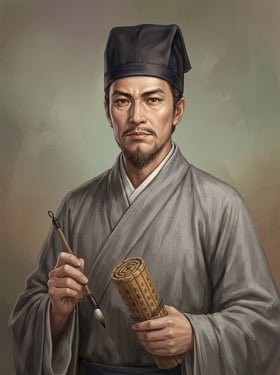
Historical Record
Wang Can, styled Zhongxuan, was a native of Gaoping in Shanyang. He was broadly learned and well-informed, possessed of a powerful memory and silent recall, skilled in arithmetic, and brilliant in letters, able to complete a composition the moment he set brush to paper. When Emperor Xian of Han moved west to Chang'an, Wang Can moved with him. At that time, the Left General of the Household, Cai Yong, was eminent for his talent and learning, esteemed by all within and beyond the court, with guests filling his gate. On hearing that Wang Can had arrived, Cai Yong went out to welcome him with his shoes on backward—proof of how highly he valued Wang Can. The guests present, seeing that Wang Can was young, frail, and of short stature, were all astonished. But Cai Yong said, "This is the grandson of Lord Wang; he has extraordinary talent—I am not his equal. All the books and writings of my house shall go to him." c:2803 At seventeen, Wang Can was summoned by the Minister over the Masses and appointed by edict Gentleman of the Yellow Gate, but because of the turmoil in the western capital he did not take up the post. Later, to escape the disorder, Wang Can went to Jing Province to attach himself to Liu Biao. Liu Biao, however, did not employ him to any great purpose, because Wang Can was of poor appearance, frail, and easygoing and unconventional in manner. After Liu Biao died, Wang Can persuaded his son Liu Cong to submit to Cao Cao. He analyzed for Liu Cong the great trends of the realm, pointing out that Cao Cao's bold strategy was foremost of the age and his cunning beyond the world, urging him to lay down his armor and turn his banners, to accord with Heaven and follow the Mandate, so as to preserve his clan. Liu Cong in the end adopted his words. Cao Cao summoned Wang Can as a Chancellor's aide and granted him the title Marquis Within the Passes. At a banquet by the Han River, Wang Can offered counsel to Cao Cao, praising him for gathering heroes and employing both civil and military men—an act worthy of the Three Kings. Later Wang Can was promoted to Libationer of Military Counsel. After the state of Wei was established, he was appointed Palace Attendant. Broadly learned and well-informed, Wang Can answered every question fluently; at a time when the old ceremonial had fallen into disuse, the creation of much of the institutional framework was determined by him, and even the jade pendants, which had vanished at the end of the Han, were remade by Wang Can on the basis of his former knowledge c:2803.
Wang Can, like Cao Pi and Cao Zhi, loved literature, and together with Xu Gan of Beihai, Chen Lin of Guangling, Ruan Yu of Chenliu, Ying Yang of Runan, and Liu Zhen of Dongping he was ranked among the "Seven Masters of Jian'an," all on good terms with one another. He served as Palace Attendant together with Du Xi and He Qia, and though broadly informed and powerful in memory, often riding as Cao Cao's companion in the carriage, Cao Cao did not esteem him as much as He Qia and Du Xi. On one occasion Du Xi had a private audience with Cao Cao at midnight; Wang Can, impatient by nature, grew restless and uneasy and asked He Qia what Du Xi and Cao Cao were discussing. He Qia laughingly replied that the affairs of the realm had no end, advising him simply to wait upon Cao Cao by day and not to worry overmuch c:12745.
In the Novel
The Wang Can of the Romance of the Three Kingdoms accords largely with the historical record, and on that basis is given literary embellishment and exaggeration. He first appears in Chapter 40, when, during Liu Biao's grave illness, he joins Fu Xun and Kuai Yue in persuading Liu Cong to surrender to Cao Cao c:2810. The novel emphasizes Wang Can's broad knowledge, powerful memory, and surpassing talent—for example, when in his youth he visited Cai Yong, Cai Yong welcomed him with his shoes on backward and praised him as having "extraordinary talent—I am not his equal" c:12742. The book also records his unusual gifts: he could memorize a stele inscription at a glance; watching others play chess, he could restore a scattered board to its original state; and he was skilled in arithmetic—all further highlighting his "broad knowledge and powerful memory." In persuading Liu Cong to surrender to Cao Cao, Wang Can's words accord largely with the historical record: he enumerates Cao Cao's achievements—capturing Lü Bu, crushing Yuan Shao, driving out Liu Bei, breaking the Wuhuan—emphasizes Cao Cao's mighty strength, and points out that surrender is the surest course c:2810.
After Cao Cao took possession of Jing Province, Wang Can, together with the other persuaders of the surrender, was enfeoffed as a Marquis Within the Passes c:5940. In Chapter 56, Wang Can, together with the civil officials Wang Lang, Zhong Yao, and Chen Lin, presents poetic compositions extolling Cao Cao's merit and virtue, intending that he receive the Mandate and proclaim himself king. Cao Cao responds with humility, declaring that his aim is to render merit by quelling the rebels on behalf of the Han house and that he has no ambition to declare himself emperor, yet he also remarks that were he to lay down his military authority he might meet with disaster, and so "he cannot, for the sake of an empty name, place himself in real peril." c:5941 In Chapter 66, Wang Can, with Du Xi, Wei Kai, and He Qia, discusses honoring Cao Cao as Prince of Wei, but meets the opposition of the Secretariat Director Xun You, who consequently dies of grief and indignation. Although Cao Cao buries Xun You generously, he ultimately drops the matter of the kingly honor c:2811. The novel's portrayal of Wang Can places him more within the Cao Wei group of civil officials, highlighting his literary talent and political participation, especially his role in such key events as persuading Liu Cong to surrender and honoring Cao Cao as Prince of Wei.
Key Relationships
* Cai Yong (mentor_of): Cai Yong was Wang Can's benefactor and the one who recognized his worth. History records that on hearing of Wang Can's arrival, Cai Yong welcomed him with his shoes on backward, praised his talent as surpassing his own, and was willing to bestow on him all the books and writings handed down in his house c:2803. The novel likewise depicts Cai Yong's high regard for Wang Can, further emphasizing Wang Can's early brilliance c:12742.
* Liu Biao's faction (serves): Wang Can once attached himself to Liu Biao to escape the disorder. Liu Biao, however, did not employ him to any great purpose, because of Wang Can's poor appearance, frailty, and unconventional manner c:2803.
* Liu Cong (advises_in): After Liu Biao died, Wang Can actively persuaded Liu Cong to submit to Cao Cao, analyzing the advantages and disadvantages and ultimately bringing about Liu Cong's surrender. This was an important act in Wang Can's political career, described in detail in both the histories and the novel c:2803, c:2810.
* Cao Wei (serves): After submitting to Cao Cao, Wang Can was summoned as a Chancellor's aide, granted the title Marquis Within the Passes, later promoted to Libationer of Military Counsel, and, after the state of Wei was established, appointed Palace Attendant. He contributed greatly to Cao Cao's political and cultural construction, playing an especially important role in determining the old ceremonial and creating institutions c:2803.
* Cao Pi, Cao Zhi, and others (friend_of): Wang Can was on good terms with literary enthusiasts such as Cao Pi and Cao Zhi, and together with Xu Gan, Chen Lin, and others was ranked among the "Seven Masters of Jian'an," jointly ushering in the flourishing of Jian'an literature c:2805.
* Du Xi, He Qia (colleague_of): Wang Can served as Palace Attendant together with Du Xi and He Qia, jointly assisting Cao Cao. History records that Wang Can once showed his impatient nature over Du Xi's midnight private audience with Cao Cao, reflecting his temperament from the side c:12745.
Signature Scenes
* Cai Yong welcomes him with his shoes on backward: When Wang Can in his youth visited Cai Yong, Cai Yong, on hearing his name, disregarded propriety and welcomed him with his shoes on backward, lavishly praising his talent and offering to bestow on him his entire household collection. This scene not only highlights Wang Can's early precocity and surpassing gifts but also displays Cai Yong's magnanimity in cherishing talent, becoming a most signature moment in Wang Can's life c:2803, c:12742.
* Persuading Liu Cong to surrender to Cao Cao: After Liu Biao died, Wang Can analyzed for Liu Cong the great trends of the realm, strongly urging him to submit to Cao Cao and pointing out Cao Cao's mighty strength and the sureness of surrender. This act had a far-reaching effect on the situation in Jing Province and established Wang Can's standing within the Cao Wei camp c:2803, c:2810.
* Cao Cao holds a banquet by the Han River, and Wang Can offers counsel: After Cao Cao had pacified Jizhou and the Han River region, he held a banquet by the Han River. At the banquet Wang Can offered counsel to Cao Cao, praising him for gathering heroes and employing both civil and military men—an act worthy of the Three Kings—displaying his outstanding political vision and eloquence c:2803.
* Determining the old ceremonial and remaking the jade pendants: At the disorder of the Han's end, the old ceremonial had fallen into disuse and the jade pendants had vanished. Drawing on his broad learning, Wang Can re-identified and remade the jade pendants, contributing to the institutional construction of the state of Wei. This reflects Wang Can's profound attainments in culture and ritual c:2803.
* Extolling Cao Cao's merit and virtue with the other civil officials (novel only): In the Romance of the Three Kingdoms, Wang Can, together with civil officials such as Wang Lang and Zhong Yao, presents poetic compositions extolling Cao Cao's towering merit and virtue, intending that he receive the Mandate and proclaim himself king. Although Cao Cao in the end did not declare himself king, this scene displays Wang Can's identity as a Cao Wei civil official and his political leanings c:5941.
Portrait file
Character profile
- Appearance
- Wang Can's appearance did not match his reputation, and he was frail of body; in childhood he was short of stature. He was thin and weak in looks and short in build.
- Character
- Wang Can was easygoing in character, of strong memory, skilled at mental calculation, quick in literary thought, and able to complete a composition as soon as he set brush to paper. Widely learned and retentive, he could recite what he had seen but once; his prose was the finest of its age, yet he was impetuous in temperament and eager to outdo others.
- Manner of speech
- Wang Can was profoundly learned, answering every question with ease; his argumentation was vigorous, forceful, and well-grounded.
- Life
- Wang Can was a native of Gaoping in Shanyang; his great-grandfather and grandfather were both among the Three Excellencies of the Han, and his father served as Chief Clerk to He Jin. He followed Emperor Xian in the westward move to Chang'an, and later attached himself to Liu Biao in Jing Province. Wang Can persuaded Liu Cong to submit to Cao Cao, and was afterward appointed by Cao Cao as an Aide to the Chancellor, granted the rank of Marquis Within the Passes, and promoted to Libationer of the Army's Counsel; after the state of Wei was founded, he was made Palace Attendant. In the spring of the twenty-second year of Jian'an, Wang Can died of illness while on campaign against Wu, aged forty-one. His two sons were implicated in the Case of Wei Feng's Conspiracy and executed, and Wang Can's line was thereby cut off.
- Anecdotes
- Wang Can was foremost among the Seven Masters of Jian'an, and was praised by Cai Yong as possessing extraordinary talent. He served as Palace Attendant of Wei, employed alongside He Qia and Du Xi, and once took part in the deliberations to honor Cao Cao as King of Wei.
Relationships
9 relationships
Quotes
4 recorded lines · 2 featured
「將軍自料比曹公何如?」
This line is the crux of Wang Can's counsel to Liu Cong to surrender, embodying his politically shrewd sense of the times.
「曹公兵強將勇,足智多謀。擒呂布於下邳,摧袁紹於官渡,逐劉備於隴右,破烏桓於白狼:梟除蕩定者,不可勝計。今以大軍南下荊襄,勢難抵敵。傅、蒯二君之謀,乃長策也。將軍不可遲疑,致生後悔。」
This passage analyzes Cao Cao's strength in detail, displaying Wang Can's outstanding strategic judgment.
Chapters6 回 ▸
- 史ch.21ch.23
- 演ch.40ch.41ch.56ch.66
Relationship timeline8 条 ▸
Inner monologues · AI-generated1 段 ▸
- I am Wang Can, courtesy name Zhongxuan. I recall that when Emperor Xian moved west, Chang'an was beset by troubles, and
Life events5 ▸
- 0208-01-01 · XiangyangLiu Cong's Surrender to Cao Cao· Witness
- 0210-01-01 · YeBronze Bird Terrace Inauguration Ceremony· Witness
- 0217-01-01 · YeGreat Epidemic of the 22nd Year of Jian'an· Killed in action
- 0219-01-01 · YeWei Feng's Conspiracy· Witness
- 0219-01-01 · YeCase of Wei Feng's Conspiracy