Strategic Background
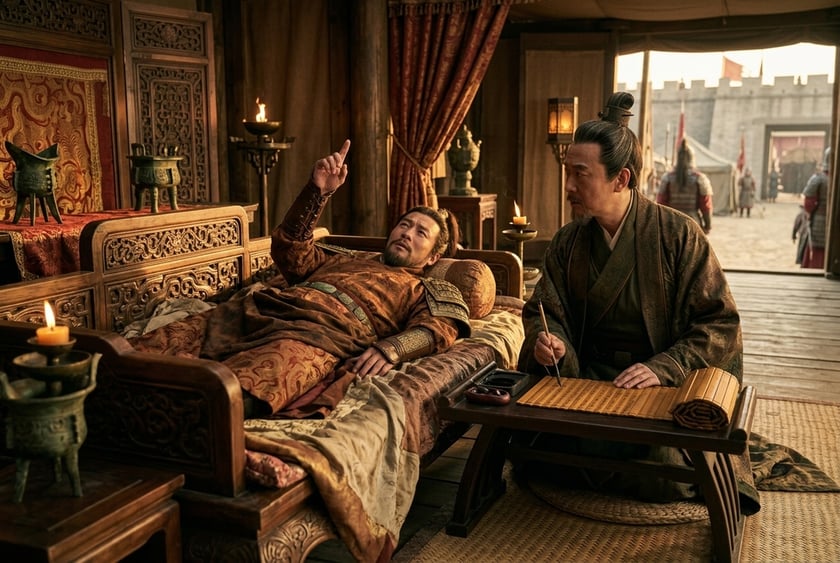
From a military-history analyst's perspective, Zhugeliangbeifa — as the parent event — serves the narrative function of "providing a unified strategic framework for four specific northern campaigns." The strategic environment of 228 CE was exceptionally harsh for Shuhan: Liu Bei was dead, and Zhuge Liang, governing as regent under the charge of Baidituogu, faced a kingdom that was smallest in territory, smallest in population, and most remotely situated of all the rival states. The strategic rationale for the northern campaigns rested on three layers of judgment. The first was the logic of "offense as defense" — one commandery of Yizhou against the nine commanderies of the Central Plains meant that pure defense amounted to a slow death; Shuhan had to actively create instability for its opponent and force Caowei to commit the bulk of its resources to western-front defense. The second was a "window of opportunity" assessment — in the Romance, Kong Ming tells Ma Su: "Cao Pi is already dead; the young Cao Rui has just taken the throne; all the rest are of no concern. Sima Yi is a man of deep stratagems, and today he commands the armies of Yong and Liang — if he is given time to train them, he will become a great calamity for Shuhan" [c:17716], explicitly identifying "Sima Yi not yet having trained the Guanlong army group" as the key window. The third was political obligation — the pressure on Zhuge Liang to honor his promise to Liu Bei at Baidituogu inclined him strategically toward "demonstrating loyalty through action" rather than seeking security through passivity.
Deployment of Forces
Caowei's overall deployment underwent two reversals. In the early period, the core was Cao Zhen, Xiahou Mao, and Zhang He, who regarded the western front as a "secondary theater" and believed the existing "Guanzhong home-front army corps" was sufficient to repel any attack, without committing highest-level strategic resources. Zhuge Liang exploited this complacency: he first used Ma Su's stratagem to spread the rumor that "Sima Yi intends to rebel" and forged a proclamation attributed to Sima Yi announcing an imminent uprising [c:17717] [c:17718], thereby arousing Cao Rui's suspicion and leading to Sima Yi's dismissal; as a result, Caowei's Diyicibeifa was in practice conducted by "Cao Xiu and Cao Zhen, commanders with no experience in strategic command" [c:17719] [c:17720]. This intelligence operation's success secured a critical early advantage in timing for Shuhan. Shuhan's deployment remained comparatively stable — Zhuge Liang as supreme commander, with Wei Yan, Zhao Yun, Ma Dai, Guan Xing, and Zhang Bao as front-line commanders, and Jiang Wei added as a major force after his defection. Zhuge Liang's clear preference was "frontal advance, gradual conquest of Longright," rejecting Wei Yan's Ziwu Valley surprise-attack plan [c:17721] and insisting on "advancing along the flat road through Longright, proceeding by the rules."
Critical Decision Points
Four decision points run through the four northern campaigns. The first is Zhuge Liang's rejection of Wei Yan's Ziwu Valley surprise attack at the outset of the first campaign — the single most debated strategic decision by military thinkers in all the northern campaigns [c:17721], compressing two opposing military philosophies, "the cautious approach" versus "the bold surprise attack," into one conversation. The second is Ma Su's loss at Jieting — the turning point from victory to defeat in the first campaign, leading to Zhuge Liang's self-demotion of three ranks and a fundamental change in how he employed personnel for all subsequent campaigns [c:17725]. The third is Zhuge Liang's use of "lute-playing to lure the enemy" to defeat the Qiang commander Yue Ji — though the tactic itself was clever, its deeper strategic significance was converting the Qiang from "Caowei allies" to "neutrals"; in the Romance, Kong Ming releases Ya Dan, saying "you are a neighboring land — let us be forever allied in friendship" [c:17723], a sign that the war was being expanded into a diplomatic enterprise. The fourth is Cao Rui's decision in his moment of crisis to reinstate Sima Yi — "Previously, Zhuge Liang wished to raise troops against the frontier; he feared only this man, so he spread false rumors to make Your Majesty distrust and dismiss him — only then did he dare advance in great force" [c:17724]. Cao Rui finally understood he had been deceived by a double-agent ruse, restored Sima Yi as Commissioner-in-Chief of the West, and from that point Caowei's western front entered the "Sima Yi era" — the caliber of the adversary facing Shuhan's northern campaigns suddenly escalated.
Outcome and Echoes
Looking at the overall results of the four northern campaigns, Shuhan never secured a stable foothold in Longright; every campaign ended in withdrawal forced by exhausted supplies, unfavorable terrain, or unforeseen personnel crises. Yet in strategic terms, the campaigns achieved three secondary objectives. First, they kept Caowei perpetually on the defensive, preventing it from concentrating forces for a southward campaign against Sunwu. Second, they elevated Jiang Wei as Shuhan's military successor [c:17716], preserving Shuhan's unified military-political command in its later years. Third, they crystallized Zhuge Liang's image as a man who "devoted himself without reservation and died in service" into the preeminent spiritual symbol of the scholar-official class throughout the medieval era — its cultural impact far transcended his actual military outcomes. From the adversary's perspective, Sima Yi's "hold and wait" strategy across multiple northern campaigns preserved his command of the western front, and after Zhuge Liang's death in 234 he moved smoothly to absorb the Guanlong army group, accumulating the decisive political and military capital that would eventually bring Simashi to power. Ironically, Shuhan's northern campaigns had cultivated the most dangerous usurper within Caowei itself.
Counterfactual Analysis
Counterfactual one: had Zhuge Liang adopted Wei Yan's Ziwu Valley surprise attack in the first northern campaign, what would have happened? Based on modern topographic research, the Ziwu Valley plank road in the late Han period was poorly suited for the movement of a large army; the risk of five thousand elite troops racing toward Changan with their supply line immediately severing was extremely high. Even if Changan fell briefly, it could not be held, and Shuhan's most elite mobile force would have been squandered. Zhuge Liang's cautious strategy was tactically sound — the problem is that it relinquished the strategic window for "a gamble." Counterfactual two: had Cao Rui not dismissed Sima Yi in 228, how would Shuhan's first northern campaign have unfolded? The advantage gained through the intelligence operation would not exist; the Shuhan army would have faced a western front where "Sima Yi held fortified positions," and even the early windfall of "seizing Tianshui and taking Shanggui" would have been difficult to realize. This fork in the road tells us that the strategic value of Zhuge Liang's counter-intelligence ploy exceeded that of any single battlefield victory. Counterfactual three: had Zhuge Liang not died in 234 but lived another ten years, could he have broken through Sima Yi's war of attrition? The answer is almost certainly no — Shuhan's agricultural population and manpower limits were an absolute ceiling; ten more years could not close the resource gap with Caowei. The most valuable thing ten more years of Zhuge Liang would have accomplished was probably the establishment of a stable succession system for military and civil governance — the difficulties that confronted Jiang Wei, and the short tenures of Jiang Wan and Fei Yi, all trace back to internal institution-building that Zhuge Liang never had time to complete.