Strategic Background
As a modern military historian, the strategic coordinates of Disicibeifa shifted significantly twice. First, a Wei leadership change: after Disancibeifa, Cao Zhen fell gravely ill and died; Wei Ming Di personally appeared at the front and placed the burden of "singlehandedly eliminating the invaders" on Sima Yi [c:17491] — meaning Zhuge Liang now faced, for the first time, a structurally capable opponent rather than a commander like Cao Zhen who relied chiefly on experience and cautious consolidation. Second, Shuhan's logistical strain. The first three northern campaigns had exhausted Hanzhong's available grain, corvée labor, and horses to the limit; this time Zhuge Liang made extensive use of transport innovations such as the Muniuliuma, but the fundamental constraint remained unresolved. The march set out "in the second month of the ninth year of Jianxing" [c:17491] — this campaign was one in which Zhuge Liang pushed to the extreme the contradiction between "must campaign" and "campaign will inevitably be limited."
Deployments
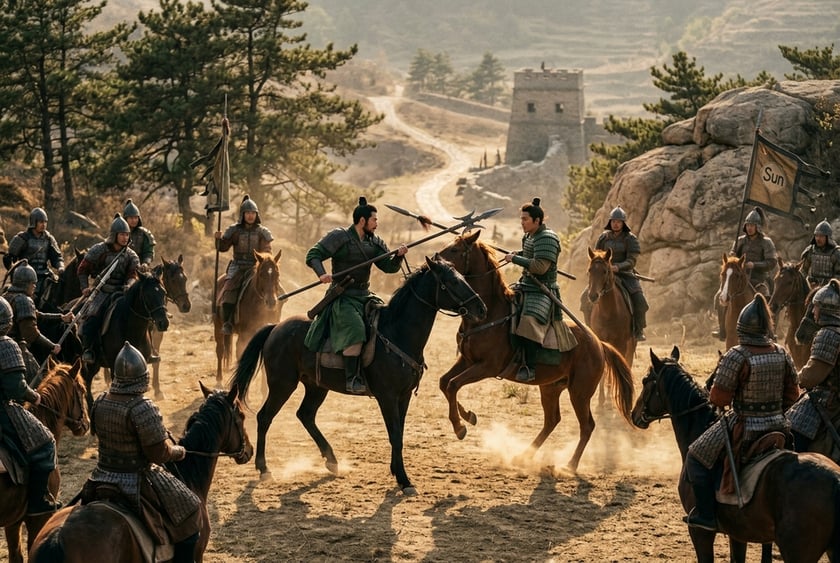
On the Wei side, Sima Yi formally took command of the entire Longxi front for the first time, appointed Zhang He as vanguard and superintended the main army, led his own main force into Qishan, and left forces to hold Shanggui; Guo Huai was separately assigned to defend the various commanderies of Longxi [c:17491]. The core of this deployment was to abandon outlying positions, concentrate the main force along the Qishan–Shanggui–Yongmei line, and use logistical superiority to fight a war of attrition. On the Shuhan side, Zhuge Liang positioned Jiang Wei, Wei Yan, Ma Dai, and Ma Zhong in four concealed positions — southeast, northwest, southwest, and northeast of the Lucheng wheat fields — while he himself led approximately one hundred men with fire catapults into the center of the wheat fields to wait [c:17492]. This "lure the enemy into the city, then close on four sides" was a thoroughly standard counter-siege tactic, transforming Lucheng from a contested position into a killing trap.
Key Decision Points
There were three key decision points. First, Zhuge Liang's selection of Lucheng as the site for the decisive battle. Lucheng combined water resources (suitable for drying grain in the intervals between fighting) with terrain (wheat fields to the east and west that could conceal ambushes), a typical Zhuge Liang integration of "military operations" with "economic mobilization." Second, Sima Yi's decision to attack Lucheng by night — his reasoning being "if we advance in daylight, the city will certainly be prepared; we can exploit the night" — a superficially reasonable choice that played directly into Zhuge Liang's anticipation. When Guo Huai's relief force arrived and both armies closed in, a volley of ten thousand crossbow bolts combined with an Shuhan inner-outer pincer drove Wei into a catastrophic defeat [c:17493]. Third, the Yong-Liang relief force arrived at forced-march speed but was struck by Shuhan forces before they had even finished making camp — "the Yong and Liang soldiers left corpses across the field, blood flowing in streams" [c:17494] — this engagement significantly reduced Wei's mobile reserve in Longxi.
But what truly determined the campaign's final outcome was Li Yan, far away in Yongan. Li Yan, charged with supervising grain transport, reported to the Later Ruler that grain had "already been delivered" when it had not, and then falsely told Zhuge Liang that "the supply line is becoming untenable — please withdraw." Zhuge Liang was compelled to pull back from a winning battlefield position, which was the campaign's greatest strategic loss. During the withdrawal, Zhuge Liang exploited the certainty that Wei would give chase, setting an ambush at Mumendao and killing Zhang He — Wei's last remaining grand-operational-level famous general — partially recovering the strategic damage.
Outcome and Echoes
On the tactical ledger the campaign was a major Shuhan victory: Lucheng shattered Sima Yi's forces, the Yong-Liang relief army was routed, and Mumendao killed Zhang He. On the strategic ledger, due to Li Yan's grain failure and Zhuge Liang's voluntary withdrawal, Shuhan again failed to translate tactical victory into actual territorial gain in Longyou. The echoes were primarily threefold. First, Sima Yi thereafter adopted a counter-strategy of "pull in forces, hold terrain, refuse battle," and his personal political standing within Wei actually became more secure because of "maintaining the front line despite this defeat." Second, Zhang He's death left Wei's western front without an independent-command veteran general; the younger generation — Guo Huai, Deng Ai, Chen Tai — was thereby pushed to the fore. Third, the Li Yan incident became the trigger for Zhuge Liang's reorganization of Shuhan's internal power balance between the "Yizhou faction" and the "Jingzhou faction" — Li Yan was stripped of rank and reduced to commoner status, and power in the Shuhan central government became further concentrated in Zhuge Liang's line, which directly affected the talent structure of Shuhan's later period.
Counterfactual Analysis
Had Li Yan not misreported, Zhuge Liang could have continued to advance from the winning position at Lucheng. The most realistic territorial gain would have been pushing the front north of Qishan and west of Shanggui, extending the Wudou–Yinping buffer into actual control over the southern half of Longyou. Had this route succeeded, Shuhan at the Wuzhangyuan phase would not have repeatedly spent Zhuge Liang's personal energy on the exhausting cycle of "long-range strike plus short-duration supply." He might have lived two to three years longer. A second counterfactual: had Zhang He not been killed at Mumendao, Wei's western command structure would not have been left with a vacuum, and many of Jiang Wei's later campaigns in Longyou — those that ended in "small gains that never built momentum" — might not have materialized. Disicibeifa stands as the most tactically brilliant yet strategically lamentable of Zhugeliangbeifa's five campaigns precisely because it most clearly illustrates how internal coordination failure can consume the fruits of battlefield victory. This is a textbook case — recurring in prolonged wars — of "internal politics being more lethal than the battlefield."