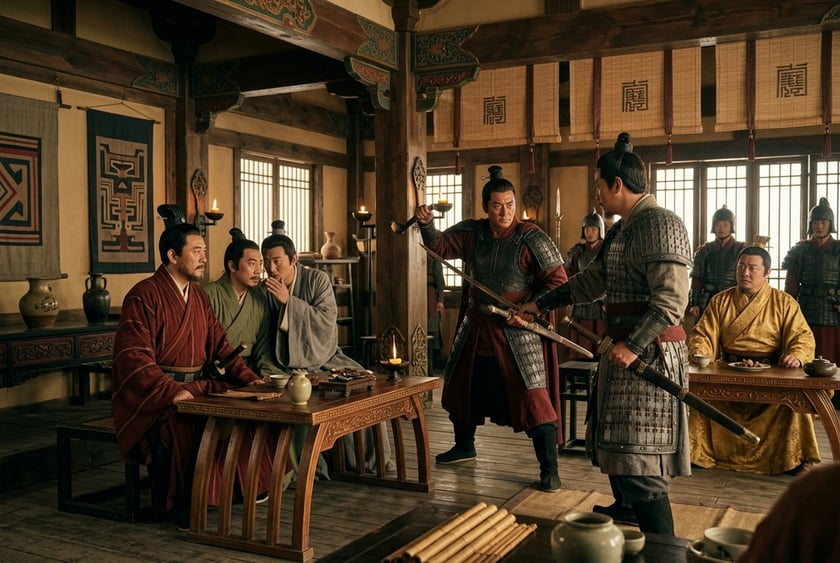
Strategic Background
As a modern military history analyst, understanding Zhuge Liang's Diyicibeifa requires placing it within the overall national policy of Shuhan — "attack as a form of defense." After Liu Bei's catastrophic defeat at Yiling and the deathbed commission at Baidicheng, Shuhan ranked last among the three San Guo powers in territory, population, and mobilizable manpower. When Zhuge Liang wrote in the Chu Shi Biao that "today the realm is divided in three and Yizhou is exhausted," this was no rhetorical flourish — it was a structural diagnosis. The northern campaign of the sixth year of Jianxing (228) was not a simple military adventure; it was an effort, during the window of Cao Rui's recent accession when frontier defenses were relatively relaxed, to seize the agricultural and pastoral resources of Longright, sever the connection between Guanzhong and Liangzhou, and fundamentally alter the curve of relative national power. The romance renders this strategic urgency through the shock felt in Cao Rui's court deliberations, with a border officer reporting that "Zhuge Liang leads a great army of over three hundred thousand, encamped at Hanzhong" — conveying the tremor [c:17461].
Dispositions of Both Sides
In the Shu army's deployment, Zhuge Liang used a typical "feint main axis, genuine secondary axis" structure: Zhao Yun and Deng Zhi advanced through Jigue as a decoy force, drawing Cao Zhen's main force to the Guanzhong front; meanwhile the main body took the Qishan road, sweeping through the three Longyou commanderies of Nan'an, Tianshui, and Anding. This deployment — using a secondary axis to pin the enemy while the main force delivers a flanking blow — carries paradigmatic significance in the mountain warfare of the Han-Wei-San Guo era. On the Wei side, Cao Zhen held overall command initially, having also deployed Xiahou Mao — who had no combat experience whatsoever — as the supervisor of all routes in the west; the romance dramatizes this personnel blunder by having Zhao Yun kill Han De and his sons at Fengming Mountain and ultimately capture Xiahou Mao alive [c:17462] [c:17463] [c:17468]. Cao Rui then changed appointments and sent Zhang He as vanguard — and only then was the Shu advance truly stopped.
Critical Decision Points
The pivot of victory and defeat in the entire northern campaign came down to two decisions. The first was Zhuge Liang's deployment of Ma Su. The tactical value of Jieting was simple: block the Longshan mountain passage and secure the depth of the three Longyou commanderies back toward Hanzhong. Ma Su, disregarding the sound principle of "establishing camp astride the road," took his army up the hill; Zhang He cut off his water supply and surrounded him; with water exhausted and troops in disarray, his force collapsed [c:17471]. The second decision was Zhuge Liang's rapid damage limitation after the Jieting collapse: rather than fighting on, he ordered a full retreat, abandoning the already-won commanderies of Nan'an, Tianshui, and Anding, containing the loss at the campaign level rather than the strategic level [c:17472]. This restraint of "better to lose territory than to sacrifice the core force" was the inescapable choice given Shuhan's national capacity.
In addition, Zhao Yun and Deng Zhi at Jigue did not achieve victory, but they were able to "withdraw without losing a single man or a single horse, with no loss of baggage and equipment either" [c:17471], preserving for Shuhan the backbone of its veterans — an undervalued critical decision.
Outcome and Reverberations
The campaign itself ended with Shuhan withdrawing, the defection of Jiang Wei, and the romance's theatrical episodes of rebuking Wang Lang. On the strategic ledger, Shuhan gained Jiang Wei and lost the three commanderies — net benefit close to zero. But the deeper impact has three dimensions: first, Wei was put on alert and began systematically strengthening its Guan-Long defenses; Zhang He and Guo Huai were fixed on the western front and never again had the opportunity to strike south into Shuhan; second, Zhuge Liang's self-demotion "to apologize to the people of the state" set a high benchmark for the rule of law in Shuhan politics [c:17472] — his treatment of Ma Su, the tearful execution, became for later generations the canonical example of "military law that makes no exception even for intimates"; third, the failure to achieve actual occupation of Longyou in the first northern campaign forced Zhuge Liang's subsequent four campaigns to repeatedly set out along the Qishan axis, producing a long-term war of attrition under the policy of "attacking as defense."
Counterfactual Analysis
If Jieting had been defended by Wei Yan or Wang Ping, how would the outcome have differed? Wang Ping had already earnestly remonstrated with Ma Su at Jieting about the need to camp astride the road; Wei Yan was an experienced area commander. Had either of them been in charge, the Shu army would very likely have held the Longshan screen and given Zhang He no opening to exploit. This would have given Zhuge Liang ample time to consolidate the three Longyou commanderies and turn them into a forward base for the northern campaigns — with Longshan as a shield and Longyou as a granary, Shuhan's strategic depth might have expanded in a truly fundamental way. A second counterfactual: if Emperor Ming of Wei had continued to trust Xiahou Mao without recalling Zhang He in time, the Shu army might have extended further into the Liangzhou direction. But neither of these counterfactuals can obscure an underlying problem: Shuhan's national capacity was inherently incapable of sustaining a prolonged occupation of the distant Longyou. The "unfulfilled achievement" of the first northern campaign, rather than being attributed solely to Ma Su's individual error, is better understood as the structural ceiling of national power becoming visible for the first time.