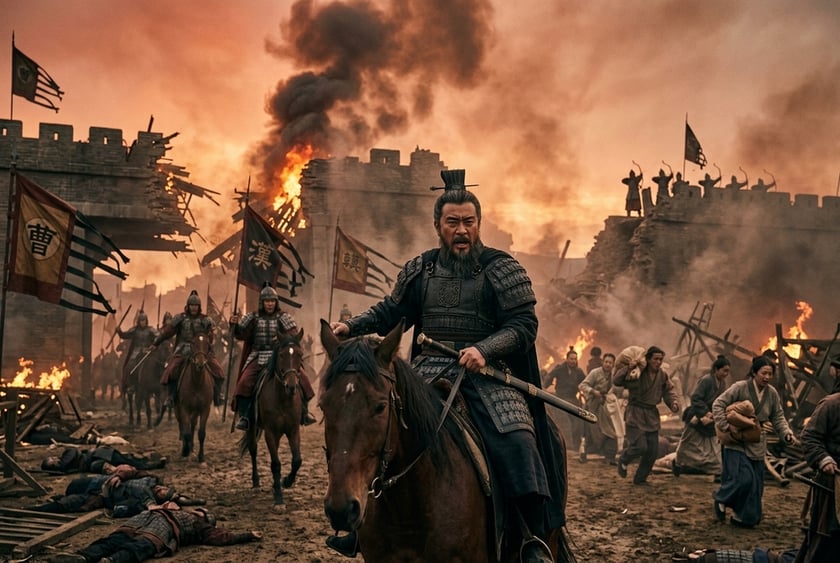
Strategic Background
The Battle of Mumendao in the ninth year of Jianxing (231) occurred at the tail end of Zhuge Liang's fourth northern campaign (Disicibeifa). The offensive had opened favorably for Shuhan — Zhuge Liang seized Wei's grain harvest at Shangyi before the enemy could, set an ambush that routed Guo Huai's main force, and in the fifth month won a major engagement against Sima Yi near Lucheng. Yet Shuhan's underlying national strength could not sustain a prolonged field army, and with Li Yan's poor management of the supply system causing a crisis on the grain road, Zhuge Liang was forced to withdraw in autumn. The withdrawal itself was fragile: an army that had already gained the upper hand, if caught in the rear by the pursuing enemy, risked seeing all its earlier victories turn to nothing. The core question of this battle was therefore "how to protect oneself during the retreat while inflicting the most decisive possible loss on the pursuer" — discouraging any easy follow-up.
Deployments
The Shuhan deployment had three layers. The first was a feigned retreat to lure the enemy: Kong Ming (Zhuge Liang) ordered every camp broken in succession, creating the appearance of a full withdrawal, but each move covered only thirty li. Sima Yi sent scouts and personally disguised himself among the troops to observe, confirmed that the Shuhan army was withdrawing in stages, yet still judged that "this is Kong Ming's stratagem — do not pursue". The second layer was a secret order to Ma Zhong and Yang Yi to take ten thousand crossbowmen to the hillsides flanking Mumendao near Jiange and prepare an ambush, awaiting the signal cannon before rolling down timber and boulders and loosing ten thousand crossbow bolts simultaneously. The third layer put Wei Yan and Guan Xing on rear-guard duty, with flags left on the walls and brushwood stacked inside to burn as smokes, creating the illusion of an "empty-city retreat". On the Wei side, Sima Yi and Zhang He were at odds over the response: Sima Yi favored not pursuing, fearing an ambush in the defiles; Zhang He in his capacity as vanguard requested to fight, arguing that "when the moment comes to win merit, I am not to be used," and repeatedly pleaded to be allowed to advance at the cost of his own life. Sima Yi eventually agreed with reluctance, ordering Zhang He to lead five thousand troops ahead, Wei Ping to follow with twenty thousand infantry and cavalry, and keeping three thousand troops under his own command as a rear support.
Key Decision Points
The outcome of this battle turned on two decisions. The first was Sima Yi's "veto-and-hesitate" behavior — he had in fact correctly predicted that the defiles would contain an ambush and repeatedly tried to dissuade Zhang He, but in the end never issued a hard prohibition. This is one of the rare cases in Sima Yi's life where he made the right judgment but compromised in execution, and the result was the loss of one of Wei's most important vanguard commanders. The second decision was Zhang He's own stubbornness: as a veteran vanguard general, he had been angered by Sima Yi's days of inaction and was convinced that this pursuit was his last chance at merit, dismissing every warning about the defiles entirely. The novel captures this mindset with striking clarity: "I already understand the situation — there is no need for concern," and "A true man gives his life for his country; even ten thousand deaths bring no regret". Behind this lay both the pride of a famous general and the anxiety of a Caowei veteran watching Sima Yi consolidate military authority at his expense. Once Zhang He abandoned rational judgment and entered Mumendao, the tactic of Wei Yan and Guan Xing luring him forward with successive feigned defeats took effect — Shuhan troops deliberately discarded armor, clothing, and equipment to litter the road, causing Wei troops to stop and scramble for the spoils, further disrupting the pursuit's momentum.
Outcome and Echoes
At dusk Zhang He pursued as far as the mouth of Mumendao. Wei Yan executed one final feigned retreat into the valley; Zhang He leveled his spear and drove his horse straight in. A cannon fired from the hillside, firelight blazed to the sky, and from both slopes timber, stone, and brushwood tumbled down to seal the path in and out. Ten thousand crossbows fired simultaneously, and Zhang He together with more than a hundred of his officers was shot dead in the gorge. When Wei's rear-echelon troops arrived, Zhang He was already dead, the withdrawal route was blocked, and they could only rein in and fall back. Zhuge Liang appeared in person on the hilltop through the firelight and called down to the Wei troops: "Tell Zhongda that sooner or later he will be taken by me" — one of the most ceremonially charged victory moments in the novel's account of Shuhan's northern campaigns. Sima Yi "grieved without end, sighing to heaven," and the Wei ruler Cao Rui wept as he ordered a lavish burial for Zhang He. In terms of strategic consequence, Zhang He's death meant that Caowei lost the most experienced western-front commander in the long contest with Zhuge Liang; during the standoff at Wuzhangyuan, Wei troops moved further toward "passive defense," ceding battlefield initiative to Shuhan even more completely. At the political level, Sima Yi's death effectively completed his monopoly over Wei's western-front command after Zhang He's fall — Cao Zhen was already dead, Zhang He now gone, and the remaining generals were mostly promoted by or personally loyal to Sima Yi. This chain of personnel changes leads directly to the Gaopinglingzhibian twenty years later.
Counterfactual Analysis
If Sima Yi had forcibly prohibited Zhang He from pursuing after detecting the ambush, could he have avoided this loss? Almost certainly yes — given Sima Yi's seniority and authority, a single firm order would have stopped Zhang He in his tracks. Yet Sima Yi did not act, possibly for three reasons. First, as an outsider commander-in-chief, he had to accommodate the face of veterans like Zhang He from the Caowei old guard. Second, he may have hoped to exploit the opportunity by letting Zhang He volunteer to advance: whether Zhang He won or lost, the result would serve Sima Yi's interests — victory benefited the whole army, defeat eliminated a senior figure whose potential influence could threaten Sima Yi's own future grip on power. Third, though the novel does not spell it out, viewed in light of Sima Yi's later pattern of "feigning illness — lying low — a single decisive strike" leading to the coup, the Mumendao incident may well have been an early experiment in what his political life would later call "using another's blade." If that inference holds, Zhang He's death was historically significant not merely as a successful tactical ambush, but as a pivotal node at which the Simashi quietly completed the dismantling of the Caowei veteran-general network — a step toward dominance in both military and political terms.