Background
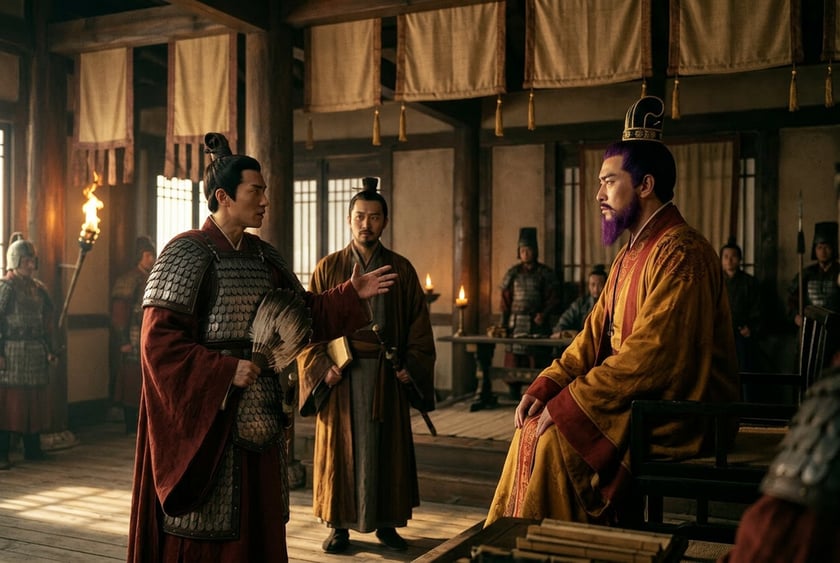
The first northern campaign of 228 CE was the first concrete step in the "defend by attacking" strategy that Zhuge Liang had spent years preparing. Shuhan had only recently recovered from the fragility left by the defeat at Yiling and the early years of Liu Chan's reign, and urgently needed a foreign victory to rebuild domestic confidence. On the Wei side, Cao Zhen had replaced Xiahou Mao as supreme commander of the western theater, and the new generation of Wei commanders — Cao Zhen, Guo Huai, Zhang He — had formally taken the stage, while the senior statesman Wang Lang accompanied the army in his capacity as Minister over the Masses [c:16685]. Strategically, this was the first direct probing clash between Shu and Wei in the Longyou region, with both sides gambling that the other would be half a step too slow to respond. The Romance frames the opening of this campaign as a debate over political legitimacy.
Key Figures
In the novel Wang Lang is portrayed as the archetype of a "Han dynasty elder who switched allegiances": he had entered officialdom in his youth through the examination for filial and incorrupt candidates and should by rights have "supported his sovereign and aided the state," yet he ultimately served the Cao clan's usurpation of Han — exactly the type Zhuge Liang denounces as one who "served Han while assisting traitors" [c:16686]. Zhuge Liang, acting under Liu Chan's edict, presents himself as spokesman for "the legitimate line of Han." Cao Zhen and Guo Huai are little more than background figures in this episode — their decision to let Wang Lang serve as debater already reflects Wei's underestimation of Shu's military capability, treating the first encounter as a political problem solvable by rhetoric.
Core Issues
The argument Zhuge Liang advances can be unpacked into three layers. First, the political collapse since emperors Huan and Ling was not the will of Heaven but a man-made disaster jointly caused by eunuchs and powerful ministers. Second, Wang Lang, as a Han official, not only failed in his duty to "rectify and restore" but actively participated in "conspiring in the usurpation." Third, the founding emperor Liu Bei (the Glorious Progenitor) perpetuated the Han line by establishing his rule in the western Shu, and it is this continuity that gives today's northern campaign its political legitimacy [c:16686]. This argument is not designed to persuade Wang Lang himself; it is written for the Shu officers and soldiers and for future readers — it anchors the military action in the moral framework of "chastising traitors and restoring Han," transforming the northern campaigns from mere territorial expansion into a form of limited "political restoration."
Political Consequences
In the Romance's narrative, Wang Lang's death on the spot symbolises the complete failure of the moral justification for Wei's supplanting of Han when confronted by Zhuge Liang, and the Shu army's morale is ignited. Yet the novel does not let Shu achieve immediate military success: the subsequent episodes of Ma Su's loss of Jieting and the abrupt collapse of the first northern campaign follow quickly, signalling that the author has no intention of presenting "talking Wang Lang to death" as a tactical victory. Rather, it is positioned as a spiritual milestone of "moral victory amid tactical defeat." This treatment is entirely consistent with Zhuge Liang's overarching image in the Romance — repeatedly campaigning north, repeatedly failing to win, yet always revered as the legitimate standard-bearer.
Counterfactual Analysis
If we strip away the Romance's dramatic lens, the real pivotal factors of the first northern campaign were the actual deployments at Jieting, Shangui, and Chencang, not a debate in front of the battle lines. In historical fact, Wang Lang as Minister over the Masses was based in Luoyang, where he participated in court deliberations and ceremonial matters; he could not have accompanied the army to Qishan, and his actual engagement with the first northern campaign was likely limited to memorials of advice or letters urging surrender. In other words, the true literary function of this episode is to give Zhuge Liang, within the universe of the Romance, a complete "victory of reason over argument," compensating for the fact that in orthodox history his repeated campaigns never achieved their strategic objectives. When readers evaluate this passage they should treat it as the Romance's concentrated statement on the contest of legitimacy between Han and Wei, not as factual reportage at the level of historical sources.