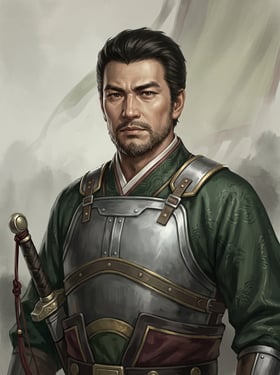
Historical Record
Wen Qin, styled Zhongruo, was a man of Qiao commandery. His father Wen Ji was a cavalry general during the Jian'an era, renowned for his valor and strength. In his youth Wen Qin became famous both as the son of a renowned general and for his own martial prowess. During Wei Feng's Conspiracy, Wen Qin was implicated through words exchanged with Wei Feng, arrested and imprisoned, and subjected to several hundred lashes; he should have been put to death, but Cao Cao, mindful of Wen Ji, pardoned him. During the Taihe era, Wen Qin served as supervising commander of the Five Camps, and later took up the post of Gate General. His temperament was harsh, violent, and discourteous; in his postings he often acted arrogantly toward superiors, disregarded official law, and was repeatedly impeached and recalled. Emperor Ming once kept him in check, but later appointed him Gate General of Huainan, then transferred him to Grand Administrator of Lujiang and General Who Soars Like a Hawk. Wang Ling once memorialized that Wen Qin was greedy and cruel and unfit to guard the frontier, requesting that he be stripped of office and punished. Wen Qin was therefore summoned back to court. Because Cao Shuang was his fellow townsman, Cao Shuang treated him generously and did not pursue his faults. Afterward, Wen Qin was sent back to Lujiang, with the additional title of General Who Conquers the Army, more favored than before. Wen Qin thus grew all the more arrogant and overbearing, fond of self-praise, exalting himself for his valor, and won considerable empty renown among the three armies. After Cao Shuang was executed, Wen Qin was promoted to General of the Van to placate him, and later succeeded Zhuge Dan as Inspector of Yang Province. Ever since Cao Shuang's death, Wen Qin lived in constant fear, and being on poor terms with Zhuge Dan, he had no one to confide in. When Zhuge Dan was transferred away and Guanqiu Jian arrived, Wen Qin secretly allied with Guanqiu Jian. c:5492
In the first month of the second year of Zhengyuan (255), Guanqiu Jian and Wen Qin raised troops at Shouchun in revolt against Sima Shi. Sima Shi led a great army to suppress them, dispatching Zhuge Dan to command the various forces of Yu Province and advance from Anfeng Ford to Shouchun, and Hu Zun to command the forces of Qing and Xu Provinces and move out between Qiao and Song, so as to cut off the retreat of Wen Qin and his men. Sima Shi encamped at Ruyang and ordered Wang Ji to lead the vanguard forces to hold Nandun. The Wei army held firm and would not give battle; Guanqiu Jian and Wen Qin, caught between advancing and retreating, feared that Shouchun would be raided and were at their wits' end. Most of the Huainan officers and men were northerners, and morale fell apart, with defectors coming continuously; only the newly attached Huainan peasants were of use to them. Sima Shi dispatched Deng Ai, Inspector of Yanzhou, to lead more than ten thousand men of the Mount Tai forces to Lejia, feigning weakness to lure them. Not realizing it was a trap, Wen Qin indeed led his troops by night to attack Deng Ai's force. At dawn, seeing the great strength of Sima Shi's army, Wen Qin withdrew his troops. Sima Shi loosed his crack cavalry in pursuit, routing Wen Qin's army, and Wen Qin fled. c:2040 When Guanqiu Jian heard of Wen Qin's defeat, he fled in fear that very night, and his whole army scattered. Wen Qin finally fled into Wu, where the Eastern Wu regime appointed him Protector-General, Bearer of the Staff of Authority, Grand General Who Guards the North, Governor of You Province, and Marquis of Qiao. c:5492 Two years later, when the Wei generals Guanqiu Jian and Wen Qin rebelled and fought the Wei army at Lejia, Sun Jun led Lü Ju and Liu Zan to raid Shouchun; coinciding with Wen Qin's defeat and surrender, the Wu army then withdrew. c:5493
In the Novel
In Romance of the Three Kingdoms, Wen Qin is portrayed as a brave and skilled fighter, but coarse and fierce in temperament and given to self-aggrandizement. He first appears in Chapter 109, raising troops together with Guanqiu Jian against Sima Shi's deposition and enthronement of rulers. c:5494 In the novel, the alliance of Wen Qin and Guanqiu Jian seems more active and righteously indignant. Wen Qin, because Cao Shuang had been killed by Sima Yi, wished to avenge Cao Shuang, and his son Wen Yang (known in history as Wen Chu, childhood name Yang) possessed valor that ten thousand men could not withstand and often longed to kill the Sima brothers. c:2041 The episode of Wen Qin and his son making a night raid on Sima Shi's main camp outside the city of Lejia is depicted in detail, with Wen Yang's valor especially prominent: he charged about alone amid the Wei camp, throwing the Wei army into alarm, while Wen Qin, failing to respond in the later stage, could not form an encirclement. c:10993 This episode is only briefly recorded in the histories, which do not mention Wen Yang's specific actions, much less his solo charge through the lines. In the novel, after Wen Qin's defeat, the Wei palace colonel Yin Damu (in history a household servant of the Cao clan acquainted with Wen Qin) pursued Wen Qin to try to persuade him to surrender. Yin Damu knew Sima Shi was about to die and in fact wished to keep Wen Qin, but Wen Qin did not understand his meaning and instead cursed him fiercely, wishing to shoot Yin Damu dead. c:5495 Though this detail is recorded in the histories, the novel, through Yin Damu's inner monologue, gives it a deeper meaning. Wen Qin finally went over to Eastern Wu, where Sun Jun treated him generously. c:5495 Later, during Zhuge Dan's revolt at Shouchun, Wen Qin again faced Sima Zhao as a guide for the Eastern Wu relief force. c:5496 When Shouchun was besieged and its provisions nearly gone, Wen Qin advised Zhuge Dan to release the northern troops to save grain, but Zhuge Dan misunderstood this as a plot against himself and in the end had Wen Qin dragged out and beheaded. c:2043 The histories do not clearly record that Wen Qin was killed by Zhuge Dan, but rather that Wen Qin and his sons were killed by Zhuge Dan. In the novel, when Wen Yang and Wen Hu saw their father killed, they vaulted over the moat and surrendered to Sima Zhao, who pardoned them and granted them rank—an episode that also diverges from the histories, in which it was after Wen Qin was killed that his sons Wen Yang and Wen Hu led their men to surrender to Wei. c:2043
Key Relationships
* Sima Shi: Wen Qin's chief adversary; in the revolt of Guanqiu Jian and Wen Qin, Wen Qin raised troops against Sima Shi's autocratic deposition and enthronement of rulers. c:2040 (In the novel, Wen Qin further wished to avenge Cao Shuang, whom Sima Shi had killed.) c:2041
* Eastern Wu: The regime Wen Qin went over to after his defeat, which appointed him Protector-General, Bearer of the Staff of Authority, Grand General Who Guards the North, Governor of You Province, and Marquis of Qiao. c:5492
* Cao Wei: The regime Wen Qin originally served, having received favors from the Cao clan, but he rebelled because of Sima Shi's autocracy. c:5492
* Wen Yang (known in history as Wen Chu, childhood name Yang): Wen Qin's son, who fought alongside his father in the revolt of Guanqiu Jian and Wen Qin and surrendered to Eastern Wu together with him after their defeat. c:2040 (In the novel, Wen Yang is portrayed as a man of peerless valor who made a night raid on the Wei camp outside Lejia.) c:10993
* Guanqiu Jian: Wen Qin's ally when he raised troops against Sima Shi. c:2040
* Zhuge Dan: After Wen Qin went over to Wu, he held Shouchun together with Zhuge Dan as a member of the Wu relief force, but was finally killed by Zhuge Dan. c:2043
* Cao Shuang: Wen Qin was once a retainer of Cao Shuang and was treated generously by him; after Cao Shuang was executed, Wen Qin lived in constant inner fear. c:5492 (In the novel, an important reason for Wen Qin's uprising was to avenge Cao Shuang.) c:2041
Iconic Scenes
* Raising troops at Shouchun against Sima Shi: Wen Qin, together with Guanqiu Jian, raised troops at Shouchun against Sima Shi's autocracy—an important turning point in his political career. c:2040
* Night raid on the Wei army at Lejia: Wen Qin led troops in a night raid on Sima Shi's main camp; though ultimately defeated, this battle displayed his valorous side. (In the novel, Wen Yang showed astonishing valor in this battle, charging through the lines alone, becoming a classic scene of the novel.) c:10993
* Going over to Eastern Wu: After his defeat, Wen Qin chose to go over to Eastern Wu, where he was given heavy office by the Wu regime, finding his home in a foreign land. c:5492
* Killed within the city of Shouchun: During Zhuge Dan's revolt at Shouchun, Wen Qin, for disagreeing with Zhuge Dan, was finally killed by him, ending his stormy life. c:2043
* Yin Damu's attempt at persuasion: After Wen Qin's defeat, Yin Damu pursued him and tried to persuade him to surrender, but Wen Qin did not understand his meaning and instead wished to shoot him. This scene highlights Wen Qin's harsh and discourteous temperament. c:5495
Portrait file
Character profile
- Character
- Wen Qin was valiant and coarsely fierce, harsh and unmannered by nature, boastful and self-aggrandizing. He had courage but no strategy.
- Life
- Wen Qin was a man of Qiao Commandery, and had once been a retainer in Cao Shuang's household. In the second year of Zhengyuan he rose in arms against Wei together with Guanqiu Jian; after his forces were defeated he took refuge with Eastern Wu. Later he was killed by Zhuge Dan within the city of Shouchun.
- Anecdotes
- Wen Qin once served as Inspector of Yangzhou and General of the Van, and was later appointed by Eastern Wu as Grand General Who Chastises the North. He once feigned defection to lure Zhu Yi, and persuaded Sun Jun to campaign against Wei.
Relationships
16 relationships
Quotes
4 recorded lines · 2 featured
「都督鎮守方面,若肯仗義討賊;欽願捨死相助。欽中子文淑,小字阿鴦,有萬夫不當之勇,常欲殺司馬師兄弟,與曹爽報讎:今可令為先鋒。」
This line reveals Wen Qin's deep-seated hatred for the Sima clan, shaping his vivid image as loyal to Cao and opposed to Sima.
「都督勿憂。我與拙子文鴦,只消五千兵,敢保樂嘉城。」
This line highlights the valor of Wen Qin and his son, laying the groundwork for Wen Yang's night raid on Sima Shi, and is charged with dramatic tension.
Chapters7 回 ▸
- 史ch.28ch.56ch.64
- 演ch.109ch.110ch.111ch.112
Relationship timeline8 条 ▸
Inner monologues · AI-generated3 段 ▸
- I am Wen Qin; my courtesy name cannot be determined from this passage. Today, after our defeat at Lejia, my men scattere
- I am Wen Qin, courtesy name Zhongruo. I now reside in Wu, holding the appointments of Protector, Acting Staff of Authori
- There is little to say of my name. I served as Inspector of Yangzhou during a time when upheaval suddenly engulfed the W
Life events11 ▸
- 0253-01-01 · JianyeSun Jun and Sun Chen's Domination of Wu
- 0255-01-01 · ShouchunSun Jun's Attack on Shouchun
- 0255-01-01 · TuogaoWen Qin Flees from Huainan to Wu· Commander
- 0255-01-01 · LejiaWen Yang Single-handedly Repulses the Wei Army· Commander
- 0255-01-01 · ShouchunRebellion of Guanqiu Jian and Wen Qin· Commander
- 0255-01-01 · ShouchunRebellion of Guanqiu Jian and Wen Qin· Commander
- 0257-01-01 · ShouchunZhuge Dan Raises Shouchun in Rebellion· Warrior
- 0258-01-01 · ShouchunThree Rebellions in Shouchun· Instigator
- 0258-01-01 · ShouchunBattle of Shouchun (Wu Aids Zhuge Dan)· Killed in action
- 0258-01-01 · LuoyangZhuge Dan's Rebellion· Killed in action
- 0258-01-01 · ShouchunZhuge Dan Holds Shouchun and Rebels against Wei· Killed in action