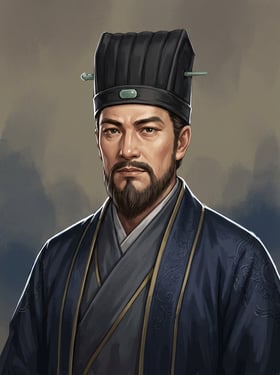
Historical Record
Jiang Ji, courtesy name Zitong, was a native of Ping'a in the state of Chu. He first held office as a commandery accounts clerk and then as provincial Aide. In the thirteenth year of Jian'an (208 CE), Sun Quan led his host to besiege Hefei. At the time Cao Cao's main army was campaigning in Jing Province and had met with pestilence; he dispatched only the general Zhang Xi with a thousand cavalry, who took over the Runan troops to relieve the siege, but Zhang Xi's force too was much troubled by pestilence. Jiang Ji therefore secretly reported to the Inspector, falsely claiming to have received a letter from Zhang Xi stating that forty thousand foot and horse had reached Yulou, and sent a registrar to welcome Zhang Xi. He dispatched three parties of messengers carrying letters to inform the defenders within the city; one party got into the city, while the other two were captured by the enemy. Sun Quan, taking it for true, hastily burned his siege-works and withdrew, and the city of Hefei was preserved c:6172.
The next year, Jiang Ji went as envoy to Qiao county, where Cao Cao asked him about relocating the people of Huainan. Jiang Ji held that, although the people cherished their land and were loath to move, failing to move them risked losing the territory. Cao Cao, however, did not heed his advice, and as a result more than a hundred thousand people in the Jiang-Huai region fled in alarm to Wu territory. When Cao Cao later saw Jiang Ji, he laughed heartily over the matter and appointed Jiang Ji Administrator of Danyang c:6172.
After Cao Cao returned from his southern campaign, he made Wen Hui Inspector of Yang Province and Jiang Ji his Aide. Cao Cao once said: "Could Jiang Ji really have done such a thing [plotting rebellion]! If he had, then I am no judge of men. This must be foolish commoners who delight in disorder, falsely implicating him." And he urged that the matter be cleared up c:3197. When Guan Yu besieged Fan and Xiangyang, Cao Cao wished to move the capital; Sima Yi and Jiang Ji remonstrated, pointing out that the flooding of Yu Jin and the others was not a defeat in battle, and that since Liu Bei and Sun Quan were outwardly close but inwardly estranged, Sun Quan would surely be displeased to see Guan Yu succeed. They advised sending someone to urge Sun Quan to seize Guan Yu's rear, promising to cede the lands south of the Yangtze to enfeoff Sun Quan, whereupon the siege of Fan would lift of itself. Cao Cao adopted their counsel, and Sun Quan indeed seized Gong'an and Jiangling, and Guan Yu was thereupon captured c:3197.
After Emperor Wen Cao Pi took the throne as King, Jiang Ji was transferred to Chief Clerk of the Chancellor. After Cao Pi became emperor, Jiang Ji was appointed General of the Household of the East. Jiang Ji asked to remain in his post, and Cao Pi decreed: "Gaozu sang, 'Where shall I find brave warriors to guard the four quarters!' The realm is not yet at peace; we must have good ministers to secure the frontiers." Later Jiang Ji presented his *Discourse on Myriad Affairs* (Wanji lun), which won Cao Pi's deep approval, and he entered the court as Cavalier Attendant-in-Ordinary. Cao Pi once issued an edict to the General Conquering the South, Xiahou Shang, saying that he might "wield authority and dispense favor, kill men and spare men." After Jiang Ji entered court, Cao Pi asked him about the moral tenor of the realm, and Jiang Ji bluntly replied that "I see only the words of a doomed state," pointing out that "wielding authority and dispensing favor" was a clear admonition in the Documents, and that "the Son of Heaven does not jest" was a thing the ancients took care over; Cao Pi was thereby brought to understanding and sent a man to recall the earlier edict c:6173.
In the third year of Huangchu (222 CE), Jiang Ji followed the Grand Marshal Cao Ren in a campaign against Wu, making a separate raid on Xianxi. Cao Ren wished to attack the midstream sandbar of Ruxu, but Jiang Ji remonstrated, holding that "the foe holds the west bank with ships ranged upstream, while our troops go into the sandbar—this is to deliver ourselves into hell, a road to peril and ruin." Cao Ren did not heed him, and was indeed defeated. After Cao Ren's death, Jiang Ji again held the post of General of the Household of the East, taking over command of his troops. Cao Pi decreed: "You combine the gifts of the civil and the martial, high-minded and resolute in spirit, ever harboring the ambition to vault the rivers and lakes and swallow up the lands of Wu, and so I again entrust you with the charge of a commander." Before long, Jiang Ji was summoned to be a Master of Writing. When the imperial carriage visited Guangling, Jiang Ji submitted a memorial pointing out that the waterways were hard to pass, and presented his *Discourse on the Three Provinces* (Sanzhou lun) to remonstrate with Cao Pi. Cao Pi did not heed him, and as a result several thousand warships were stranded and could not move. Jiang Ji further advised against opening military farms on the spot, and Cao Pi adopted this. When the imperial carriage on its return reached Jinghu, the waters were running dry, and Cao Pi handed all the ships over to Jiang Ji. Jiang Ji dug four or five channels to gather the ships, built earthen barriers in advance to dam the lake's waters, and drew the rear ships into the Huai. After Cao Pi returned to Luoyang, he greatly praised Jiang Ji, saying: "Henceforth, in plans for attacking the foe, give them good thought and discuss them well" c:13408.
After Emperor Ming Cao Rui took the throne, Jiang Ji was granted the rank of Marquis Within the Passes. When the Grand Marshal Cao Xiu led troops to attack Wan, Jiang Ji submitted a memorial holding that "to penetrate deep into enemy territory and face Sun Quan's crack troops, while Zhu Ran and the others lie upstream pressing on Cao Xiu's rear—I do not see the advantage in it." Later Cao Xiu's army was defeated, and Jiang Ji was promoted to Central Protector of the Army c:13409. During the Taihe era, Jiang Ji once submitted a memorial advising that the ancient rite of the Feng and Shan sacrifices be followed; on hearing it, Cao Rui said, "It makes the sweat run to my feet," and the matter was dropped c:13413.
In the tenth year of Zhengshi (249 CE), Jiang Ji followed the Grand Tutor Sima Yi to encamp at the floating bridge over the Luo River and put to death Cao Shuang and his party. When the affair was accomplished, Jiang Ji was advanced to Marquis of a Capital District, with a fief of seven hundred households. Jiang Ji submitted a memorial firmly declining, holding that "in counsel I had no prior knowledge, and in battle I led no men," and that he ought not to receive such a reward undeserved, but he was not permitted. That year Jiang Ji died, with the posthumous title of Marquis Jing c:3198.
In the Novel
In *Romance of the Three Kingdoms*, Jiang Ji's image is concentrated in a few key historical events and is given a greater coloring of strategy and remonstrance. When Guan Yu besieged Fan, Cao Cao wished to move the capital to avoid his edge. At this point Sima Yi offered a plan, pointing out that Sun and Liu were at odds and that an envoy could be sent to contact Sun Quan, promising him the lands south of the Yangtze to make him seize Guan Yu's rear. Jiang Ji seconded this from the side, saying: "Zhongda's words are right. We can at once dispatch an envoy to Eastern Wu; there is no need to move the capital and stir the multitude." c:3201 This episode broadly matches history, but Jiang Ji's part in the novel is relatively small, appearing mainly as a seconder of Sima Yi's plan.
When Sima Yi launched the Incident at the Gaoping Tombs, Jiang Ji played an important role. When Sima Yi learned that Huan Fan had left the city, fearing he would offer counsel to Cao Shuang, Jiang Ji reassured him: "A worn-out horse pines for its stable-fodder—Cao Shuang surely cannot make use of him." c:13402 He meant that Huan Fan coveted Cao Shuang's bounty and would not truly scheme for him. Sima Yi then sent Xu Yun and Chen Tai to persuade Cao Shuang, and had Jiang Ji write a letter, carried by Yin Damu to Cao Shuang, stating that Sima Yi and Jiang Ji had sworn by the Luo River that they sought only to strip away his military authority and intended nothing more c:13402. In the novel, this act of Jiang Ji's directly brought about Cao Shuang's surrender; but the *Shiyu* records that Jiang Ji was troubled by the breach of faith in his words, fell ill, and died—something the novel does not clearly mention, instead portraying Jiang Ji as a firm supporter of Sima Yi c:3198.
After Sima Yi put Cao Shuang to death, the Grand Commandant Jiang Ji proposed: "There are still Lu Zhi, Xin Chang, who hewed through the gate-bars and broke out, and Yang Zong, who seized the seal and would not yield it up—none of them should be let go." But Sima Yi held that "each acted for his own master; they are righteous men," and restored them to their former posts c:3202. This episode highlights Sima Yi's magnanimity while also showing Jiang Ji's stern attitude in handling political enemies, consistent with the loyal, upright, daringly remonstrating character of the historical Jiang Ji, though the histories do not clearly record any such specific words of his on the matter.
Key Relationships
* Cao Wei (serves): Jiang Ji served the Cao Wei regime loyally throughout his life, entering office in Cao Cao's time and passing through the reigns of Cao Pi and Cao Rui down to the time of Cao Fang, rising to Grand Commandant; he was an important strategist and general of Cao Wei c:6171.
* Sima Yi (friend_of): At crucial moments, Jiang Ji repeatedly cooperated with Sima Yi, planning together on behalf of Cao Wei. Especially in the Incident at the Gaoping Tombs, Jiang Ji was an important supporter and planner for Sima Yi, joining him in putting Cao Shuang to death c:3198.
* Cao Shuang (enemy_of): In the Incident at the Gaoping Tombs, Jiang Ji, together with Sima Yi, overthrew Cao Shuang's power, and was his chief political adversary c:3198.
* Wen Hui (advises_in): Jiang Ji was once sent back to Yang Province by Cao Cao to serve as Wen Hui's Aide. Cao Cao praised Wen Hui as "well-versed in military affairs" and charged generals such as Zhang Liao and Yue Jin to "consult with Wen Hui in all movements," which shows that during their service together in Yang Province, Jiang Ji as Aide must have given much assistance in military and administrative matters c:3199.
* Cao Cao (serves): Jiang Ji came to prominence under Cao Cao; in the siege of Hefei, the relocation of the Huainan people, Guan Yu's siege of Fan, and other events, he repeatedly offered counsel to Cao Cao and won his deep trust and esteem c:6172.
* Cao Pi (serves): After Cao Pi took the throne, Jiang Ji continued to be employed in important posts, serving as Chief Clerk of the Chancellor, General of the Household of the East, Cavalier Attendant-in-Ordinary, Master of Writing, and others. He presented his *Discourse on Myriad Affairs*, remonstrated against Cao Pi's words about "wielding authority and dispensing favor," and repeatedly offered important counsel in military operations, winning Cao Pi's high praise c:6173.
* Cao Rui (serves): In the reign of Emperor Ming Cao Rui, Jiang Ji was granted the rank of Marquis Within the Passes and continued to play a role at court, offering counsel on such matters as Cao Xiu's attack on Wan and the Feng and Shan sacrifices c:13409.
* Huan Fan (enemy_of): In the Incident at the Gaoping Tombs, Huan Fan tried to offer counsel to Cao Shuang, while Jiang Ji held that "a worn-out horse pines for its stable-fodder—he surely cannot make use of him," implying that Huan Fan was no cause for worry, and standing as his political opposite (novel only) c:13402.
Iconic Scenes
* Relieving the siege of Hefei: In the thirteenth year of Jian'an, Sun Quan besieged Hefei. Jiang Ji forged a letter from Zhang Xi, falsely claiming that relief was about to arrive, and made Sun Quan believe it, so that he hastily withdrew his troops and the siege of Hefei was lifted—displaying his exceptional resourcefulness c:6172.
* Remonstrating against Cao Cao's plan to move the capital: When Guan Yu besieged Fan and Xiangyang, Cao Cao wished to move the capital to avoid his edge. Jiang Ji, together with Sima Yi, remonstrated with Cao Cao and put forward the strategy of allying with Wu against Guan Yu, ultimately bringing about Guan Yu's downfall, which showed his far-reaching strategic vision c:3197.
* Remonstrating against Cao Pi's "wielding authority and dispensing favor": Cao Pi once decreed to Xiahou Shang that he might "wield authority and dispense favor, kill men and spare men." Jiang Ji bluntly declared this to be "the words of a doomed state," and pointed out that "wielding authority and dispensing favor" was a clear admonition in the Documents and that "the Son of Heaven does not jest" was a thing the ancients took care over, prompting Cao Pi to withdraw the order—embodying his loyal, upright, daringly remonstrating character c:6173.
* Remonstrating over the Guangling waterway: When Cao Pi's carriage visited Guangling, Jiang Ji submitted a memorial pointing out that the waterway was hard to pass, and presented his *Discourse on the Three Provinces* to remonstrate. Cao Pi did not heed him, and as a result the warships were stranded. Jiang Ji then cleverly dug channels to draw off the water, enabling the ships to enter the Huai, displaying his outstanding engineering skill and adaptability c:13408.
* The Incident at the Gaoping Tombs: Jiang Ji followed Sima Yi to encamp at the floating bridge over the Luo River and took part in putting Cao Shuang to death. He wrote a letter urging Cao Shuang to surrender, and firmly declined the reward, embodying his loyalty to the state and his lack of any craving for merit c:3198.
* Appraising Zhong Hui: When Zhong Hui was young, his father Zhong Yao once brought him to see Jiang Ji. On seeing Zhong Hui, Jiang Ji praised him as "no ordinary man," foretelling Zhong Hui's future distinction and displaying Jiang Ji's ability to judge men c:13416.
* The words "a worn-out horse pines for its stable-fodder": In the Incident at the Gaoping Tombs, when Huan Fan left the city and Sima Yi feared he would offer counsel to Cao Shuang, Jiang Ji described Huan Fan with the words "a worn-out horse pines for its stable-fodder—he surely cannot make use of him," implying that Huan Fan coveted wealth and rank and would not truly scheme for Cao Shuang, embodying Jiang Ji's insight into human nature (novel only) c:13402.
* Advising on the disposal of Cao Shuang's faction: After Sima Yi put Cao Shuang to death, Jiang Ji advised him to deal with Cao Shuang's remaining partisans Lu Zhi, Xin Chang, and Yang Zong, but Sima Yi held that they "each acted for their own master; they are righteous men," and did not adopt the advice. This episode shows Jiang Ji's decisiveness and sternness in handling political enemies (novel only) c:3202.
Portrait file
Character profile
- Character
- Jiang Ji was loyal, upright, and bold in remonstrance, gifted in both civil and military affairs.
- Life
- Jiang Ji was a man of Ping'a in the state of Chu. He began as a commandery accounts clerk and then a province mounted escort (biejia). He once forged a letter to relieve Hefei, and successively held the posts of Grand Administrator of Danyang, Mounted Escort of Yang Province, Registrar and Western Section clerk to the Chancellor, Chief Clerk to the Chancellor of State, General of the Household of the East, Cavalier Attendant-in-Ordinary, Master of Writing, Central Protector of the Army, General Who Protects the Army, and General Who Commands the Army, finally rising to Grand Commandant, with the posthumous title of Marquis Jing.
- Anecdotes
- Jiang Ji once judged Huan Fan to be "a worn-out horse pining for its manger of beans"; later, over the affair of Cao Shuang, he lost Shuang's trust and, falling ill, died. Together with Sima Yi he urged Emperor Taizu to grant a portion of Jiangnan and enfeoff Sun Quan in order to lift the siege of Fan; after the Incident at the Gaoping Tombs he was enfeoffed as Marquis of Duxiang.
Relationships
7 relationships
Quotes
16 recorded lines · 3 featured
「駑馬戀棧豆,必不能用也。」
A metaphor for the short-sighted; it later evolved into an idiom and became widely current.
「夫『作威作福』,書之明誡。『天子無戲言』,古人所慎。惟陛下察之!」
This line stresses that a ruler's words and deeds must be prudent, carrying a profound political admonition.
「汉祖遇亡虏爲上將,周武拔渔父爲太师;布衣厮养,可登王公,何必守文,试而後用?」
This line advocates recruiting talent without adhering to a single mold, reflecting Jiang Ji's wisdom in judging and employing men.
Chapters10 回 ▸
- 史ch.4ch.14ch.15ch.22ch.25ch.26ch.27ch.28
- 演ch.75ch.107
Relationship timeline6 条 ▸
Inner monologues · AI-generated3 段 ▸
- I am Jiang Ji, courtesy name Zitong. Serving at court, I often felt that the weight of a single word lay not in its eloq
- I am Jiang Ji, courtesy name Zitong. Looking back on my life at this moment, what weighs on my mind is not whether every
- My name is Jiang Ji, courtesy name Zitong, and I come from Ping’e in the state of Chu. In my youth, my native land’s mou
Life events3 ▸
- 0209-01-01 · HefeiJiang Ji's False Letter Saves Hefei· Instigator
- 0229-01-01 · HefeiMan Chong Relocates and Builds the New Hefei City· Advisor
- 0241-01-01 · HefeiMan Chong's Defense of Huainan· Advisor