Strategic Background
In the first month of the twenty-fifth year of Jian'an (220), Cao Cao died in Luoyang. Cao Pi succeeded him in Ye as King of Wei, Chancellor, and Governor of Jizhou. Emperor Liu Xie of Han had been reduced to a figurehead for more than twenty years — ever since Caocaoyingtianzidouxu in the first year of Jian'an (196), the Han dynasty had existed in name only within a structure of Cao power in fact. Cao Cao in his lifetime maintained the posture of "King Wen of Zhou," leaving abdication for his descendants; Cao Pi, in the very year of his father's mourning, immediately set this process in motion. His political intention was to upgrade his identity from "son of a powerful minister" to "founder of a dynasty," establishing supreme legitimacy within Caowei itself. The timing was also precisely calculated: at that moment Liu Bei in the west and Sun Quan in the east had not yet proclaimed themselves emperors. By declaring the empire first, Cao Pi positioned himself as "the legitimate heir of Han's abdication," placing both rivals in the rhetorical posture of "pretenders."
Key Figures
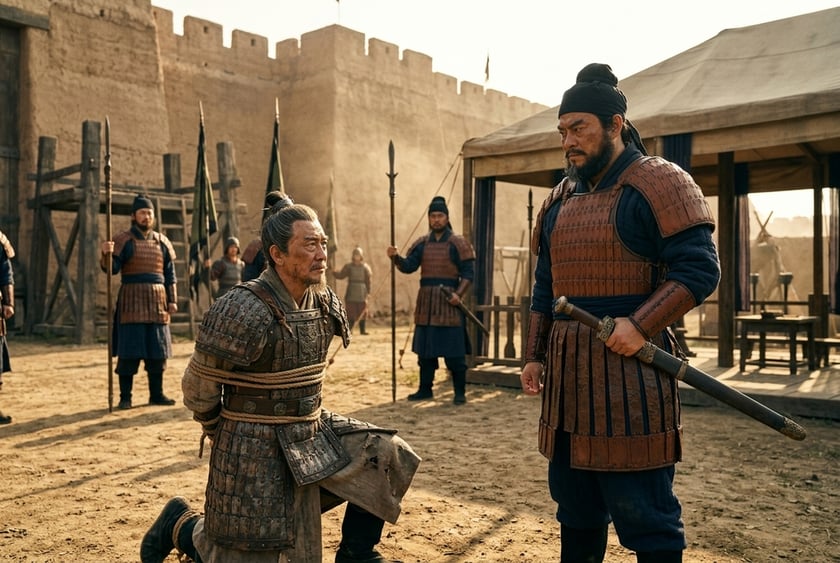
Cao Pi was the initiator; he personally choreographed every step of the process. Hua Xin was the most critical public executor — at the abdication ceremony he sword in hand compelled Emperor Liu Xie to kneel and hear the decree, proclaiming in stentorian tones that "to enthrone one emperor and depose another is the constant way of antiquity," completing the transformation of the Han emperor from sovereign to tributary duke. Wang Lang, Jia Xu, Sima Yi, and Chen Qun formed the core advisory layer of the abdication persuasion group. Sima Yi proposed "submitting a memorial of gracious declination, so as to stop all slander under heaven" — the critical technical detail that enabled the abdication ritual to be framed as "the way of Shun and Yu." Emperor Liu Xie was the party abdicating. On the eve of the ceremony he "dwelled in the palace in dread, not daring to go out," took comfort from Empress Cao's condemnation of the rebel ministers, but was in the end brought out at sword-point by Cao Hong and Cao Xiu. Empress Cao (Cao Jie) hurling abuse at those ministers was the only publicly recorded voice of opposition from within the Cao family — and it was the note that later historians used to preserve a margin of moral credit for the Cao father and son's image as "loyal to Han."
Core Issues
The first issue was constructing the legitimacy of the abdication. Cao Pi had to reframe "a powerful minister seizing the throne" as "the way of Shun and Yu" — which is the entire purpose of the three-declination three-petition ritual, the mass ministerial petitions, and the auspicious omens and prophetic texts. Sima Yi's proposed "memorial of gracious declination" was the craft detail of this reframing. The emperor's second re-issuance of the abdication edict, Hua Xin's second memorial in reply, the ministers' second petition — the number of "repetitions" in the entire procedure was precisely controlled so that the final "acceptance of abdication" would appear to be an "unwilling compliance with heaven's mandate." The second issue was the transition arrangements between old and new dynasties. Liu Xie was enfeoffed as Duke of Shanyang and immediately departed Xu Chang for his fief, where he was permitted to maintain Han dynastic observances. This "magnanimous treatment" both displayed the new dynasty's generous character and set a template for subsequent abdication models — the treatment of retiring emperors in Jin replacing Wei, and Song replacing Jin, essentially followed this pattern. The third issue was the "retroactive legitimation" of the new dynasty. On the very day of his enthronement, Cao Pi posthumously honored Cao Cao as "Taizu Emperor Wu," completing the generational transition from a powerful-minister clan to a founding dynasty.
Political Consequences
First: the canonical image of the four-hundred-year Han dynasty formally ended, and the political resource of "Han" as a banner lost its meaning within Caowei — thereafter, Shuhan's claim to the Han title as a political narrative could no longer mobilize the gentry of the Central Plains. Second: the abdication procedure was "templated." Henceforth all dynastic transitions were channeled into this format: Jin replacing Wei (266), Song replacing Jin (420), Qi replacing Song (479), Liang replacing Qi (502), Chen replacing Liang (557), Sui replacing Zhou (581), Tang replacing Sui (618) — all employed the three-declination three-petition, auspicious-omen group-memorial, and platform-enthronement as their core rituals. Caopidaihan is the source of the medieval Chinese "abdication orthodoxy" narrative. Third: Empress Cao's cursing of the "rebel ministers" left a moral fracture within Caowei — when the Simashi replicated the same procedure to replace Wei thirty years later, this fracture was magnified, and the Wei imperial clan's inability to mobilize resistance was directly connected to the internal divisions sown at the moment of Han's replacement. Fourth: the record of an "abrupt strange wind and all the torches going out" during the abdication ceremony — though embellished by the romance — reflects the anxiety in public opinion toward the usurpation, an anxiety that Caowei repeatedly tried to assuage through "auspicious omen" politics throughout the middle years of the dynasty.
Counterfactual Analysis
Had Cao Pi chosen to continue his father's "King Wen of Zhou" posture — remaining a king for his entire life and leaving the succession to his own descendants — the founding of Caowei might have been delayed by a generation, but the legitimacy might have been more stable. The cost would have been bearing the identity of "powerful minister" for the rest of his life. In the romance's framing, the core motivation for Cao Pi's eagerness to replace Han was that the historical status of "founding emperor" was for him alone to claim — unwilling to share it with his father's generation — and this mentality meant abdication had to be completed within his own lifetime. A second counterfactual: had Cao Pi simplified the abdication ritual — skipping the three-declination three-petition and accepting directly — the political legitimacy of "the way of Shun and Yu" would have been voided, and the abdication procedure could not have become the standard template for later dynastic transitions. History has him choosing the most elaborate version, which both established Caowei's short-term legitimacy and provided a complete blueprint that the Simashi subsequently copied to replace Wei — the deepest "historical irony" that Caopidaihan bequeathed to posterity.