Background
The abdication ceremony of the tenth month of Yankang year 1 was the first dynastic transition in Chinese political history to be completed under the name of "abdication" — it was both the moment when the ancient ideal of "abdication" stretching back through the Zhou and Qin dynasties was first institutionalized, and the origin point of the abdication template subsequently applied in the transitions from Caowei to Han, from Jin to Wei, through the Song, Qi, Liang, and Chen dynasties, and the transitions by Sui, Tang, and beyond. Viewed through the political narrative of the Romance of the San Guo, the legitimacy of this abdication rested on three stacked layers: auspicious omens, remonstration by court officials, and the emperor's voluntary surrender. Xu Zhi and Li Fu first adduced three categories of portent — "a phoenix appeared, a qilin emerged, and a yellow dragon manifested in Ye Commandery" — as evidence of the Mandate of Heaven; Hua Xin, Wang Lang, Jia Xu, and more than forty others provided the human basis of "the people's will converging"; and Emperor Xian personally presenting the imperial seal and ascending the Shouchantai to abdicate supplied the formal basis of "voluntary abdication". The three layers combined gave the abdication a complete shell of legitimacy — "Heaven's will — the people's will — the ruler's will" — and this shell subsequently became the standard operating procedure for every "abdication-type" dynastic change. One can say that Caopidaihan set the template for China's abdication political paradigm for more than a thousand years thereafter.
Principal Figures
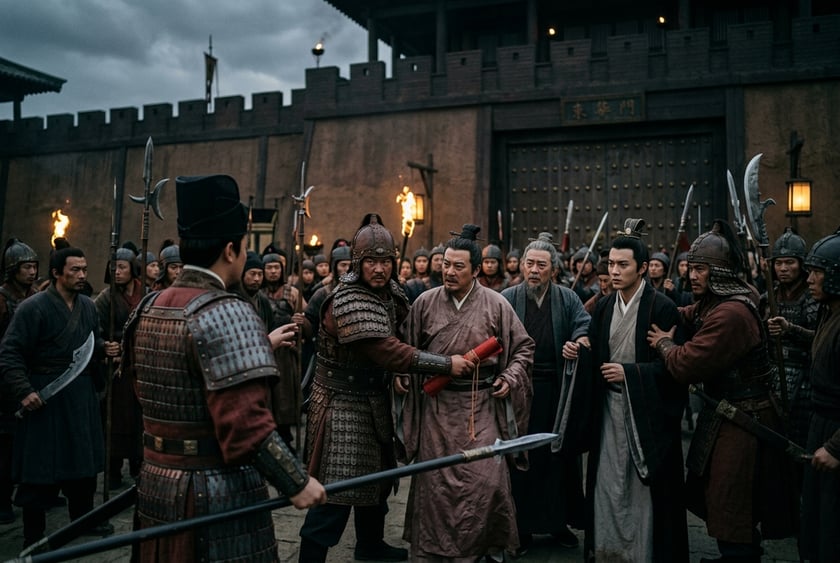
There were four groups of central parties to the abdication ceremony. The first is the abdicating party: Emperor Xian Liu Xie, who had ascended the throne at age nine and had weathered Dong Zhuo, Li Jue and Guo Si, and Cao Cao; at the time of the abdication he had been on the throne for thirty-one years and was the nominal final symbol of the Han house. The second is the receiving party: King of Wei Cao Pi, who after Cao Cao's death completed the power transition in three fluid steps — "mourning — succession — abdication" — controlling the timing of each step precisely. The third is the faction urging abdication: Hua Xin as chief executor, together with Wang Lang, Jia Xu, Chen Qun, Huan Jie, and others constituting the "abdication-urging bloc". Hua Xin was the concrete enforcer of the "palace confrontation," tearing at the imperial robe and issuing stern threats in person; Jia Xu was the key strategist for "procedural design," proposing the construction of the Shouchantai and two rounds of ritual decline by Cao Pi "to dispel collective doubts and forestall further objections"; Chen Qun and Huan Jie were responsible for drafting the edicts. The fourth group is the lone protester: the fu-bao keeper Zu Bi, who was executed on the spot for refusing to surrender the imperial seal to Cao Hong — he was very nearly the only official in this entire abdication ceremony to die in fidelity to the Han house, and the novel casts him as "the last loyal minister of the Han."
The Central Issue
The central issue of the abdication was not "whether power would transfer" — that had been effectively accomplished when Cao Cao was elevated to Duke of Wei, then King of Wei, was awarded the Nine Bestowments, and was accorded sacrifices to Heaven and Earth. The real issue was "how the transfer of power could achieve permanent legitimacy." Cao Pi's stated anxiety in the novel is telling: "Though there have been two edicts, I still fear that future generations will not exempt me from the stigma of usurpation." This reveals that what Cao Pi cared most about was not current power but his "historical judgment." Jia Xu's solution was exquisitely calculated: build the Shouchantai, decline twice, select a propitious day, assemble more than four hundred public officials and more than three hundred thousand imperial guards as witnesses, and have the Han emperor personally hold out the imperial seal. Every detail was an element of "procedural legitimacy" design: declining twice was to avoid any impression of eagerness; building the platform created a "sacred space"; the auspicious day anchored the event to the "destiny of Heaven"; and the personal presentation of the seal materialized "voluntary abdication." This procedural design was the first complete "usurpation-legitimation" project in Chinese political history, and its ingenuity even influenced later scholarship on Wang Mang — scholars thereby realized that Wang Mang's abdication procedure "failed" because it lacked military coercive force, whereas Cao Pi's procedure "succeeded" because it had the backing of "several hundred armored men carrying spears and halberds".
Political Consequences
The most immediate consequence was the formal end of four hundred years of Han dynasty rule and the establishment of the Caowei dynasty, with the reign era renamed from Yankang to Huangchu. Emperor Xian was demoted to Duke of Shanyang, receiving a state fief of ten thousand households. Cao Pi's accession marked the transformation of Cao family power from "a powerful minister acting as regent" to "Heaven's designated heir," and the legitimacy of Caowei thereby received official endorsement. On a deeper level, the abdication's consequences were fourfold. First, it inaugurated the "abdication-legitimation" political paradigm: two hundred years later Sima Yan would use the same procedure to displace Wei, and subsequently Liu Yu, Xiao Daocheng, Xiao Yan, Chen Baxian, Yang Jian, and Li Yuan all completed their dynastic changes using the same template — one may say that Cao Pi's abdication profoundly transformed the logic of Chinese dynastic change for the next thousand years. Second, it initiated an ethical tension for the scholar-official class between "loyalty to the ruler" and "following the prevailing tide" — those who urged the abdication, such as Hua Xin and Wang Lang, rose to the pinnacle of power afterward, while Zu Bi was beheaded; this contrast became a case study in "the great principle of lord and minister" that later Confucian scholars debated endlessly. Third, the religious language of "Heaven's Mandate" began to enter everyday political life — auspicious omens, astral signs, and prophetic apocrypha were systematically incorporated into official discourse after Caowei's founding, laying the groundwork for the fusion of Wei-Jin xuanxue philosophy with apocryphal political discourse. Fourth, by using "abdication" Cao Pi erased the stigma of "warlord usurpation," but he also thereby abandoned the legitimizing source of "conquest by force" — which simultaneously increased Caowei's dependence on both the imperial clan and the great families, planting a structural seed for the Simashi clan's eventual displacement of Wei by the same method.
Counterfactual Analysis
The most imaginative counterfactual is: if Emperor Xian had committed suicide on the spot, the abdication procedure could not have been completed, and Cao Pi would have been compelled to ascend the throne through "deposing an emperor and self-enthroning." "Deposition and enthronement" versus "abdication" are fundamentally different in legal theory — the former is naked usurpation, the latter is "transfer of the Mandate of Heaven." Had Cao Pi taken the "deposition" route, Caowei's legitimacy would have been severely damaged; the great clans (such as Chen Qun and Hua Xin) would have faced far heavier moral pressure, and the stable period of Caowei might have shortened from forty years to twenty. Second, if Hua Xin had been less rough in the palace confrontation — had he not torn at the imperial robe and not executed Zu Bi — the "procedural voluntariness" of the abdication would have been more credible, and the historical verdict against Cao Pi's "stigma of usurpation" would have been less severe. Yet the novel deliberately casts Hua Xin as a crude enforcer — precisely to prepare the name "Hua Xin" to bear a thousand years of condemnation, a typical instance of the novel's "loyalty versus villainy contrast" narrative technique. A third scenario: if Emperor Xian had lived out his days in comfort after the abdication (as he in fact did, surviving until 234, eight years longer than Cao Pi himself), the "peaceful" face of the abdication would have been more prominent. Yet even so, the Han imperial relatives were massively marginalized, surveilled, and stripped of political rights after the abdication, irrevocably demonstrating that "abdication" was nothing but usurpation dressed in ritual. To grasp the true weight of this abdication, one must read backward from the fact that it defined the verbal and procedural template for dynastic change in China for the next thousand years.