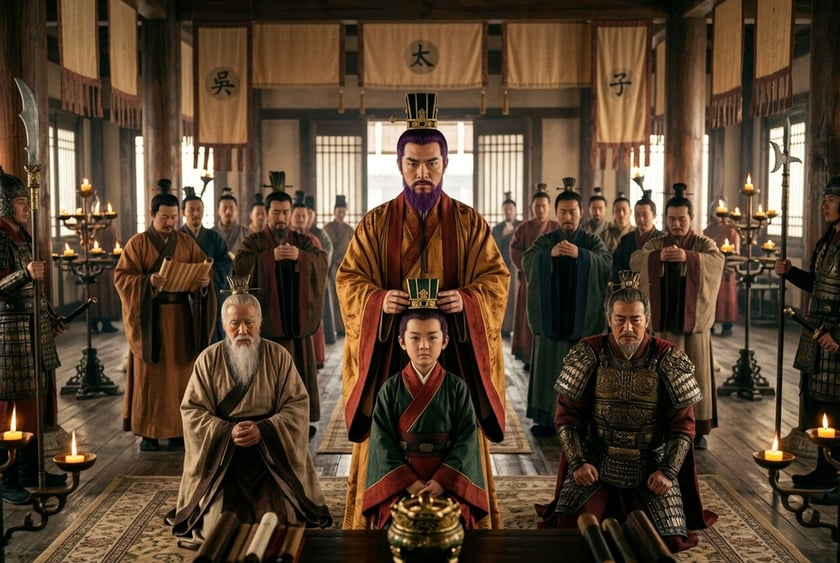
Origins
The overarching cause of Shouchunsanpan — the Three Rebellions of Shouchun — was the shift of the Simashi from "holding political power" to "acting as ruler in all but name" following the Gaopinglingzhibian. After the coup of Jiaping 1 (249), Sima Yi crushed the Cao Shuang faction in a single stroke and wrested control of the central decision-making of Caowei from the imperial kinship, but this coup settled only the capital region of Luoyang; the regional commanders-in-chief stationed at the frontiers, holding large armies — especially the Huainan Army Group — were not simultaneously suppressed. The Huainan Army Group was the largest and most battle-hardened force on Caowei's Wu border, locked for years in a grinding contest with Sunwu along the Hefei–Shouchun–Ruxu line, and traditionally commanded by Caowei veterans. They had witnessed the extreme handling of Cao Shuang's extermination and understood perfectly well that they themselves would sooner or later be the next targets of purging. The three military uprisings were the consecutive reactive responses of the Huainan commanders-in-chief when faced with the binary choice between "waiting to die or fighting for survival."
Participants
The core forces of the three rebellions differed in composition. The first — Wang Ling's rebellion — followed a "royal kinsmen plus great clans" path: Wang Ling wished to depose the young ruler Cao Fang and enthrone Cao Biao, King of Chu; this was the last gamble of Cao clansmen seeking to recover imperial authority in the manner prevailing before the Gaopinglingzhibian. The second — the rebellion of Guan Qiujian and Wen Qin — followed a "regional commanders-in-chief plus local military power" path: they raised the banner of "purging the court of its evil, eliminating Sima Shi," without the appeal of royal kinsmen, but mobilizing a network of Huainan local military installations and old Wei commanders. The third — Zhugedanzhiluan — escalated to a "regional commander-in-chief plus outside support" path: Zhuge Dan proactively sent his son Zhuge Jing into Sunwu as a hostage and requested Wu intervention, creating a three-party military situation of "internal Caowei rebellion, Wu reinforcements, and Sima main force besieging." The force composition of the three rebellions shows a progressive deterioration from "royal kinsmen — frontier commander — frontier commander plus outside forces," precisely reflecting the Simashi's deepening purge of the Caowei interior layer by layer.
Key Turning Points
Each of the three rebellions had its own key turning point, but all shared a single structural weakness: isolation. The turning point in Wang Ling's first rebellion was Sima Yi's personal campaign — despite his advanced age Sima Yi personally led a large army south; Wang Ling saw the game was up and died by his own hand along the road. The turning point in the second rebellion of Guan Qiujian and Wen Qin was Sima Shi's decision to campaign in person despite his eye disease — he held position and refused battle, wearing down the adversary's morale, then used cavalry to intercept Guan Qiujian's relief forces; Guan Qiujian was killed in the chaos, and Wen Qin escaped alone to Wu. The turning point in Zhuge Dan's rebellion was the Wu relief force becoming trapped inside Shouchun after arriving, with no room to maneuver outside — Sima Zhao deployed Zhong Hui, Wang Ji, and others to besiege Shouchun for half a year; inside the city Jiang Ban and Jiao Yi in turn counseled surrender; and the entire Quan Yi father-and-son group defected after being recruited by a family letter. All three rebellions failed to generate effective political appeal — they lacked a "successor candidate" widely enough recognized to rally support, and could not induce other army groups (Xiahou Ba in the Guanzhong region had already fled to Shuhan; Jingzhou had changed hands multiple times; Hebei had long submitted to the Simashi) to follow.
Suppression and Results
Simashi's handling of the three rebellions became more thorough each time. Wang Ling's rebellion brought retribution only to the core figures; Guan Qiujian's rebellion brought the extermination of whole clans; Zhuge Dan's rebellion culminated in the complete elimination of all "those who dared to fight and had not surrendered" within Shouchun, together with large-scale population relocations — this amounted to pulling out by the roots the "organizational foundation" of the Huainan Army Group. After the three rebellions, the entire Huainan military-political system was brought directly under Simashi control: Shouchun was no longer the stronghold of an independent regional commander but became a forward outpost of the Simashi central forces in the Jianghuai region; the Caowei regional military garrison system as a possible political threat to the Simashi essentially left the stage. Two years after Zhuge Dan's death (260), Sima Zhao dared to engineer the extreme episode of "the Wei Emperor personally leading an expedition against Sima that was repulsed, followed by the assassination of Emperor Cao Mao" — the backdrop being that there were no longer any military forces in the regions capable of responding to an anti-Sima cause.
Historical Reverberations
Shouchunsanpan occupies a dual position in the late San Guo period. From a tactical standpoint it was the last large-scale armed resistance inside Caowei — the combined forces mobilized across the three rebellions reached nearly three hundred thousand, far exceeding any contemporaneous border engagement against Wu or Shuhan; yet all three failed, showing that regional army groups without central political support were incapable of independently resisting a powerful regent. From a strategic standpoint the three rebellions exposed Caowei's "political instability on the Wu border" to Sunwu — Sun Lin personally intervened in support during the third rebellion, representing the largest-scale Wu military operation against Wei, but one that ended up draining the already volatile Wu domestic politics and indirectly accelerating Wu's decline. From a political standpoint, the three rebellions and their suppression completed a "legitimacy dress rehearsal for yet another dynastic replacement following the replacement of Han" — through the military power, personnel networks, and rhetorical resources accumulated in suppressing the three rebellions, the Simashi reduced replacing Wei and founding Jin to a single procedural step. Later historians generally treat "Gaopinglingzhibian — Shouchunsanpan — assassination of Cao Mao — fall of Shuhan — Weijinchandai" as the complete sequence of Western Jin's establishment; within this sequence Shouchunsanpan was the longest, most painful, and most blood-soaked middle passage.