Origins
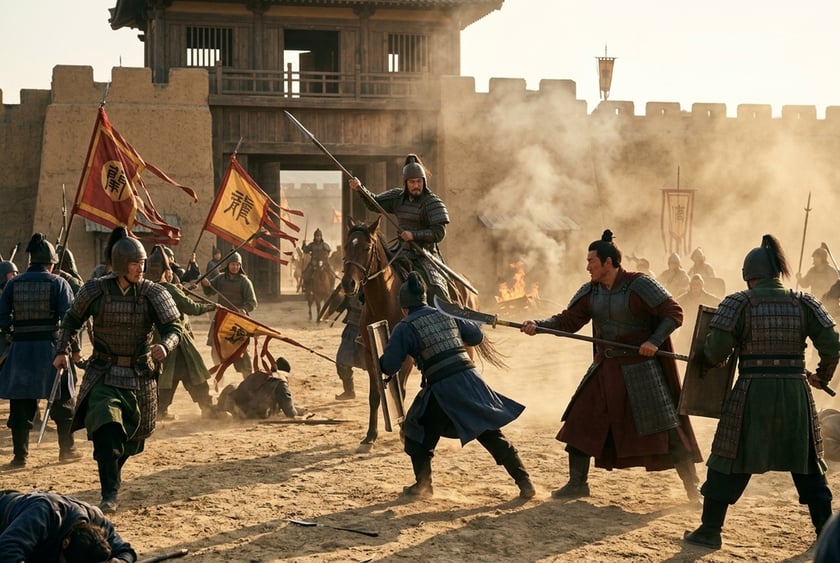
Zhugedanzhiluan was not an isolated event — it was the largest in scale, the most costly in casualties, and the most far-reaching in political impact of the three events grouped as Shouchunsanpan. The first two uprisings — Wang Ling (251) and Guan Qiujian and Wen Qin (255) — shared a common characteristic: "veteran Caowei generals refusing to accept Simashi centralization of power," and after their failures the surviving subordinates and regional military resources both accumulated in Zhuge Dan's hands. In the fourth month of the second year of Ganlu, Sima Zhao resolved to summon Zhuge Dan to court to serve as Minister of Works — the standard operational procedure for stripping him of military authority. Zhuge Dan saw through this and understood it to be a death trap of "summon then execute," and in the fifth month he struck first: he killed the Yangzhou governor Le Chen and raised Shouchun in revolt [c:17754]. Structurally, this was the third and final major wave of backlash against the Simashi policy of "internal absorption of regional commands." Its origin was not personal ambition but an irreconcilable redistribution of power between the Sima family center and the old-guard Wei regional commanders — and that clash, with Zhuge Dan's death, was declared ended in Simashi's complete victory.
Participating Forces
The rebel side: Zhuge Dan's Huainan base forces numbered approximately one hundred thousand or more, plus some forty or fifty thousand newly recruited from Yangzhou. The Wu reinforcements were coordinated by Grand General Sun Lin; front-line commanders were Wen Qin and Tang Zi, with deputy commanders Quan Duan, Quan Yi, and Zhu Yi — thirty thousand entering the city and thirty thousand encamped outside at Anfeng as a flanking force [c:17755]. The court side: Sima Zhao personally led two hundred and sixty thousand troops conscripted from the four provinces of Qing, Xu, Jing, and Yu, and brought the Wei emperor's imperial train to Xiangcheng to manifest legitimacy; siege commander Wang Ji, cooperating encircler Chen Qian, relief-interception forces under Zhou Tai, Shi Bao, and Hu Lie, plus Zhong Hui, Jia Chong, and Fu Gu serving as strategic advisors in the main body [c:17755]. The Romance adds two additional character groupings on top of this historical framework: first, Jia Chong as the schemer who "recommended the move against Zhuge Dan" using divisive tactics; second, Zhong Hui as the primary strategist, cast in the style of "a Zifang" — both of these dramatizations are comparatively thin in the official histories.
Critical Turning Points
The first turning point was Wen Qin's entry into the city. Wen Qin was a veteran general of Huainan who had fled to Eastern Wu after the Guan Qiujian uprising, and in this campaign returned to Huainan in his capacity as a Wu reinforcement commander. In theory he should have been Zhuge Dan's most reliable ally. But their relationship rested on the fragile foundation of "shared resistance to Simashi," lacking long-term trust. The second turning point was the defeat and death of Zhu Yi. Zhu Yi's encampment at Anfeng was supposed to be Wu's outer relief force and the key to a flanking posture between inside and outside the city; after his consecutive battlefield losses, Sun Lin not only failed to send reinforcements but instead personally executed him right in the field camp at Huoli — from that point Wu's relief forces completely lost their rhythm, and there was no longer anyone outside the walls worth counting on [c:17755]. The third turning point was the death of Wen Qin inside the city. As grain ran out, Wen Qin urged releasing the northern Wei-registered soldiers from the city to conserve provisions; Zhuge Dan suspected this was a scheme to "disarm me," and executed Wen Qin. Wen Yang and Wen Hu scaled the walls and surrendered to Wei; Sima Zhao generously rewarded the two brothers in order to shake the morale of those still inside the city — Zhuge Dan simultaneously lost control politically and psychologically [c:17757]. The fourth turning point was Sima Zhao's adoption of Zhong Hui's strategy of "leave the south gate open to lure out a breakout," keeping the south gate as an exit point and waiting for the city's interior to collapse on its own — the Romance foregrounds this as Zhong Hui's "Zifang-style" moment of supreme brilliance [c:17755].
Pacification and Outcome
In the second month of the third year of Ganlu, the city's soldiers were too starved and weakened to hold their weapons; Zhuge Dan led his personal guards in a breakout attempt and was cut down, his head sent to Luoyang, his three clans exterminated. Tang Zi, Quan Duan, Quan Yi, and the other Wu commanders were captured or surrendered to the last man. Sima Zhao, accepting Zhong Hui's counsel of "do not butcher the Wu troops but release them back to the south as a show of magnanimity," released tens of thousands of Wu soldiers as a political card [c:17758]. The destructive force of this move far exceeded the military victory itself: the returned Wu troops spread by word of mouth on their way back to Jiangdong that "Sima Zhao is more benevolent than Sun Lin," directly puncturing Sun Lin's legitimacy in Jiangdong. On learning that the families of Quan Duan, Tang Zi, and others who had surrendered to Wei were still in Jiangdong, Sun Lin executed all of their family members there in a show of terror to maintain his hold on power [c:17760]; the Wu ruler Sun Liang, witnessing Sun Lin's brutality, began to harbor the intention of deposing him — Eastern Wu's central government thereafter entered the chain of political upheaval led by Sun Xiu's elimination of Sun Lin and then Sun Hao's succession.
Historical Echoes
For Caowei's internal affairs, Zhuge Dan's death in battle meant the complete destruction of the old regional-commander establishment; Simashi's last external obstacle to replacing Caowei had been cleared away. In the following two years, Sima Zhao received the Nine Bestowments, was enfeoffed as Duke of Jin, then as Prince of Jin, and the pace of the dynastic transfer encountered no further resistance. For Eastern Wu, this was the starting point of Sun Lin's collapse of autocratic power: the tens of thousands of released Wu troops became an uncontrollable variable in central politics; Sun Lin could only maintain control through terror, which only accelerated his own isolation. For Shuhan, Jiang Wei made an attempt during this campaign to coordinate with Zhuge Dan by attacking the Great Wall to the north, but by the time he received word that Zhuge Dan had already been defeated he was compelled to withdraw — yet another northern campaign reduced to an empty gesture [c:17759]. After this siege, the political structure of the later San Guo period was definitively locked in place: Wei was no longer the Wei of the Cao family, Wu was no longer the Wu of Sun Quan, and Shuhan's capacity for northern campaigns was being ground down with Jiang Wei's successive setbacks. In this sense, the Battle of Shouchun was both the final movement of the "three uprisings" and a preview of the unification of the San Guo.