Origins
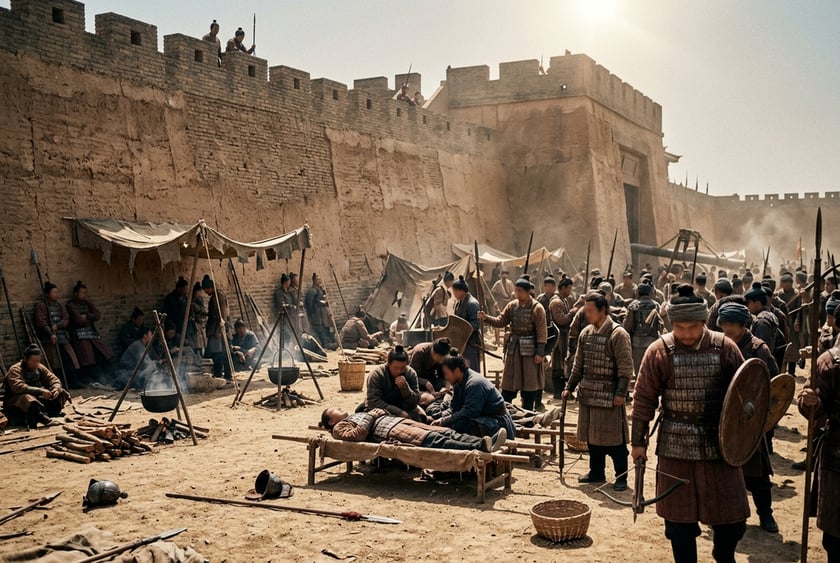
This event and "the Zhuge Dan Rebellion" (event 398) are, in historical terms, the same campaign — only the angle of analysis differs: here the focus is on a regional commander's political defiance. After Guanqiu Jian and Wen Qin were defeated and killed in the sixth year of Jiaping (254), Zhuge Dan succeeded to the post of General Who Conquers the East, becoming the last figure of real military weight among Caowei's frontier commands. He had watched his colleagues liquidated one by one and understood that the Simashi policy of "internalizing the frontier commands" was irreversible. In early Ganlu 2, he scattered his personal fortune to win over the strongmen of Huai'nan, expanded his garrison to one hundred thousand troops, and reinforced the defenses of Shouchun — effectively turning the city into a private fiefdom. In Sima Zhao's eyes this was intolerable "private hoarding of power." That same fourth month Sima Zhao ordered Zhuge Dan to come to the capital as Excellency of Works — a nominal promotion that in reality stripped him of his troops. Zhuge Dan read the summons instantly as a death sentence. In the fifth month he raised his forces in revolt, killed Yang Province Inspector Le Lin, and seized Shouchun [c:17761].
Forces Involved
On the rebel side: Zhuge Dan's Huai'nan regulars, roughly one hundred thousand strong, plus forty or fifty thousand newly levied troops from Yang Province. Wu's relief force was coordinated overall by Grand General Sun Lin; frontline commanders were Wen Qin, Tang Zi, and deputies Quan Duan, Quan Yi, and Zhu Yi. On the Wei side: Sima Zhao personally led twenty-six ten-thousand-strong armies drawn from Qing, Xu, Jing, and Yu provinces, and brought along the Wei emperor's imperial entourage encamped at Xiangcheng to assert dynastic legitimacy. The siege was commanded by Wang Ji (acting General Who Stabilizes the East), with Chen Qian (General Who Pacifies the East) in supporting operations; the relief interception forces were Zhou Tai, Shi Bao, and Hu Lie; Zhong Hui, Jia Chong, and Fu Gu served as staff advisers in the main army [c:17761]. Sima Zhao's edicts played a decisive role at this juncture — he issued a blanket amnesty specifically pardoning "officers, soldiers, and civilians of Huai'nan who were misled by Dan," thereby shrinking Zhuge Dan from "a frontier commander in principled defiance" to "an isolated rebel," and morally fracturing the garrison inside Shouchun [c:17761].
Critical Turning Points
The battle's turning points overlap substantially with those described in event 398, but from the perspective of the frontier commands' fate three stand out. The first was the death of Zhu Yi. Zhu Yi had encamped at Anfeng as the external anchor of the Wu relief effort; after he was defeated in succession by Zhou Tai and Shi Bao, Sun Lin had him executed at the Huoli encampment — the moment the Wu relief operation lost its rhythm [c:17761]. The second was the death of Wen Qin. Wen Qin was an old Huai'nan general who had gone into exile after Guanqiu Jian's uprising; his cooperation with Zhuge Dan rested on the fragile basis of a shared opposition to the Sima family. When food ran out inside the city, Wen Qin proposed releasing the Wei-registered soldiers to reduce mouths to feed. Zhuge Dan suspected a power grab and had him killed; Wen Qin's sons Wen Yang and Wen Hu scaled the walls and defected to Wei — symbolizing the complete disintegration of the "anti-Sima frontier alliance" from within. The third was Sima Zhao's release of the Wu troops. After the city fell, Sima Zhao accepted Zhong Hui's advice and released the tens of thousands of captured Wu soldiers to return home, demonstrating the magnanimity of the central government. The political damage this caused far exceeded the military victory itself: it thrust the state of Wu under Sun Lin into a legitimacy crisis.
Suppression and Outcome
In the second month of Ganlu 3, the soldiers inside the city were too starved to hold their weapons. Zhuge Dan led his personal guard in a breakout attempt and was cut down; his severed head was sent to Luoyang and his three clans exterminated [c:17761]. Tang Zi, Quan Duan, Quan Yi, and the other Wu commanders all surrendered. The Huai'nan frontier command was completely dismantled, the defenses of Shouchun were razed, and the Wei emperor's entourage returned to Luoyang. From that point forward, Caowei had no remaining regional military force capable of challenging the center. Through this campaign Sima Zhao accomplished three things simultaneously: he eliminated the last pocket of resistance; he established the position of trusted protégés such as Zhong Hui; and by "not massacring the Wu troops" he won favorable political opinion among the people of the south.
Historical Resonance
From the perspective of frontier-command institutional history, the fall of Shouchun announced the end of Caowei's system of "regional supervisors of military affairs." Cao Pi's original frontier-devolution design was meant to forestall internal rebellion by the imperial clan, assigning external military weight to more distant Cao relatives and trusted non-Cao commanders alike. The Sima family used the three successive rebellions to dismantle this design step by step, ultimately drawing all frontier military power back to centrally trusted intimates. This "internalization of the frontier commands" was a major structural fault-line that would doom the Western Jin dynasty — when the Yongjia crisis demanded that regional commands bear the burden of pacification, there were no commanders in the field who still possessed both the military capacity and the political authority needed. In a real sense, the isolation of Luoyang during the Yongjia catastrophe can be traced as a remote cause to the fall of Shouchun in Ganlu 3. For Eastern Wu, the released tens of thousands of Wu soldiers became an uncontrollable variable in central politics, and Sun Lin's retaliatory executions of the surrendered generals' families accelerated his own isolation. Sun Xiu soon contrived to eliminate Sun Lin, but after three years of chain-reaction coups Eastern Wu's inner court had spent the last of its vitality before a generation of talent like Lu Kang could stabilize the government.