Strategic Background
The fifth northern campaign as described in the Romance took place in the ninth year of the Jianxing reign (231 CE), four years after Ma Su's loss at Jieting had reversed Diyicibeifa. In those four years, Zhuge Liang had accomplished three things: first, he had overhauled the system of military discipline following the Ma Su affair, re-establishing clear lines of responsibility for using personnel against the consensus of advisors; second, he had adjusted the rhythm of the northern campaigns, shifting from "one large-scale main offensive" to "small-scale repeated probing combined with incremental objective-by-objective advances," with the second, third, and fourth northern campaigns aimed primarily at attriting Wei forces and securing individual commanderies in Longright; third, he had developed the Muniuliuma to address the problem of "transporting supplies over a thousand li at a loss of more than half". This renewed advance out of Qishan was the pivotal experiment in which Zhuge Liang first attempted to sustain a longer front using an "engineered supply system." In strategic intent, he had already abandoned any hope for "a decisive overthrow in a single stroke" and had shifted to a strategy of "accumulating small victories into a grand momentum," gnawing away at Longright piece by piece. This strategic adjustment was both realistic and arduous, for it demanded that Shuhan's national capacity for supply be able to reliably sustain year-after-year distant campaigns — and that was precisely the core counterpoint that Wei exploited by walling up and waiting for the Shuhan forces to exhaust their provisions.
Deployment of Forces
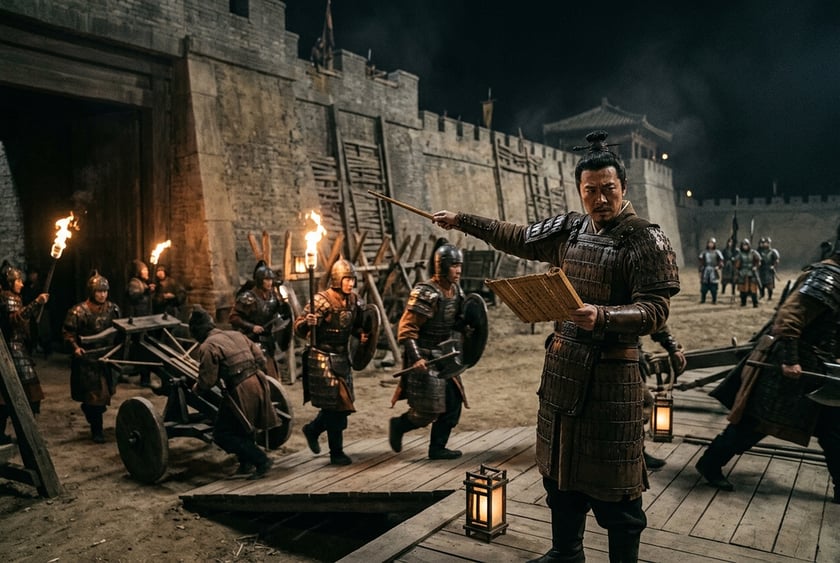
On Shuhan's side, the core of Zhuge Liang's deployment followed the principle of "two-flank surprise, central main engagement, rear-echelon engineering." On the flanks, Wei Yan and Jiang Wei were charged with a surprise attack on Sanguan, while Jiang Wei and Wang Ping were assigned to take Wudou and Yinping. The central force, including Zhang Yi, Ma Dai, Guan Xing, and Zhang Bao in separate columns, employed ambush and lure-and-trap tactics. In the rear, Li Yan oversaw the coordination of grain transport, with the Muniuliuma deployed for the first time on a large scale — an early attempt in Chinese military history at a "semi-mechanized supply system". On Wei's side, Cao Zhen initially governed Guanzhong and commanded the western Qishan route; Sima Yi, newly transferred from the Jingzhou theater to Longright, formed a complementary "east-west coordination" posture with Cao Zhen. Zhang He served as the vanguard commander for specific engagements, but strategic decision-making rested with Cao Zhen and Sima Yi. Guo Huai oversaw the Qiang and Hu pacification and grain supply in Longright's rear areas.
Critical Decision Points
The campaign had three critical decision points. The first was "Sima Yi's decision to hold fortified positions and refuse battle". With Wei forces having already suffered a string of setbacks (Fei Yao's entire force annihilated, Sanguan lost, Wudou and Yinping overrun), Sima Yi made no hasty counterattack; instead, he placed his strategic weight on "depleting the Shuhan army's provisions" — his judgment being that the Shuhan army was campaigning thousands of li from home and its supply line was necessarily fragile; once the autumn rains came and the plank roads were cut off, the Shuhan forces would withdraw on their own. This was an extremely cool-headed assessment, but also an extremely passive one: it meant Wei was willing to pay the price of "ceding some commanderies and absorbing punishment" in exchange for "preserving the core and waiting for the enemy to collapse." The second decision point was "whether Zhuge Liang should exploit his early gains and advance further." After Shuhan's forces had fought several clean ambushes on the western Qishan route and morale was high, conventional military logic called for pressing forward to expand results. Zhuge Liang chose instead to hold position and consolidate the commanderies already taken, waiting for provisions to arrive before the next step — reflecting his clear-eyed understanding that "a distant-expedition army cannot sustain continuous operations." The third decision point was "Li Yan's failure to deliver provisions on time." This was the true reason this northern campaign collapsed. Li Yan, in the rear, failed for unspecified reasons to deliver the grain to the front line on schedule; Shuhan's forces were compelled to withdraw prematurely. The Romance weaves this thread through chapters 100 to 102 as a subplot; the official histories record that Zhuge Liang returned to Chengdu, impeached Li Yan, and had him stripped of rank and demoted to commoner status. This episode exposed the fundamental structural weakness of Shuhan's northern campaigns: logistical capacity insufficient to sustain a "sustained-advance" strategy.
Outcome and Echoes
At the tactical level, this campaign's results were quite impressive: Fei Yao's force was annihilated, Sanguan was seized, Wudou and Yinping fell to Shuhan (both commanderies were kept by Zhuge Liang after the campaign as forward bases for subsequent northern offensives), Cao Zhen was pressured to the point of dying of illness shortly after the campaign, and the pressure on Wei's Guanzhong defenses was pushed to its peak. At the strategic level, the campaign was full of frustration: Shuhan ultimately withdrew when provisions ran out, without achieving a decisive breakthrough in Longright; Wei, through this standoff, validated the effectiveness of the "hold fortifications and wait for provisions to give out" tactic, which Sima Yi then repeatedly employed in subsequent campaigns, locking Shuhan's northern offensives in the dilemma of "able to win tactically, unable to win strategically." At the political level, an important reckoning followed this campaign within Shuhan — Li Yan was dismissed for failing to deliver provisions on time, signaling the further consolidation of Zhuge Liang's supremacy within Shuhan's military-political system. Li Yan had been the other regent entrusted by Liu Bei at his deathbed; his fall meant there was no longer anyone in Shuhan who could look Zhuge Liang in the eye as a genuine "second-in-command." This change both stabilized the execution of the northern campaign strategy and planted the seeds of the problem that "after Zhuge Liang's death, no one could carry the weight" in Shuhan's later years.
Counterfactual Analysis
Two counterfactuals deserve extended treatment. The first: had Li Yan delivered the provisions on time and Shuhan's forces not withdrawn in 231, could a decisive breakthrough in Longright have been achieved? Looking at the hidden threads in both the Romance and the official histories, Wei was at that time mobilizing reinforcements from Youzhou and Bingzhou to move south; Sima Yi was about to receive sufficient forces for a counterattack. Even if Shuhan's provisions were uninterrupted, it would have been very difficult to complete comprehensive control of Longright before Wei's main force arrived. Shuhan's best attainable outcome was "capturing one or two more minor commanderies and consolidating the front line" — the grand objective of "using Long to control Guan" could not be realized. This shows that the strategic ceiling of Shuhan's northern campaigns had long been determined by the ratio of national power between the two sides; no individual battle victory could change the ceiling at the strategic level. The second: had Zhuge Liang, before this campaign, chosen not to develop the Muniuliuma but instead concentrated his energy on deepening agricultural garrisons in Hanzhong, what would have resulted? The core logic of this path was "first thicken the foundation, then fight" — in theory more consistent with the logic of "protracted war." But Shuhan's political window of time was already closing at an accelerating pace: Wei's national power grew every year while Shuhan, constrained by population and geography, could not expand at the same rate; Zhuge Liang himself was fifty-one that year (he died at Wuzhangyuan four years later). Had he continued to "thicken first," he could almost certainly not have lived to see the outcome of the northern campaigns. So he chose the middle path of "engineered supply plus repeated offensives" — neither abandoning advances nor attempting to compensate for the resource gap through technology. In a certain sense, the very invention of the Muniuliuma embodies Zhuge Liang's deepest reflection on Shuhan's northern campaign strategy: when neither manpower nor institutions could sustain this gambit, he turned to machines to supplement what human capacity could not supply. This attempt to "use technology to compensate for structural disadvantage" is one of the most remarkable records in Chinese military history of individual heroism contending against the arc of history.