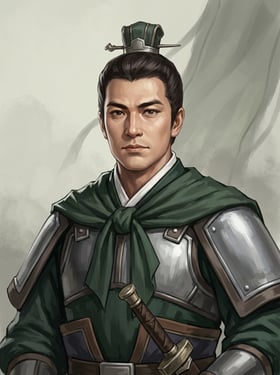
Historical Record
Zhang Ni, courtesy name Boqi, was a native of Nanchongguo in Ba Commandery. He came from a poor family, but even as a youth showed extraordinary integrity and spirit. At the age of twenty he served as a county merit officer (gongcao). During the period when the Former Lord Liu Bei pacified the land of Shu, mountain bandits attacked the county and the county magistrate abandoned his family and fled, but Zhang Ni, at the risk of his own life, carried the magistrate's wife on his back to safety. His reputation thus rose, and he was summoned by the provincial government to serve as an aide-de-camp (congshi).
In the fifth year of the Jianxing era (227 CE), when the Chancellor Zhuge Liang advanced north to Hanzhong, mountain bandits such as Zhang Mu of Mianzhu in Guanghan took advantage of the moment to plunder military supplies and the populace. Zhang Ni, in the capacity of commandant (duwei), led troops to suppress them. Judging that the bandits were scattered and hard to crush head-on, he feigned making peace with them and set a date for a feast. At the height of the drinking, Zhang Ni personally led his attendants to cut down more than fifty men including Zhang Mu, wiping out the chief leaders, and within ten days pacified the rest of their followers.
Later Zhang Ni fell gravely ill and his household was poor. He Zhi, Grand Administrator of Guanghan, had always been known for his generosity; though Zhang Ni had no deep acquaintance with him, he personally went by carriage to He Zhi to seek treatment for his illness. He Zhi devoted his full efforts to healing him, and after several years Zhang Ni recovered—a reflection of his character of treating others with good faith. He was appointed Gate General (yamen jiang), placed under Ma Zhong, and campaigned north against the rebellious Qiang of Wenshan and pacified the Man tribes of four southern commanderies, repeatedly winning military merit.
In the 14th year (236 CE), when Fu Jian, the Di king of Wudu, requested to submit, the Grand General Jiang Wan was deeply anxious about it. But Zhang Ni said calmly: "Fu Jian's submission is sincere; there will be no trouble. I have always heard his younger brother is crafty, and the Yi and Di tribes can hardly be of one mind—I fear there is some rift between the brothers, which is why it has been delayed." Several days later, word indeed came that Fu Jian's younger brother had defected to Cao Wei with four hundred households, and only Fu Jian came alone to submit.
Since Zhuge Liang's campaign against Gao Ding, the Sou-Yi people of Yuexi Commandery had repeatedly rebelled, killing the Grand Administrators Gong Lu and Jiao Huang. Thereafter the Grand Administrators dared not go to the commandery seat and could only station themselves at Anding County, more than eight hundred li from the commandery, leaving Yuexi a commandery in name only. At the time the court discussed restoring the old commandery and appointed Zhang Ni Grand Administrator of Yuexi. Zhang Ni led his troops to the commandery seat, won over the people with kindness, and the Man and Yi all submitted, many coming over. The Zhuoma tribe to the north, the fiercest, would not obey his command; Zhang Ni personally went to suppress them and captured their leader Wei Lang alive. He then released Wei Lang, explained to him where his interests lay, and had him win over the rest of the tribe. Zhang Ni memorialized to appoint Wei Lang a village marquis, and his more than three thousand households all settled into peaceful livelihood and served Shu Han. Hearing of this, the other tribes also gradually came over. For this merit Zhang Ni was granted the rank of Marquis Within the Passes (Guannei hou).
Within the commandery were the three counties of Dingzuo, Taideng, and Beishui, more than three hundred li from the commandery seat, which had long produced salt, iron, and lacquer, but the Yi people had long occupied them for their own use. Zhang Ni led his troops to recapture them and installed senior officials. When he reached Dingzuo, the local chieftain Lang Cen, maternal uncle of King Panmu, deeply trusted by the Man and Yi, was displeased at Zhang Ni's arrival and refused to come in person to pay his respects. Zhang Ni sent several dozen stalwarts to go straight to seize the two men, whipped and killed them, returned their bodies to the tribe, and lavishly rewarded their followers. He proclaimed to the people Lang Cen's evil deeds and warned: "Do not act rashly, or you will surely be destroyed!" Each tribe bound their own hands and pleaded guilty. Zhang Ni held a feast for them, reaffirmed his good faith, and thereby obtained the salt and iron resources, with implements fully supplied.
Yuexi Commandery had an old road that passed through Maoniu to Chengdu, level and short. But since the Maoniu tribe had cut off this road for more than a hundred years, travelers could only detour through Anshang, which was both perilous and far. Zhang Ni sent attendants with goods to lavishly bribe Lugu and explain to him where his interests lay. Lugu thereupon led his brothers, wives, and children all to come over to Zhang Ni; Zhang Ni made a covenant with them, opened the old road, cleared a thousand li, and restored the ancient system of post stations. He memorialized the court to enfeoff Lugu as King Xuanniupi and sent an envoy to bring Lugu to court to pay tribute. The Latter Lord Liu Shan therefore further enfeoffed Zhang Ni as General Who Soothes the Rong, while still concurrently serving as commandery administrator.
When Zhang Ni first saw Fei Yi serving as Grand General, Fei Yi was generous by nature and took no precautions against newly submitted men. Zhang Ni wrote to admonish him: "In the past, Cen Peng and Lai She both perished by assassins because of their misplaced trust; now, General, you hold high rank and great power, and ought to take warning from these precedents and be somewhat on your guard." Later Fei Yi was indeed killed by Guo Xiu, a defector from Wei.
Zhang Ni held office in Yuexi Commandery for fifteen years, and within its borders all was peaceful and harmonious. He repeatedly requested transfer back to Chengdu and was at last summoned to the capital. The Yi people, clinging to him with reluctance, held his carriage wheels and wept. As he passed the town of Maoniu, the local chieftain came to greet him carrying his child on his back, and followed him to the border of Shu Commandery. The supervisors who came to pay tribute with Zhang Ni numbered more than a hundred. After reaching Chengdu, Zhang Ni was appointed General Who Quells Brigands. He was generous and stout-hearted, and the gentry mostly respected him. Yet he was by nature unrestrained and careless of small proprieties, and people therefore also criticized him.
In the 17th year of the Yanxi era (254 CE), when Li Jian, magistrate of Didao in Wei, secretly requested to submit, the General of the Guard Jiang Wei led Zhang Ni and others to march out to Longxi, using the support Li Jian provided. At the time Zhang Ni's old rheumatic ailment had worsened after he reached Chengdu, and he had to lean on a staff to rise. As for Li Jian's request to submit, the general discussion was full of doubt, but Zhang Ni believed it must be genuine. When Jiang Wei set out, people held that Zhang Ni, newly returned and lame, could not accompany the army. But Zhang Ni volunteered to serve the state and vowed to die on the battlefield. Before setting off, he took leave of the Latter Lord Liu Shan, saying: "I have received Your Majesty's enlightened grace; afflicted with illness, I have ever feared that I might one day fall and fail the imperial favor. Now I am fortunate to take part in the campaign. If Liang Province is pacified, I am willing to be a frontier garrison commander; if it cannot be achieved, I will surely sacrifice my life to repay." The Latter Lord shed tears in emotion at this.
After reaching Didao, Li Jian led the officials and people of the city out to welcome the Shu army. The Shu army fought the Wei general Xu Zhi, and Zhang Ni gave his life in the field, but those he killed and wounded exceeded the number of his own side's dead. After Zhang Ni's death, his eldest son Zhang Ying was enfeoffed Marquis of Xixiang, and his second son Zhang Huxiong inherited the rank. When the Yuexi Yi people of the south heard of Zhang Ni's death, none did not weep with grief; they built a temple for him and went there to make offerings whenever there was flood or drought.
In the Novel
In Romance of the Three Kingdoms, Zhang Ni's image revolves mainly around his valor and loyalty, especially the important role he played in the southern campaign and the northern expeditions. He first appears during Zhuge Liang's southern campaign against Meng Huo. Zhuge Liang set a fire-attack stratagem in Panshe Valley and ordered Zhang Ni and Ma Zhong to lead the thousand men who had submitted from the local caves to act according to plan, taking part in the encirclement and suppression of the Man troops.
During the northern expeditions against Cao Wei, Zhang Ni repeatedly campaigned with Jiang Wei. In Chapter 97, the Wei general Wang Shuang was exceptionally fierce and cut down the Shu generals Xie Xiong and Gong Qi in succession. Kongming sent Liao Hua, Wang Ping, and Zhang Ni out to meet him. Zhang Ni fought Wang Shuang for several bouts without a decision; Wang Shuang feigned defeat, and as Zhang Ni pursued, Wang Shuang struck his back with a meteor hammer, and Zhang Ni was wounded, spitting blood. This differs from the historical record of Zhang Ni's heroic death on the battlefield; here the emphasis is on his experience of being wounded in combat.
In Chapter 100, Kongming again campaigned north, holding that Mount Qi was the head of Chang'an and a strategic location. He deployed his troops, ordering Wei Yan, Zhang Ni, Du Qiong, and Chen Shi out through Jigu, and Ma Dai, Wang Ping, Zhang Yi, and Ma Zhong out through Xiegu, all to converge at Mount Qi. This further displays Zhang Ni's status as an important general in Zhuge Liang's military deployments.
In Chapter 109, during Jiang Wei's northern expedition, Zhang Ni was appointed grain-transport officer. This is slightly at odds with the historical image of him as a frontline general, but he was still an indispensable figure in the army.
In Chapter 111, Zhang Ni's end is depicted as even more tragic. In battle with the Wei army, Jiang Wei was surrounded by the combined forces of Chen Tai and Deng Ai and fell into a tight encirclement. The General Who Quells Brigands, Zhang Ni, hearing of it, led several hundred horsemen to fight their way into the encirclement and rescued Jiang Wei. However, Zhang Ni was shot dead by a hail of Wei arrows. Jiang Wei was able to escape, and after returning to Hanzhong, moved by Zhang Ni's loyalty and valor, memorialized to grant honors to his descendants. This episode is basically consistent with the historical record of Zhang Ni dying in battle against Xu Zhi at Didao, but the novel, through the episode of Jiang Wei being trapped and Zhang Ni sacrificing himself to rescue him, greatly heightens Zhang Ni's loyalty, valor, and spirit of sacrifice.
Key Relationships
* Shu Han (serves): Zhang Ni was an important general of Shu Han, loyal throughout his life, who made great contributions to the stability of Shu Han's frontier and to its northern expeditions. Starting as a county merit officer, he successively held the offices of commandant, Gate General, Grand Administrator of Yuexi, General Who Soothes the Rong, and General Who Quells Brigands.
* Ma Zhong (advises_in): Zhang Ni once served under Ma Zhong, campaigning north against the rebellious Qiang of Wenshan and pacifying the Man tribes of four southern commanderies, repeatedly performing remarkable feats in military planning and combat.
* Zhang Mu (fights_in): Zhang Ni, in the capacity of commandant, led troops to suppress the Mianzhu mountain bandit Zhang Mu of Guanghan, and set a stratagem to cut down more than fifty men including Zhang Mu, pacifying the rebellion.
* Wei Lang (fights_in): While in Yuexi Commandery, Zhang Ni suppressed the disobedient northern Zhuoma tribe and captured their leader Wei Lang alive. He then released Wei Lang, had him win over the rest of the tribe, and memorialized to enfeoff Wei Lang as a village marquis.
* Jiang Wei (serves_under): During the northern expeditions against Cao Wei, Zhang Ni repeatedly campaigned with Jiang Wei. In the novel, Zhang Ni even died to rescue Jiang Wei (novel only).
* Zhuge Liang (serves_under): During Zhuge Liang's southern campaign against Meng Huo, Zhang Ni was ordered to take part in the fire-attack stratagem in Panshe Valley (novel only).
* Fei Yi (advises_in): Zhang Ni once wrote to admonish the Grand General Fei Yi, urging him to guard against assassins, foretelling Fei Yi's end.
* Latter Lord Liu Shan (serves): Before his death, Zhang Ni took leave of Liu Shan, expressing his resolve to die for the state, and Liu Shan was moved to tears by this.
Iconic Scenes
* Risking death to rescue the magistrate's wife, winning fame in the province: During the Former Lord's pacification of Shu, mountain bandits attacked the county and the magistrate abandoned his family and fled. But Zhang Ni, braving the bare blades, carried the magistrate's wife on his back to safety, and his fame spread far for this deed, so that he was summoned by the provincial government to serve as an aide-de-camp.
* Cleverly slaying Zhang Mu, pacifying the mountain bandits: In suppressing the Mianzhu mountain bandit Zhang Mu of Guanghan, Zhang Ni set a stratagem of "feigning peace and laying a feast," and at the height of the drinking personally led his attendants to cut down more than fifty men including Zhang Mu, swiftly pacifying the rebellion.
* Seeking a physician while ill, moving others with his good faith: When gravely ill and poor, Zhang Ni went to seek treatment from the Guanghan Grand Administrator He Zhi, with whom he had no deep acquaintance; He Zhi devoted his full efforts for several years and finally healed him, displaying Zhang Ni's character and skill in human dealings.
* Pacifying Yuexi with kindness and authority both: After becoming Grand Administrator of Yuexi, Zhang Ni won over the Man and Yi with kindness and took decisive measures against the recalcitrant—such as capturing Wei Lang alive and slaying Lang Cen—finally bringing peace to Yuexi Commandery, restoring the old road, and obtaining the salt and iron resources.
* Forewarning Fei Yi, discerning and decisive: Zhang Ni once wrote to admonish the Grand General Fei Yi, urging him to guard against assassins; later Fei Yi was indeed killed by Guo Xiu, a defector from Wei, reflecting Zhang Ni's foresight.
* Asking to fight on his deathbed, going boldly to his duty: During Jiang Wei's northern expedition, Zhang Ni, though gravely ill, volunteered for service and expressed to the Latter Lord Liu Shan his resolve to die for the state, finally dying in battle against the Wei general Xu Zhi at Didao.
* Fire attack in Panshe Valley, aiding Kongming's southern campaign: In the novel, Zhang Ni, ordered by Zhuge Liang, led the submitted Man troops together with Ma Zhong to take part in the fire-attack stratagem against Meng Huo in Panshe Valley, contributing to the victory of the southern campaign (novel only).
* Sacrificing himself to rescue Jiang Wei, dying for the state under a hail of arrows: In the novel, when Jiang Wei was tightly surrounded by the Wei army, Zhang Ni led several hundred horsemen to fight into the enemy ranks and rescue Jiang Wei, but was himself shot dead by a hail of arrows, dying heroically for the state (novel only).
Portrait file
Character profile
- Character
- Zhang Ni was fervent and heroic, clear in discernment and decisive in judgment, unrestrained and caring little for ceremony [c:4]. Hearing that Jiang Wei was hard pressed, he led several hundred horsemen and cut his way into the encircling ranks to rescue his lord [c:5].
- Life
- Zhang Ni was a native of Nanchong in Ba Commandery. At his capping (twenty) he was a county Merit Officer, and when the First Ruler pacified Shu, he braved bared blades to carry the county magistrate's wife to safety and so escaped harm [c:6]. He assisted Ma Zhong in campaigning north against the rebel Qiang of Wenshan and pacifying the barbarians of four commanderies to the south [c:6]. In the seventeenth year of Yanxi, Zhang Ni set out with Jiang Wei to Longxi, and died in battle clashing with the Wei general Xu Zhi [c:6].
- Anecdotes
- Zhang Ni once wrote a letter to Zhuge Zhan admonishing Zhuge Ke [c:1]. He served as Grand Administrator of Yuesui and pacified Yuesui Commandery [c:7]. Zhang Ni was General Who Sweeps Away Bandits of Shu Han [c:8].
Relationships
8 relationships
Quotes
3 recorded lines · 3 featured
「苻健求附款至,必無他變。素聞健弟狡黠,又夷狄不能同功,將有乖離,是以稽留耳。」
This line displays Zhang Ni's profound insight into the situation and his capacity for strategic foresight.
「無得妄動,動即殄矣!」
Terse and forceful, it embodies Zhang Ni's decisiveness and authority in military matters.
「昔岑彭率師,來歙杖節,咸見害於刺客,今明將軍位尊權重,宜鑒前事,少以為警。」
By citing a historical allusion to warn others, it shows his far-sighted planning and loyalty.
Chapters6 回 ▸
- 史ch.43
- 演ch.90ch.97ch.100ch.109ch.111
Relationship timeline7 条 ▸
史 ch.43
- Ma Zhong§39
advises_in
拜牙门将属马忠,北讨汶山叛羌,南平四郡蛮夷
- Zhuge Zhan§47
advises_in
与瞻书,规戒勿令诸葛恪履敌庭
- Jiang Wei§49
fights_in
衛將軍姜維率嶷等出陇西
- Xu Zhi§49
dies_in
狄道交锋,嶷临阵殒身
演 ch.90
- Zhuge Liang§13
commands_in
与马忠引本洞所降千人埋伏盘蛇谷外
演 ch.97
- Wang Shuang§24
fights_in
交战不分胜负;中流星锤伤背
演 ch.111
dies_in
引数百骑杀入重围救出姜维;自被魏兵乱箭射死
Inner monologues · AI-generated3 段 ▸
- I have long suffered from rheumatism. When I reached Chengdu, I could stand only with the support of a cane. Yet when Li
- I am Zhang Ni, courtesy name Boqi. I recall that when Fu Jian, king of the Di in Wudu, asked to submit, the men sent to
- My name is Yi, and my courtesy name is Boqi. I am from Nanchongguo in Ba Commandery. If you ask what was noteworthy abou
Life events3 ▸
- 0228-01-01 · ChencangZhuge Liang's Second Northern Expedition· Warrior
- 0228-01-01 · ChencangBattle for Chencang· Warrior
- 0231-01-01 · Mount QiZhuge Liang's Fifth Northern Expedition· Warrior