Background
The fifth northern campaign (the twelfth year of Jianxing / 234) was Zhuge Liang's last in his lifetime and the longest-sustained, largest-in-scale-of-military-farming, and longest-in-direct-standoff-with-Wei-forces among all of Shuhan's northern campaigns. The key technological support for this campaign was precisely the Muniuliuma — as the culminating product of the engineering experience accumulated across the preceding campaigns, it shouldered the main grain transport burden during the Wuzhangyuan standoff phase. But in the Romance's narrative, the Muniuliuma was not merely a transport vehicle but a composite device to which Zhuge Liang had given a dual tactical function: capable of carrying grain and also, when seized by the enemy, of being locked in place — becoming in turn a trap and lure. This dual design of "tool as tactic" opened up an entirely new approach to grain-road warfare for the Shu side.
Course of Events
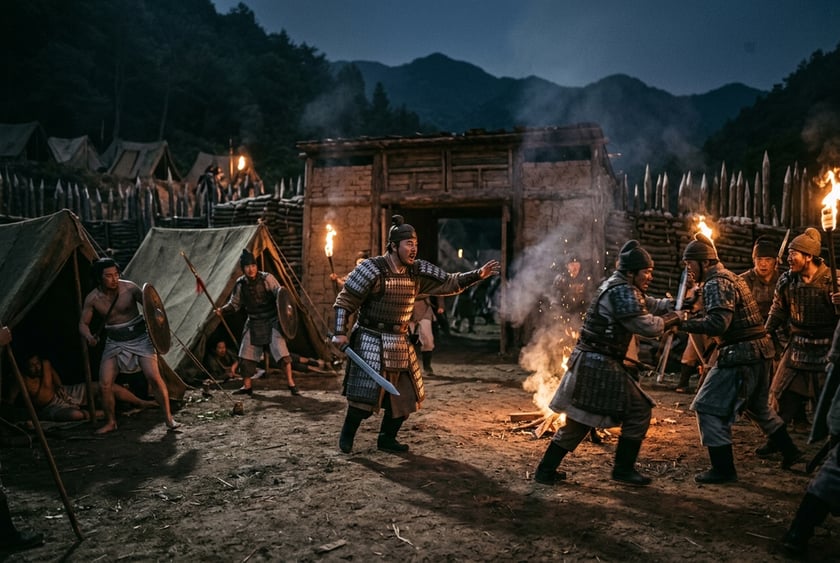
The unfolding of the event is richly dramatic [c:17083]. The Wei general Cen Wei led his troops driving Muniuliuma laden with grain along the Qishan road; partway along they encountered a unit on patrol, and Cen Wei sent men to verify by reconnaissance that it was Wei troops before comfortably merging. This was precisely the trap Zhuge Liang had laid in advance — the supposed "Wei troops" were in fact Shu troops in disguise. Once the two forces merged, the Shu side suddenly revealed their identity; Wang Ping personally led his soldiers to strike from within the column, the Wei troops were caught completely off guard, Cen Wei was killed, and the remainder scattered. Wang Ping not only recovered the grain but also led the entire train of Muniuliuma away. When Guo Huai heard the report and galloped up to rescue, Wang Ping ordered his soldiers to twist the Muniuliuma's "tongues" (the critical mechanical switch of the device), rendering them immovable, then abandoned them all along the road and fought a rearguard action as he withdrew. Guo Huai, assuming he had stumbled upon a windfall, ordered them collected — with the result that his Wei troops exerted every effort pushing and pulling, yet the Muniuliuma "could not be driven at all." While Guo Huai was puzzling over this, Wei Yan and Jiang Wei burst out from behind the mountains in two columns and launched a flanking encirclement, with Wang Ping turning his troops around to complete the enclosure. After Guo Huai fled in defeat, Wang Ping ordered the Shu troops to twist the Muniuliuma's tongues back to their original position, and successfully drove them away again. Watching from a distance, Guo Huai then saw yet another column — "carrying flags and swords, of strange and eerie appearance" — driving the Muniuliuma away as swiftly as a surging tide; the Wei troops cried out "this must be divine assistance" and no longer dared to give chase.
Outcome
At the tactical level, this engagement showcased three layers of ingenuity. First, an "internal assault" launched by disguised infiltrators embedded within the Wei force opened the battle. Second, the Muniuliuma's mechanical lock-down function created the "seize it and still can't take it away" anti-capture trap. Third, ambushing flanking forces combined with a mystifying visual display produced psychological shock. Guo Huai, as the principal Wei commander on the Longxi front who had fought the Shu forces on numerous occasions, in this engagement was subjected to total intellectual domination — unable to protect the grain road, unable to reclaim the equipment, and unable to explain the origin of that final column of "spirit soldiers" [c:17083]. At the strategic level, the victory in this grain-road engagement gave the Shu army a period of supply stability during the Wuzhangyuan phase, providing the material basis for the prolonged standoff.
Impact
In the Romance's narrative, this engagement is the archetypal display of Zhuge Liang's philosophy of "victory through ingenuity," though its historical authenticity remains disputed — neither the specific method of deployment nor the mechanical principles of the Muniuliuma are clearly recorded in the official histories; one can only conjecture that during the fifth northern campaign it did indeed shoulder an important grain transport role, but whether a mechanism with trigger-lock properties such as the "twisted tongue" existed in practice remains in the realm of literary imagination. Even so, this narrative has exerted long-term influence in several respects afterward. First, it pushed the concept of "transport vehicle plus tactical design as a composite" to an extreme, becoming a classic case study in later military manuals of the "lure the enemy into reverse seizure" pattern. Second, it reinforced the image of Zhuge Liang as "approaching the divine" in his strategic arts — capable of making the enemy believe "spirit soldiers have come to his aid." Third, from the perspective of how historical figures are constructed as characters, it further casts Guo Huai into the role of "defeated time and again" as a foil — a sharp contrast to the capable official depicted in official history who successfully held Longxi on multiple occasions and maintained prolonged opposition against Jiang Wei. In the tension between literature and history, the Muniuliuma grain transport battle is one of the finest specimens for observing the narrative strategy of the Romance of the Three Kingdoms.