Strategic Background
As a modern military historian, the strategic intent of Diercibeifa was entirely different from Diyicibeifa. Only a few months after the first northern campaign ended in failure, Zhuge Liang moved again. On the surface this looks like an eager attempt to recover lost ground; the underlying reasons are twofold. First, Sunwu had dealt Cao Xiu a crushing defeat at Shiting in the eighth month of 228, forcing Wei to shift forces eastward toward the Huai River, leaving the Guanzhong defenses relatively thin — a rare strategic window. Second, Zhuge Liang's "Second Memorandum on the Expedition" contained a frank self-critique of the previous failure and made explicit the logic of Shuhan's existential trade-off — "if we do not attack the enemy, the royal enterprise will also perish" — making offensive operations a structural necessity. The campaign's objective was therefore shifted from "seizing Longyou" to "breaking through Chencang and seizing the throat of Guanzhong," aiming to push the front directly from the western Long mountain range to the edge of the Guanzhong basin.
Deployments
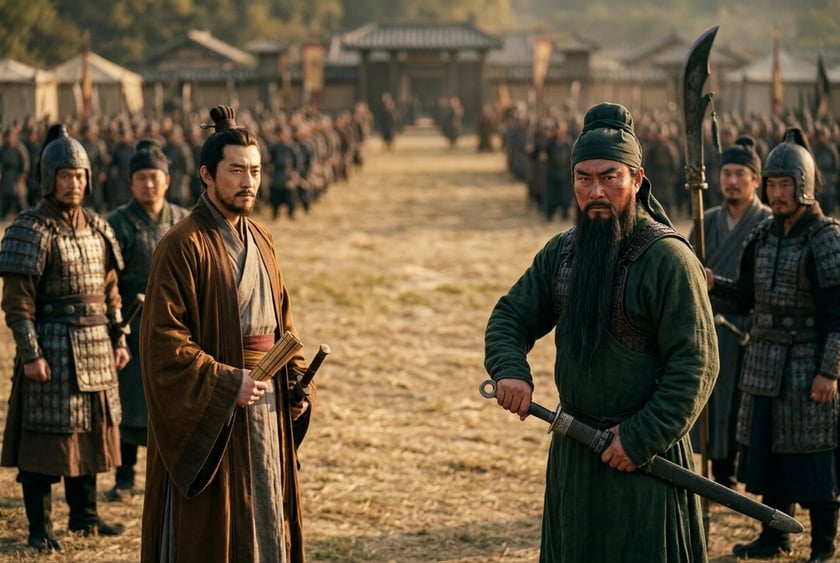
Shuhan's deployment prioritized speed; Wei Yan served as the lead vanguard and drove straight toward Chencang through the Chencang valley. This route was the reverse of Han Xin's legendary flanking march of earlier centuries — it was short and the supply line was tight, the extreme solution Zhuge Liang chose when calculating the limits of his supply chain. On the Wei side, Cao Zhen, though bruised by Diyicibeifa, retained his command and personally volunteered, nominating the fierce warrior Wang Shuang from Didao in Longxi — "wielding a sixty-jin broadsword, riding a thousand-li steed, drawing a two-dan iron-core bow, with three meteor hammers hidden on his person" — as the vanguard commander; Cao Zhen himself and Guo Huai and Zhang He each held separate passes. The true obstacle for the Shuhan army was Hao Zhao, who had been pre-positioned by Cao Zhen to defend Chencang and had been reinforcing its fortifications ever since Diyicibeifa ended.
Key Decision Points
The entire campaign's outcome hinged on the assault on Chencang. Hao Zhao held the city with just over a thousand men. The Shuhan forces first used scaling ladders — burned down by fire arrows; then battering rams — smashed by hurled boulders; then underground tunnels — intercepted by counter-ditches dug inside the walls. These three layers of attack and defense were essentially a contest at the outer limits of siege technology. Zhuge Liang faced two choices: concentrate Shuhan's main force and assault at any cost to take Chencang and then exploit the breakthrough; or acknowledge that the siege was hopeless, withdraw decisively, and preserve the main force intact. He chose the latter. Tactically this looked like weakness; strategically it was clarity — Shuhan could not afford to bleed its limited elite forces against an isolated stronghold that did not lie on the primary strategic axis.
During the withdrawal, the killing of Wang Shuang was one of the few precise operations that both historians and novelists alike have praised: the Shuhan force feigned retreat, Zhang Yi staged a false rout, Liao Hua and Wang Ping lay in ambush, and Wang Shuang — misthrown meteor hammer striking a Shuhan officer — pursued too deep and was shot dead by a volley of arrows. This kill eliminated the leading Wei pursuit commander and ensured the safe withdrawal of the Shuhan main force intact.
Outcome and Echoes
The campaign ended with the Shuhan force failing to take the fortified city and pulling back, but at a relatively controlled cost. The Shuhan army avoided a repeat of the sort of main-force organizational collapse that had occurred at Jieting; the killing of Wang Shuang even helped recover morale. Hao Zhao's reputation as a new-generation master of defensive warfare was established by this engagement, and Wei Ming Di issued a special edict commending him. From a broader perspective, Diercibeifa's greatest "non-battle gains" were the structural constraints it exposed for Shuhan's northern campaigns: first, the logistics ceiling — the supply line from Hanzhong to Chencang was already approaching its limit; second, the siege ceiling — Shuhan forces could hold their own against Wei in open-field and mountain warfare, but lacked the manpower scale and logistical depth needed to conduct a prolonged investment of a reinforced city. These two constraints essentially governed the rhythm of all Zhuge Liang's subsequent northern campaigns — deploy fast and seek decision in battle, do not assault fortified cities, seek gains through field engagements. The later Battle of Lucheng and the Shangfanggu encirclement were all extensions of this rhythm.
Counterfactual Analysis
Had Hao Zhao not been at Chencang, and had Cao Zhen failed to reinforce in time, the Shuhan army could very likely have taken this gateway to Guanzhong within two to three weeks; once Chencang fell into Shuhan hands, the western portion of the Guanzhong basin would have been directly exposed to Shuhan forces, and Zhuge Liang might even have pressed toward Changan. But this route in itself would have required Shuhan forces to establish an in-place logistics base; given Shuhan's national strength, the idea of "occupying and holding Guanzhong" was almost impossible to realize — as later demonstrated by Zhong Hui, Jiang Wei, and the grinding campaigns in Hanzhong and Jiange. A second counterfactual: had Zhuge Liang chosen to force the Chencang assault and turned Diercibeifa into a "siege of Chencang," he might have achieved a breakthrough in the short term, but more likely would have been counter-encircled once Sima Yi's relief force arrived (in the novel, Sima Yi is quoted as recommending Cao Zhen to lead the relief), suffering unbearable human losses. In this sense, the "withdrawal without victory" of Diercibeifa was not a failure but an honest acknowledgment of Shuhan's national capacity.