Background
In Romance of the Three Kingdoms, the Battle for Chencang is presented as a pivotal episode in Zhuge Liang's Second Northern Expedition, set in the winter of the sixth year of Jianxing. The strategic focus was not simply the capture of a city, but whether the Chencang route could be opened so the advance into Guanzhong could continue. When Cao Rui asked how to respond to the Shu army, Sima Yi judged that Zhuge Liang might take the route through Chencang and recommended building fortifications in advance, nominating Hao Zhao to defend them. Wei thus turned a potential invasion route into a prepared defensive position. The narrative portrays Wei’s response as anticipatory: the defenders did not meet the attack on the spur of the moment, but relied on fortifications, troops, and terrain to make the route a bottleneck that Shu would have to spend time and resources to pass. It is important to note that this account is based on the novel’s narrative in chapters 96 to 99, not on corroboration from independent historical sources. The characters’ words and actions, and the details of the campaign, should therefore be understood first and foremost as the novel’s expression of political and military concerns. The passages provided also do not give the full conclusion of the Battle of Chencang, so its outcome must remain unknown.
Main Figures
Hao Zhao is the central figure on the defending side. The novel first has Sima Yi describe him as “resourceful,” skilled at defense, and suited to guarding a strategic route. It then translates this assessment into action through defensive measures such as deep trenches and high ramparts, abatis, fire arrows, flying stones, and an inner moat. Zhuge Liang, in turn, is cast as the decision-maker directing the assault. He believes Chencang is essential to the advance, refuses to take a detour, and orders Wei Yan to attack. When ladders, battering rams, and tunnels fail, he continues to press the assault. Wei Yan is the frontline commander, while Liao Hua is ordered to lead troops in digging a tunnel; together, they represent attempts at a direct assault and an engineering breakthrough. Wang Shuang, a commander of Wei’s relief forces, is recorded in the novel as having been killed. Zhang He appears later in the account, pursuing the Shu army. When Cao Zhen hears that Wang Shuang has been slain, he falls ill with grief and returns to Luoyang, showing how battlefield losses affected Wei’s command. Zhang Ni and Wang Ping appear in chapter 99 in the deployment to defend the old Chencang road, while Sima Yi takes part in assessing and planning for the campaign beforehand. Together, the figures form a picture of strategic anticipation, the defense of a fortified city, the repulse of repeated assaults, and subsequent troop redeployments.
Key Issues
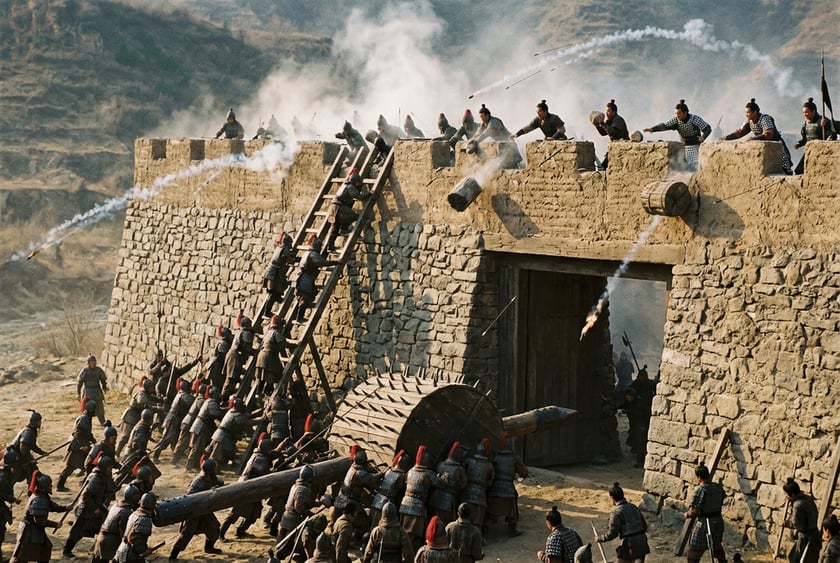
First, Chencang illustrates the relationship between a route and a strategic stronghold. Zhuge Liang’s view that “only after taking this city can the army advance” shows that the attackers regarded the city as a prerequisite for further progress. The defenders, by relying on the city’s fortifications, turned that prerequisite into a war of attrition. The siege methods described in the novel also form a sequence of escalating techniques: Wei Yan leads a direct assault; the attackers then try to scale the walls with ladders, batter them with rams, fill in the moat, and dig tunnels to break through. Hao Zhao counters by burning the ladders with fire arrows, smashing the rams with flying stones, and digging another trench inside the city to intercept the tunnels. The contest between attackers and defenders is therefore not merely a clash of courage, but also a competition in intelligence, engineering, troop deployment, and control of time.
Second, the novel uses the choice between “taking a detour” and “persisting” to show the costs of strategy. A Shu scout report raises the possibility of taking the Taibai Ridge route, but Zhuge Liang believes Chencang is crucial to Jieting and the continued northward advance, so he chooses to keep attacking in an effort to secure the passage. As the siege drags on without success, the initially proactive assault comes under increasing time pressure.
Third, the novel does not reduce victory or defeat to the outcome of a single siege. Wang Shuang’s death is a local battlefield success, but it does not in itself prove that Chencang was captured or that Shu achieved its goal of advancing north. The gap between a tactical victory, control of a stronghold, and strategic success is key to understanding this campaign.
Political Consequences
In the novel’s political narrative, the defense of Chencang first demonstrates Wei’s ability to strengthen its frontier defenses by appointing and positioning commanders in advance. Sima Yi proposes the plan, Cao Rui approves it and appoints Hao Zhao, making the city’s defense not merely an individual commander’s achievement but also an example of central decision-making working in tandem with frontline execution. Wei, however, does not escape losses: Wang Shuang’s death leaves Cao Zhen grief-stricken and worsens his illness. Cao Zhen then returns to Luoyang, while Guo Huai, Sun Li, and Zhang He guard the various routes to Chang'an. The narrative thus links the loss of a commander with adjustments to the military deployment. The text does not, however, sufficiently explain the impact of these changes on Wei’s political situation or overall military strength, so their political consequences should not be exaggerated. For Shu, the failure to open the route immediately through repeated assaults means its plans for advance are checked by the city’s defenses. In chapter 99, Zhuge Liang orders Zhang Ni and Wang Ping to guard the old road with a small force, and plans to wait for the Wei army to withdraw before attacking with the main army. This presents him as a commander who values conserving troops and seeks to gain the initiative through terrain and timing. These passages primarily serve to shape the two states’ commanders and strategic styles; on their own, they do not establish specific decisions or campaign outcomes in real political history.
Counterfactual Scenarios
If Wei had not built the city of Chencang in advance, or if Hao Zhao had failed to organize its defenses into successive lines of resistance, the Shu army might have found it easier to advance along the route, forcing Wei to meet it farther back. But the novel alone does not allow us to conclude that Zhuge Liang would therefore have captured Guanzhong, since these passages do not fully explore factors such as roads, supplies, and the forces defending the areas farther ahead. Conversely, if Zhuge Liang had accepted his subordinates’ advice and taken the mountain path over Taibai Ridge, he might have avoided the attrition of a frontal assault on the fortified city, but he might also have faced difficulties transporting supplies over mountain roads, deploying his forces, and linking the route to the planned direction of advance. The novel offers insufficient evidence to determine which route was better. Another possibility would have been for the Shu army to pause the siege and concentrate its forces on blocking the relief route, forcing the defenders to endure a longer isolation. Yet this would also have given Wei time to assemble forces and counterattack. Wang Shuang’s death, too, can only be treated as a local success: if Wei’s relief and pursuit forces failed to coordinate effectively, Shu might have gained greater freedom of action; if the relief forces continued to apply pressure, Shu would have faced the added strain of besieging the city while dealing with the relief army on a second front. The value of counterfactual analysis lies not in claiming that any particular outcome was inevitable, but in revealing how the situation at Chencang depended on the interaction of routes, fortifications, time, and relief forces. Since the available passages end with related deployments and battle episodes, the campaign’s final outcome should still be marked as unknown.