Strategic Background
The Battle of Shiting was on its surface a limited engagement, but behind it lay the last large-scale military demonstration by the Sunwu regime on the eve of its imperial proclamation. In the second year of Taihe (228), Caowei had just turned back Zhuge Liang's first northern campaign on the western front — Jieting had been won — and Sima Yi and Zhang He stood at the height of their prestige. In the southeast, following Cao Pi's death, Cao Xiu of the imperial clan supervised Yangzhou and remained the embodiment of royal family military authority. Sun Quan faced an obvious strategic dilemma: he wished to proclaim himself emperor, but lacked a sufficiently weighty victory to legitimize the move; he wished to consolidate the Huainan front, but every frontal assault on Hefei had ended in defeat — across the twenty years since Chibi, there were almost no credible northern campaign victories to speak of. Under this twin constraint of "must win, yet cannot fight head-on," the Wu side chose an asymmetric approach: "feigned surrender to draw the enemy deep, with a pre-arranged ambush." Zhou Fang, acting as a government official, personally wrote letters of supposed defection and cut off his own hair as a oath of sincerity — deploying an officer's personal honor as the instrument of deception. This kind of stratagem was relatively rare in the Caowei military and represented an unorthodox paradigm; it was the true pivot of the Battle of Shiting.
Dispositions of Both Sides
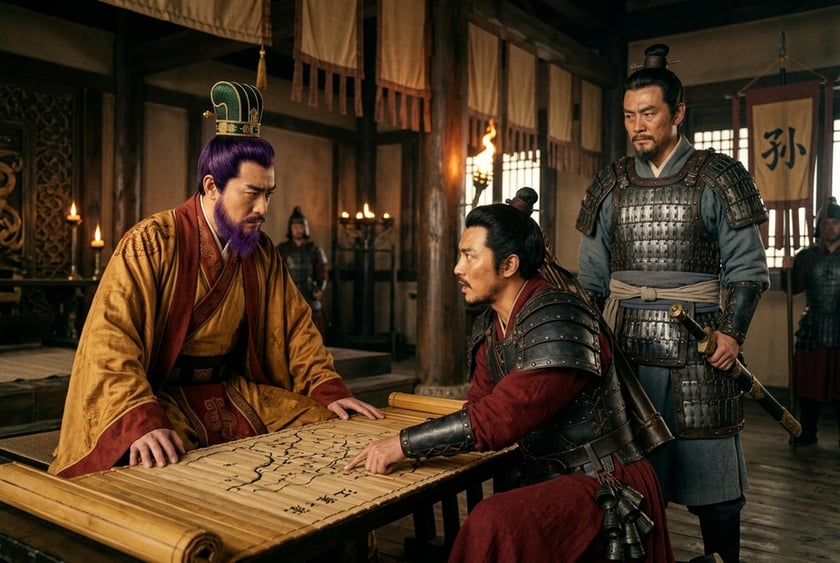
The Wei commander Cao Xiu was an achievement-driven imperial clan general who needed a victory comparable to what Sima Yi and Zhang He had accomplished on the western front. When he received Zhou Fang's secret letter, he was psychologically inclined to believe it. Caowei's deployment called for a broad advance with the vanguard pushing deep into the Shiting defile; deputy Jia Kui was ordered to stand ready in support. But Jia Kui's proposed support plan — "You must station the entire force at Wancheng; the Commander must not advance rashly but wait for us to strike from both sides" — was rejected by Cao Xiu with the retort, "Are you trying to steal my credit?" [c:17424]. The essential nature of this internal conflict was a struggle for primacy between the imperial clan faction and the non-clan faction, not a tactical disagreement. The Wu deployment was structured in three layers: the first layer had Zhou Fang drawing the enemy deep through feigned surrender on the outskirts of Wancheng; the second had Xu Sheng as vanguard seizing and blocking the Shiting defile, shutting off any forward route; the third had Zhu Huan and Quan Cong each leading thirty thousand troops around both flanks of Mount Shiting to strike at the rear of the Wei camp, using signal fires as the trigger [c:17425][c:17426]. Lu Xun himself led the central army along the main road — a complete triangular encirclement of "gate sealed, two flanks pinching, frontal attack to break the formation."
Critical Decision Points
The Battle of Shiting had four critical junctures. The first: Cao Xiu ordered Jia Kui executed but was dissuaded by his generals and settled for "stripping him of troops while keeping him in service" — a suboptimal second-best choice that neither adopted Jia Kui's advice nor truly removed him, which is why Jia Kui's feint forces were later able to save Cao Xiu himself [c:17424]. The second: Zhou Fang's sudden disappearance from within Cao Xiu's army. After Cao Xiu reached Shiting, scouts reported Wu forces holding the mountain pass; a frantic search for Zhou Fang revealed that he had "taken a few dozen men and vanished without a trace," at which point Cao Xiu finally realized he had fallen into a trap [c:17425]. The third: the "double ambush" scheme in which Zhang Pu and Xue Qiao each held two ten-thousand-strong forces in reserve north and south of Shiting — ostensibly Cao Xiu's counter-strike plan against the Wu forces before him. But he did not know that Wu's real main force, Zhu Huan and Quan Cong, had swung around the outer edge of Mount Shiting and was already behind his own camp; his own ambush deployment became a burden that slowed his response when the night assault came [c:17425][c:17426]. The fourth: Jia Kui setting up feint forces as Cao Xiu's routed troops fled — planting banners densely in wooded terrain and narrow, rugged paths, causing the pursuing Xu Sheng to "suspect an ambush and dare not advance further," thereby saving Cao Xiu [c:17426]. These four junctures together determined that the Battle of Shiting was a tactically brilliant ambush, but at the campaign level it failed to capture or kill Cao Xiu outright — leaving the political aftermath of Cao Xiu's return to Luoyang to die of illness.
Outcome and Reverberations
The immediate military gains of the Battle of Shiting were substantial: Wei troops abandoned their wagons, horses, military supplies, and equipment wholesale, and Xu Sheng pursued them all the way to Jiaxia [c:17426]. But the more consequential impact was a cascade of political developments. Cao Xiu fell ill from shame and anguish after the battle, a carbuncle erupted on his back, and he died — the first generation of celebrated Caowei imperial clan commanders was essentially extinct. The vacancy was filled directly by non-clan generals such as Man Chong, and Caowei's military authority shifted further toward powerful non-clan ministers, adding another layer to the personnel foundation that would culminate in the Gaopinglingzhibian. On the other side, Sun Quan formally proclaimed himself emperor the year after this victory (229), using the Battle of Shiting as military validation of his imperial legitimacy — a critical step in Wu's self-elevation from "peripheral regime" to "independent empire." From Sima Yi's perspective, the Battle of Shiting was a live lesson in how "a front-line collapse for Caowei can trigger a contraction across the whole board." He immediately abandoned his pursuit in Longxi and fell back to protect Changan — the habit of "designing deployments around worst-case assumptions" became his defining style from that moment on.
Counterfactual Analysis
What if Cao Xiu had actually listened to Jia Kui's proposal to "attack by two roads converging on Wancheng" before the battle? The most likely chain of events: the Wei army advances on two axes, the "draw the enemy deep" precondition of the Wu feigned-surrender plan falls apart, and Lu Xun's triangular encirclement cannot take shape. At most the campaign would have ended in mutual withdrawal — Wu would not have achieved an overwhelming victory. The second counterfactual: if Zhu Huan and Quan Cong's flanking signal fires had not been lit on time, Xu Sheng's frontal assault and the Wei pre-positioned ambush forces would have collided head-on, and the Wu troops, dispersed as they were, might have become bogged down. The third, more macro counterfactual: if Cao Xiu had survived and returned to Luoyang merely to be punished and kept in post, the Caowei imperial clan's military authority might have persisted for another generation, delaying Sima Yi's rise by five to ten years — with cascading effects on the entire political timetable of the eventual supplanting of Wei. Seen against these alternate paths, the true historical weight of the Battle of Shiting lies not in casualty figures, but in how a single carefully engineered ambush accelerated three things simultaneously: the decline of Caowei imperial clan military power, the legitimation of Wu's imperial proclamation, and the comprehensive takeover by non-clan grandees — three developments intertwined within a single year, forming a pivotal turning point in the political direction of the second half of San Guo.