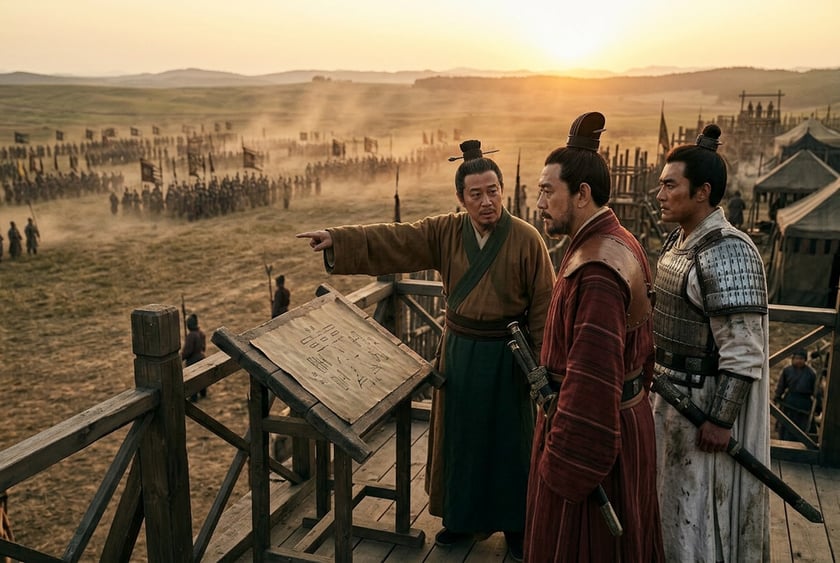
Background
The Zhou Fang false-defection case in the seventh year of Huangwu (228) was the detonator of the Battle of Shiting. At the strategic level, Sun Quan had by this time gradually established a posture of full-scale advance against Cao Cao: the Sun-Liu relationship had been repaired after Yiling, the internal Shanyue pacification was essentially complete, and Lu Xun had accumulated sufficient command prestige in the Jingzhou direction. What was still lacking was an opportunity to lure Caowei's main force into a pre-designated battlefield. Zhou Fang was selected to execute this task both because his position as governor of Poyang gave him a credible basis for "rebellion" in the border zone — he had previously suppressed local revolts by Peng Shi and Peng Qi, making him in Wei's eyes a candidate border commander "willing to communicate with the Central Plains" — and because his background as a scholar who "from youth loved learning and was recommended as a filially pious and incorruptible man" gave his intelligence packaging a higher degree of believability. This method of selecting personnel based on "using a genuine identity to disguise intent" was one of the most sophisticated intelligence-warfare techniques of the San Guo period.
Forces Involved
This engagement involved four parties: Sun Quan and Lu Xun as the top-level decision-makers; Zhou Fang as the executor; Cao Xiu as the target; and Sima Yi and Jia Kui as the representing divergent responses within Caowei. Among these, Jia Kui's judgment — "Zhou Fang is a man of intelligence and strategy; he would certainly not genuinely surrender. This is only a deceptive ploy to lure troops" — was entirely correct as an intelligence warning, but it was suppressed. The reason was Cao Xiu's excessive confidence in his own judgment, compounded by the structural contradiction within Caowei's military of "generals and ministers competing for credit." When Jia Kui persisted in his recommendation for a pincer strategy, Cao Xiu "shouted for his attendants to drag him out and behead him," and only a collective plea from the assembled generals spared Jia Kui his life — a detail that speaks directly to the fact that Caowei's army had already lost its mechanism for allowing subordinates to disagree.
Critical Turning Points
The false-defection case contained two decisive moments. The first was Zhou Fang's dispatch of the "seven letters" — in the preliminary setup phase, Zhou Fang asked Sun Quan's approval to "send a trusted man with seven sealed documents to lure Xiu", using seven letters written from different perspectives and at different times to construct a complete narrative of "I am being progressively squeezed by Sunwu and have no choice but to submit to Wei." The second was Zhou Fang cutting off his own hair as a personal oath in Cao Xiu's presence — when Cao Xiu doubted his words, Zhou Fang "drew a sword, cut off his hair, and flung it to the ground", invoking the traditional concept from the Classic of Filial Piety that "one's body, hair, and skin are received from one's parents," elevating the dispute over "whether to believe him" from paper-based packaging to a pledge of personal character. The combination of these two steps — textual preparation followed by in-person drama — was the core of why the false defection succeeded.
Suppression and Outcome
After Zhou Fang succeeded in luring Cao Xiu in, Lu Xun immediately at Shiting "chose open ground to lay out his formation and awaited the Wei army", with Xu Sheng as vanguard and Zhu Huan and Quan Cong on the left and right flanks, launching a pincer strike at the moment when the Wei marching column was stretched thin and vulnerable in mountainous terrain. The operational details of the battle itself fall outside the scope of this event, but the outcome is clear: Cao Xiu was routed in defeat; "the carts and baggage, cattle, horses, donkeys and mules, military supplies, and equipment seized were beyond counting, and the number of surrendered soldiers exceeded tens of thousands", dealing a decisive blow to Caowei's offensive capacity in the Huainan direction. Sun Quan's reward for Zhou Fang was magnificent — Sun Quan personally left the walls of Wuchang to receive the returning army, enfeoffed Zhou Fang as a Marquis Within the Passes, and publicly praised him: "Your cutting off your hair to accomplish this great undertaking — your merit and name shall be written on bamboo and silk". This public ritualization of a false-defection achievement served simultaneously as a personal reward for Zhou Fang and as a signal to other border commanders: Sunwu was willing to pay the highest-grade return for high-risk intelligence missions.
Historical Echoes
The Battle of Shiting was Cao Xiu's final campaign — he developed a carbuncle on his back afterward and died; the process by which Caowei's clan-based famous generals exited the stage accelerated from this point. Viewed over a longer arc, this battle had three strategic consequences: first, Caowei's offensive posture in the Huainan direction went silent for over a decade, greatly relieving the pressure Sunwu faced at Hefei; second, Lu Xun's command standing was thereby consolidated, forming the foundation for his later rise to the chancellorship during the Chiwu years; third, Sima Yi, as the de facto successor to Caowei's military system after Cao Xiu's death, from this point ascended to a more central political position — from this perspective, Zhou Fang's single act of false defection indirectly accelerated the decline of Caowei's clan forces and the rise of Simashi. From the perspective of intelligence history, this case is a classic example in ancient Chinese military history of combining "long-term documentary packaging" with "in-person bodily pledge" — its techniques remain standard texts in the study of deception and counter-deception to this day.