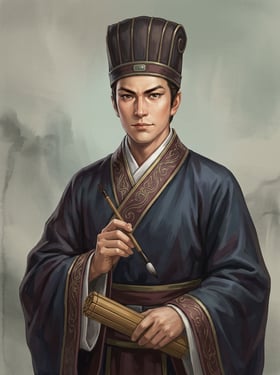
Historical Record
Yang Xiu, styled Dezu, came from the eminent Yang clan of Hongnong; his father was the Grand Commandant Yang Biao. Yang Xiu was renowned for his brilliant talent and held important posts within Cao Cao's group. He was on close terms with Cao Cao's third son Cao Zhi, being an important aide and supporter at Cao Zhi's side. In the sixteenth year of Jian'an (211), Cao Zhi was enfeoffed as Marquis of Pingyuan, and three years later (214) was transferred to be Marquis of Linzi. During Cao Cao's campaign against Sun Quan, he once ordered Cao Zhi to remain and guard Ye, encouraging him with the example of his own appointment as Prefect of Dunqiu at the age of twenty-three, in the hope that Cao Zhi would accomplish something. However, although Cao Zhi was much favored by Cao Cao for his outstanding talent and was for a time regarded as a candidate for heir apparent, his nature was willful and unpolished, and he drank without restraint. By contrast, Cao Pi was skilled at dissembling and made use of the palace attendants around him to speak well of him, ultimately succeeding in securing his position as heir. Yang Xiu, together with Ding Yi and Ding Yi, were precisely the "wings" of Cao Zhi in his contest for the position of heir apparent, playing an important role in this process. Cao Cao repeatedly hesitated over the matter of the succession, and the assistance of Yang Xiu and the others doubtless deepened this wavering, but in the end could not change Cao Zhi's fate.
In the Novel
In Romance of the Three Kingdoms, Yang Xiu's image is endowed with more vivid and tragic literary qualities. He first appears in Chapter 60, when Zhang Song came as an envoy to Cao's camp, and because of his unremarkable looks and provoking words Cao Cao was displeased with him. At this point Yang Xiu stepped forward and engaged Zhang Song in a brilliant debate. Trusting in his own broad learning and eloquence, he looked down on the scholars of the realm and tried to display before Zhang Song the abundance of talent in the Central Plains. Yang Xiu boasted to Zhang Song of Cao Cao's New Book of Mengde, only to find that Zhang Song could recite the entire work from memory backward and pointed out that it was the work of an anonymous writer of the Warring States, which greatly astonished Yang Xiu, made Cao Cao lose face, and even led him to order the book burned.
Yang Xiu's cleverness is shown many times in the novel, but it also repeatedly touched on Cao Cao's taboos. He could easily see through Cao Cao's intent in writing the character "alive" on the garden gate — that he found the gate too "wide" — and could read the hint in "a single box of pastry" as "one mouthful of pastry per person," and even saw through Cao Cao's ruse of "killing in a dream," declaring frankly, "The Chancellor was not in a dream; it is you, sir, who were in the dream". These episodes all display Yang Xiu's extraordinary insight, but they also made Cao Cao increasingly resentful of him, sowing the seeds of murder. In the contest between Cao Zhi and Cao Pi for the position of heir, Yang Xiu strove all the more to scheme for Cao Zhi. He once advised Cao Zhi that when going out the gate of Ye, if he were obstructed he might directly cut down the gatekeeper, to show his decisiveness in carrying out the king's command; though this for a time won Cao Cao's praise of Cao Zhi, when Cao Cao learned it had been taught by Yang Xiu, he came instead to dislike Cao Zhi too. Yang Xiu even prepared for Cao Zhi "more than ten answer-notes," enabling him to reply fluently to Cao Cao's questions, but this was finally reported by Cao Pi, deepening Cao Cao's murderous intent toward Yang Xiu.
In the end, Yang Xiu's death came during the Hanzhong Campaign, when Cao Cao, caught between advance and retreat, gave out the watchword "chicken ribs." Relying on his insight into Cao Cao's mind, Yang Xiu immediately judged that Cao Cao was about to withdraw the army and had the soldiers pack their baggage. This act was seen by Cao Cao as throwing the troops into confusion, and Yang Xiu was finally executed on the charge of "deluding and disordering the army's morale," dying at the age of only thirty-four. The Yang Xiu of the novel is a tragic figure who, trusting in his talent and acting recklessly, was undone by his own cleverness, his talent and his fate forming a stark contrast.
Key Relationships
* Cao Zhi (friend_of): Yang Xiu was Cao Zhi's close friend and important aide. In the historical record, Yang Xiu, together with Ding Yi and Ding Yi, were the "wings" of Cao Zhi in his contest for the position of heir apparent, actively assisting him. In the novel, Yang Xiu schemed for Cao Zhi all the more, even preparing "answer-notes" for him in an attempt to help Cao Zhi perform well before Cao Cao, which finally angered Cao Cao and became one of the important reasons for his death.
* Cao Wei (serves): Yang Xiu held such posts as Registrar within Cao Cao's group, serving the Cao Wei regime. With his broad learning and eloquence he gave counsel at Cao Cao's side and handled military and governmental affairs.
* Yang Biao (parent_of): Yang Xiu was the son of the Grand Commandant Yang Biao, of an eminent family of distinction. This illustrious background to some degree facilitated Yang Xiu's career and gave him a certain standing within Cao Cao's group.
* Cao Cao (advises_in): Yang Xiu was Cao Cao's subordinate and often gave him counsel, but because of his exceptional wit and his insight into Cao Cao's mind he repeatedly touched on Cao Cao's taboos. From reading the character "wide" and "a single box of pastry," to seeing through "killing in a dream," and finally the "chicken ribs" affair, Yang Xiu's cleverness became instead the root of the calamity that cost him his life.
Iconic Scenes
* Debating Zhang Song (novel only): When Zhang Song came as an envoy to Cao's camp, Yang Xiu engaged him in a fierce verbal contest. Yang Xiu tried to display the talent of the Central Plains with Cao Cao's New Book of Mengde, but Zhang Song recited it on the spot and pointed out that it was an old work, greatly astonishing Yang Xiu and indirectly prompting Cao Cao to tear up the New Book of Mengde. This scene fully displays Yang Xiu's erudition and self-conceit, as well as Zhang Song's photographic memory and wit.
* Deciphering the inscription on Cao E's stele (novel only): Cao Cao, Yang Xiu, and others were appreciating the inscription on Cao E's stele at the home of Cai Yan; on the back of the stele were eight riddle characters written by Cai Yong: "yellow silk, young wife, grandson, mortar of pungent herbs." None of the others could solve it, and only Yang Xiu could swiftly decipher it as the four characters "exquisite fine phrasing," which greatly amazed Cao Cao, but also bred his wariness of his talent.
* The "chicken ribs" affair: During the Hanzhong Campaign, Cao Cao, caught between advance and retreat, gave out the watchword "chicken ribs." Relying on his keen insight, Yang Xiu immediately judged that Cao Cao was about to withdraw the army and had the soldiers pack their baggage. This act was seen by Cao Cao as throwing the troops into confusion and became the direct fuse for Yang Xiu's execution. This event concentrates Yang Xiu's cleverness and reckless reliance on his talent, as well as Cao Cao's suspicious nature and decisive ruthlessness.
* Repeatedly touching on Cao Cao's taboos (novel only): Yang Xiu repeatedly used his exceptional wit to read Cao Cao's hidden thoughts, such as the character "alive" on the garden gate, "a single box of pastry," and the false appearance of "killing in a dream." Although these events displayed Yang Xiu's cleverness, they also made Cao Cao dislike him and grow murderous, laying the groundwork for his eventual tragic fate.
Portrait file
Character profile
- Character
- Learned and eloquent, he presumed upon his talent and looked down on the scholars of the realm. Trusting in his gifts and unrestrained, quick-witted and fond of showing off, he repeatedly ran afoul of Cao Cao's taboos.
- Manner of speech
- Sharp and quick in intellect, lucid in tone as he parsed characters and unraveled riddles, often self-satisfied in his sophistry.
- Life
- He died at the age of thirty-four; for leaking confidential instructions and consorting with the feudal lords he was seized and executed by the Grand Progenitor, implicated also in the affair of Cao Zhi. In the end he was beheaded outside the camp gate on the charge of 'confounding the morale of the army.'
- Anecdotes
- A man of Hongnong, he was recorder in the Chancellor's office and once served as army recorder on campaign. Together with the Ding Yi brothers he formed the wings supporting Cao Zhi, and was one of the two whom Mi Heng dismissed as 'mere boys.'
Relationships
5 relationships
Family1
Friends1
Enemies2
Other1
Quotes
25 recorded lines · 3 featured
「以今夜號令,便知魏王不日將退兵歸也:雞肋者,食之無肉,棄之有味。今進不能勝,退恐人笑,在此無益,不如早歸。來日魏王必班師矣。故先收拾行裝,免得臨行慌亂。」
The 'chicken ribs' allusion embodies both Yang Xiu's talent and the source of the disaster he courted; it is widely circulated.
「『門』內添『活』字,乃『闊』字也。丞相嫌園門闊耳。」
The 'kuo (wide)' character-on-the-gate allusion shows Yang Xiu's exceptional wit and is also a portrait of his talent-flaunting arrogance.
「盒上明書『一人一口酥』,豈敢違丞相之命乎?」
The 'one bite of pastry per person' allusion highlights Yang Xiu's brilliance, yet also hints at his overexposed edge.
Chapters4 回 ▸
- 史ch.19
- 演ch.60ch.71ch.72
Relationship timeline4 条 ▸
Inner monologues · AI-generated3 段 ▸
- I am Yang Xiu, courtesy name Dezu. If I were to ask myself now what I relied on throughout my life, what would it be? No
- I am Yang Xiu, courtesy name Dezu, a chief clerk in the Chancellor’s residence, and have always prided myself on my quic
- I am Yang Xiu, courtesy name Dezu, son of Yang Biao, the Grand Commandant. I recall that when I first served as registra
Life events3 ▸
- 0211-01-01 · ChengduZhang Song Presents the Map and Plots to Cede Shu· Witness
- 0219-01-01 · HanzhongDeath of Yang Xiu· Victim
- 0220-01-01 · YeSuccession Struggle Between Cao Pi and Cao Zhi· Killed in action