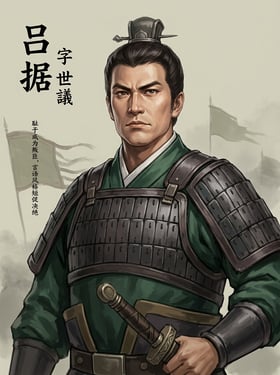
Historical Record(史载)
Lü Ju, styled Shiyi, was a son of the Eastern Wu general Lü Fan. He first entered service as a Gentleman through his father's privilege, and later, when his father Lü Fan fell gravely ill, was appointed Deputy Army Colonel to assist in handling military affairs. After Lü Fan died, Lü Ju was promoted to Gentleman of the Household Who Pacifies the Army. During his tenure he repeatedly led troops to suppress mountain bandits; wherever the terrain was most treacherous and difficult, whatever he attacked he successfully pacified. He also once accompanied the Grand Master of Ceremonies Pan Jun in a campaign against the Five Streams, and once again won merit c:893.
When Zhu Ran attacked Fancheng, Lü Ju, together with Zhu Yi, broke through its outer fortifications, and upon returning in triumph was appointed Subordinate General. Thereafter he entered court to fill the post of Commander of the Right Section of the Horse Stables, and was later promoted to Colonel of the Elite Cavalry. In the first year of Taiyuan, the southeast was struck by a great storm, and the river flooded, even submerging the city gates. Sun Quan sent men to inspect the flood conditions, and only Lü Ju was seen to have had men prepare large boats against any emergency. Sun Quan therefore commended him and appointed him General Who Sweeps Away Wei. When Sun Quan fell gravely ill, he appointed Lü Ju Commander of the Right Section for the Crown Prince. After the Crown Prince ascended the throne, Lü Ju was appointed General of the Right c:893.
When the army of Wei marched out to Dongxing, Lü Ju led troops to campaign against them and won merit. The following year, after Sun Jun executed Zhuge Ke, Lü Ju was promoted to General of Agile Cavalry and put in charge of the affairs of the Western Palace. In the second year of Wufeng, he received the staff of authority and, together with Sun Jun and others, raided Shouchun, and on the return route defeated the Wei general Cao Zhen at Gaoting c:893.
In the first year of Taiping, Lü Ju led troops to invade Wei, but before reaching the Huai River he heard that Sun Jun had died and that his younger cousin Sun Chen had succeeded him in controlling the government. Greatly enraged at this, Lü Ju thereupon led his army back, intending to depose Sun Chen. When Sun Chen learned of Lü Ju's intention, he sent the Secretariat with an edict ordering Wen Qin, Liu Zuan, Tang Zi, and others to go and intercept Lü Ju, and dispatched his elder cousin Sun Lü to lead the capital troops to meet Lü Ju at Jiangdu. Lü Ju's attendants urged him to surrender to Wei, but Lü Ju declared, "I would be ashamed to be a rebel subject," and in the end chose to take his own life; his family was exterminated to the third degree c:893.
When Sun Quan was gravely ill, he once summoned Zhuge Ke, Sun Hong, Teng Yin, Lü Ju, and Sun Jun, and entrusted them with affairs after his death c:4904. After Sun Chen took power, Lü Ju and the various commanders jointly submitted a memorial recommending Teng Yin as Chancellor. On the surface Sun Chen appointed Teng Yin Grand Marshal, to replace Lü Dai in garrisoning Wuchang, but Lü Ju led his troops back and sent word to Teng Yin, intending jointly to depose Sun Chen. When Sun Chen learned of it, he sent troops to intercept Lü Ju and dispatched the Palace Attendant and General of the Left Hua Rong and the Secretariat Assistant Ding Yan to inform Teng Yin, urging him to hasten to Wuchang. Knowing that calamity was at hand, Teng Yin thereupon detained Hua Rong and Ding Yan, mustered troops to defend himself, summoned the Commander of the Standing Army Yang Chong and the General Sun Zi, informed them that Sun Chen was committing treason, and forced Hua Rong and the others to write a letter denouncing Sun Chen. Sun Chen would not listen, but on the contrary submitted a memorial claiming that Teng Yin was plotting rebellion, and promised a noble rank to the General Liu Cheng, having him lead troops in an urgent attack on Teng Yin. Teng Yin again held Hua Rong and the others hostage, attempting to forge an edict to mobilize troops, but when Hua Rong and the others would not comply, Teng Yin thereupon killed them c:897.
In the Novel(演中)
In the Romance of the Three Kingdoms, Lü Ju appears mainly in chapters 108, 111, and 113—three chapters in all. However, the Romance's depiction of Lü Ju is relatively brief, and it does not give detailed literary shaping to his life and deeds. He has but a single line of dialogue, which stands in contrast to his standing in history as an important Eastern Wu general. The Romance does not describe in detail his suppression of mountain bandits, his pacification of the Five Streams together with Pan Jun, or his specific performance at the Battle of Dongxing, nor does it dwell on the details of his power struggle with Sun Jun and Sun Chen. The Romance more often uses him as a background figure or a minor character to advance the plot c:893.
The Romance does reflect Lü Ju's character trait of being "ashamed to be a rebel subject," but the specific narrative is less detailed than in the historical records. For example, the historical record states that he took his own life rather than surrender to Wei, but this heroic act is not fully rendered in the Romance, appearing more as a brief summary of a historical event c:893. The Romance also does not mention his specific interactions with figures such as Wen Qin and Pan Jun, and these key relationships recorded in the histories are diluted or omitted in the Romance.
Key Relationships
* Lü Fan (parent_of): Lü Ju was a son of the renowned Eastern Wu general Lü Fan. He first entered service as a Gentleman through his father's privilege, and later, when Lü Fan fell gravely ill, was appointed Deputy Army Colonel to assist in directing military affairs c:893.
* Pan Jun (fights_in): Lü Ju once accompanied the Grand Master of Ceremonies Pan Jun in a campaign against the Five Streams, and won merit in this battle c:893.
* Sun Jun (enemy_of): During Sun Jun's administration, Lü Ju was promoted to General of Agile Cavalry and put in charge of the affairs of the Western Palace. However, after Sun Jun died, Lü Ju expressed displeasure at his younger cousin Sun Chen succeeding to the government, and intended to depose Sun Chen, which indirectly led to his opposition with the Sun Jun family c:893.
* Sun Chen (enemy_of): After Sun Jun died, Sun Chen took power, at which Lü Ju was greatly displeased and led his army back intending to depose Sun Chen. Sun Chen in turn sent troops to intercept Lü Ju, ultimately driving Lü Ju to take his own life c:893.
* Wen Qin (rival_of): To intercept Lü Ju, Sun Chen once sent the Secretariat with an edict ordering Wen Qin, Liu Zuan, Tang Zi, and other generals to combine forces and strike Lü Ju c:897. Wen Qin had once been a Wei general who later surrendered to Eastern Wu, and he, like Lü Ju, was an Eastern Wu general, but under Sun Chen's orders he became Lü Ju's adversary. The histories record that Wen Qin, though in another's state, could not bring himself to bend and humble himself before others, so that from Lü Ju and Zhu Yi to all the great commanders, all hated him, and only Sun Jun constantly supported him c:892.
* Teng Yin (ally_of): After Sun Chen took power, Lü Ju and the various commanders jointly submitted a memorial recommending Teng Yin as Chancellor. When Lü Ju led his troops back, he sent word to Teng Yin, intending jointly to depose Sun Chen, showing that the two had once allied against Sun Chen c:897.
Signature Scenes
* Preparing Boats Against the Flood: In the first year of Taiyuan, the southeast was struck by a great storm, the river flooded, and the city gates were submerged. Sun Quan sent men to inspect the flood conditions, and only Lü Ju was seen to have had men prepare large boats against any emergency. Sun Quan therefore commended him and appointed him General Who Sweeps Away Wei, displaying Lü Ju's foresight and his ability to cope with crisis c:893.
* The Battle of Dongxing: When the army of Wei marched out to Dongxing, Lü Ju led troops to campaign against them and won merit—one of his important military achievements as a commander c:893.
* Intending to Depose Sun Chen and Taking His Own Life: After Sun Jun died, his younger cousin Sun Chen succeeded him in controlling the government. Greatly enraged at this, Lü Ju led his army back, intending to depose Sun Chen. When Sun Chen sent troops to intercept him and his attendants urged him to surrender to Wei, Lü Ju flatly refused, declaring "I would be ashamed to be a rebel subject," and in the end chose to take his own life, dying for his cause—displaying his steadfast loyalty and his spirit of preferring death to submission c:893. This scene is the turning point of Lü Ju's personal fate and the most vivid embodiment of his character.
Portrait file
Character profile
- Character
- Lü Ju was ashamed to become a traitorous subject [c:1]. He hated Wen Qin [c:4].
- Manner of speech
- His manner of speech was curt and resolute [c:13].
- Life
- Lü Ju became a Gentleman through the protection of his father's rank, and was later promoted by Fan Ji to Deputy Commandant of the Army, assisting in military affairs and repeatedly quelling mountain bandits. He followed Pan Jun in the campaign against the Wuxi tribes and won merit; when Zhu Ran attacked Fancheng, he joined Zhu Yi in breaking the enemy's outer encirclement, and was afterward appointed General of the Vanguard. In the first year of the Taiyuan era, Sun Quan, on account of a great storm, sent him to inspect the state of the waters, and he alone took a large ship as a precaution against the unexpected, and was afterward appointed General Who Sweeps Away Wei. When Sun Quan fell gravely ill, he was appointed Commandant of the Right Section of the Crown Prince. After the Crown Prince took the throne, he was appointed General of the Right. When the Wei army came out at Dongxing, he took part in the campaign and won merit. The next year, Sun Jun killed Zhuge Ke, and Lü Ju was promoted to General of Agile Cavalry and put in charge of the affairs of the Western Palace. In the second year of the Wufeng era he joined Sun Jun in raiding Shouchun and defeated Cao Zhen at Gaoting. In the first year of the Taiping era he led troops to invade Wei, but on learning that Sun Jun had died and that Sun Chen had taken his place, he withdrew his army, intending to depose Sun Chen; he was seized by troops Sun Chen sent against him, and in the end took his own life and was exterminated to the third degree of kin [c:3].
- Anecdotes
- He was the second son of Lü Fan and inherited his title [c:8]. He held such offices as Assistant General of the Central Gentlemen, General Who Pacifies the Army of the Central Gentlemen, General of the Vanguard, Commandant of the Right Section of Maxian, Colonel of Elite Cavalry, General Who Sweeps Away Wei, Commandant of the Right Section of the Crown Prince, General of the Right, General of Agile Cavalry, and Overseer of the affairs of the Western Palace [c:8]. He was killed together with Teng Yin by Sun Chen, and his wife was the younger sister of Sun Yi [c:6]. Sun Xiu later ordered his tomb rebuilt to honor his loyalty [c:12].
Relationships
7 relationships
Lines
- 史 ch.56 §35
「恥為叛臣。」
Chapters4 回 ▸
- 史ch.28ch.56ch.64
- 演ch.111
Relationship timeline5 条 ▸
Inner monologues · AI-generated1 段 ▸
- The river wind brushed the banners, chilling anyone in armor. As I now lead my troops back, my intention is not to becom
Life events7 ▸
- 0252-01-01 · DongxingdiBattle of Dongxing· Warrior
- 0252-01-01 · JianyeSun Quan's Deathbed Regency Decree· Advisor
- 0253-01-01 · JianyeSun Jun and Sun Chen's Domination of Wu· Victim
- 0255-01-01 · ShouchunSun Jun's Attack on Shouchun· Warrior
- 0255-01-01 · TuogaoWen Qin Flees from Huainan to Wu· Warrior
- 0258-01-01 · JianyeSun Chen's Regency and Sun Xiu's Restoration· Victim
- 0258-01-01 · JianyeExecution of Sun Chen at the Lari Feast