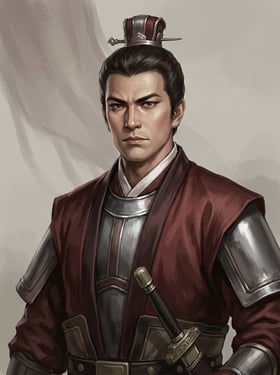
Historical Record
Sun Jun, styled Ziyuan, was the great-grandson of Sun Jing—Sun Jian's younger brother—and the son of Sun Gong. From a young age he excelled at archery and horsemanship, and was shrewd, decisive, and exceptionally bold. In the later years of Sun Quan's rule, Sun Jun was appointed Commandant of the Martial Guard, and later promoted to Palace Attendant.
When Sun Quan fell gravely ill, he summoned Zhuge Ke, Teng Yin, Lü Ju, Sun Jun, and others, and entrusted his affairs to them. Among them, Sun Jun was charged with assisting the government and continued to serve as General of the Martial Guard, responsible for the palace guard, and was enfeoffed as Marquis of Duxiang. After Sun Quan's death, the Director of the Secretariat Sun Hong, being on bad terms with Zhuge Ke, schemed to forge an edict to do away with Ke. Learning of this, Sun Jun reported it to Zhuge Ke, who then had Sun Hong executed at a council meeting before formally announcing the mourning.
Two years later, in 253 CE, because Zhuge Ke had suffered a great defeat at the Battle of Hefei New City and had become arrogant and overbearing, provoking much resentment, Sun Jun secretly plotted with the Wu sovereign Sun Liang to kill Zhuge Ke. At a court banquet, Sun Jun set an ambush and seized the chance to cut down Zhuge Ke in the hall. After this success, Sun Jun was appointed Chancellor and Grand General, overseeing all military affairs within and without, and was further enfeoffed as Marquis of Fuchun.
However, once Sun Jun held power, the arrogant and treacherous side of his nature grew increasingly apparent. He executed people wantonly, drawing widespread resentment from the populace. He also behaved improperly, defiling palace women, and even carried on an illicit affair with Sun Quan's daughter, Princess Luban.
In 255 CE, when Guanqiu Jian and Wen Qin of Wei rose in revolt against Sima Shi, Sun Jun led the Agile Cavalry General Lü Ju, the General of the Left Liu Zan, and other forces to Shouchun in support. Wen Qin, however, surrendered to Wu after his defeat. Sun Jun treated Wen Qin generously, and although Wen Qin was fierce and unyielding, refusing to submit to others, and was often at odds with great generals such as Lü Ju and Zhu Yi, Sun Jun consistently protected him. That same year, when an envoy from Shu Han came on a visit, the generals Sun Yi, Sun Shao, Lin Xun, and others attempted to assassinate Sun Jun, but the plot was exposed. Sun Yi and the others took their own lives, and several dozen people were implicated and put to death, even Princess Sun Luyu not being spared.
During his time in power, Sun Jun also moved the deposed crown prince Sun He from Changsha to Xindu, and sent an envoy to order Sun He to take his own life. Sun He's principal consort, Lady Zhang, then also killed herself.
In the Novel
In Romance of the Three Kingdoms, Sun Jun's character is further developed, especially in the episode of Zhuge Ke's killing, which adds many dramatic details. In the novel, Sun Jun is portrayed as a man beloved by Sun Quan in his lifetime, in charge of the imperial guard cavalry. When Zhuge Ke stripped him of his military authority, Sun Jun was enraged and secretly plotted with the Minister of Ceremonies Teng Yin to be rid of Zhuge Ke.
The novel describes in detail the various ill omens before Zhuge Ke went to the banquet—a yellow dog tugging at his robe, a white rainbow piercing the sun—as well as the dissuasion of his confidant Zhang Yue, all of which lend a fatalistic coloring to Zhuge Ke's death. Unlike the historical account, in the novel Sun Jun directly memorialized to the Wu sovereign Sun Liang about Zhuge Ke's "disloyal intent," and it was Sun Liang who held the banquet, with troops hidden behind the wall hangings.
At the banquet, when Zhuge Ke declined to drink, pleading a stomach ailment, Sun Jun cleverly suggested he drink the medicinal wine kept ready in the residence, thereby dispelling Zhuge Ke's suspicions. In the end, the Wu sovereign Sun Liang left the table on a pretext, whereupon Sun Jun cast off his long robe, donned armor, took up a sharp blade, and shouted, "By the Son of Heaven's edict, execute the traitor!"—and cut down Zhuge Ke. The novel also emphasizes Sun Jun's treatment of Zhuge Ke's household, and the episode of casting the corpses of Zhuge Ke and Zhang Yue into a common grave pit, vividly playing up Sun Jun's cruelty and Zhuge Ke's tragic end.
In the novel, after killing Zhuge Ke, Sun Jun was enfeoffed by Sun Liang as Chancellor, Grand General, and Marquis of Fuchun, overseeing all military affairs within and without, with all power falling into his hands. The novel also mentions the episode of Sun Jun leading troops across the river to attack Shouchun when Guanqiu Jian and Wen Qin revolted, which is broadly consistent with the historical record.
Key Relationships
* Eastern Wu (serves): As a member of the Sun clan, Sun Jun served Eastern Wu his whole life, and after Sun Quan's death assisted the young sovereign Sun Liang, holding the reins of government.
* Zhuge Ke (enemy_of): Sun Jun and Zhuge Ke were political mortal enemies. After Sun Quan's death, Zhuge Ke for a time held overwhelming power, but his arrogance and tyranny and his defeat at New City stirred discontent. Sun Jun finally plotted with Sun Liang to kill Zhuge Ke, thereby seizing real power in Wu.
* Teng Yin (ally_of/rival_of): In the killing of Zhuge Ke, Teng Yin was Sun Jun's ally, plotting together with him. Yet the histories record that Sun Jun and Teng Yin "were not in harmony within, but accommodated each other without," and after killing Zhuge Ke, Sun Jun still further enfeoffed Teng Yin as Marquis of Gaomi, maintaining a surface harmony. The novel stresses that Teng Yin had long borne a grudge against Zhuge Ke and actively offered Sun Jun his counsel.
* Sun Luyu (enemy_of): The histories record that during Sun Jun's tenure, when the plot of Sun Yi and others to murder Sun Jun was exposed, several dozen people were implicated and put to death, including Princess Sun Luyu.
* Sun He (enemy_of): During his tenure, Sun Jun moved the deposed crown prince Sun He from Changsha to Xindu and ordered him to take his own life. This was connected to the old enmity between Princess Quan (Sun Luban) and Sun He's mother, Lady He; Princess Quan persuaded Sun Jun to relocate Sun He and order his death.
* Sun Luban (ally_of/lover_of): The histories record that Sun Jun "defiled palace women and carried on an illicit affair with Princess Luban," showing the improper intimacy between the two and reflecting Sun Jun's moral corruption.
* Wen Qin (friend_of): After Wen Qin was defeated in Wei and surrendered to Wu, Sun Jun "treated him generously." Although Wen Qin was fierce and at odds with other generals, Sun Jun consistently protected him.
Signature Scenes
* Entrusted with the regency by Sun Quan: When Sun Quan fell gravely ill, he summoned Zhuge Ke, Teng Yin, Lü Ju, Sun Jun, and others and entrusted his affairs to them. Sun Jun thereby gained regental authority and continued to command the palace guard. This was the starting point of his road to power.
* Killing Zhuge Ke: This was the most decisive event of Sun Jun's life. Plotting with the Wu sovereign Sun Liang, he laid an ambush at a court banquet and cut down the all-powerful Zhuge Ke, thereby monopolizing power and becoming the new de facto ruler of Wu. The novel vividly depicts this scene, adding the ill omens before Zhuge Ke's arrival and Sun Jun's decisive action, greatly heightening the drama.,
* Arrogant, treacherous, and given to killing: Once Sun Jun held power, the dark side of his nature was fully exposed; he abused his authority and slaughtered freely, provoking seething popular resentment. During this period he also "defiled palace women and carried on an illicit affair with Princess Luban," further displaying his moral decay.
* Ordering Sun He's death: During his tenure, Sun Jun moved the deposed crown prince Sun He from Changsha to Xindu and ordered him to take his own life. This consolidated his power and also reflected the cruelty of his political methods.
* Suppressing Sun Yi's plot: The generals Sun Yi, Sun Shao, Lin Xun, and others once attempted to assassinate Sun Jun, but the plot was exposed. Sun Jun suppressed the conspiracy and put several dozen people to death by implication, including Princess Sun Luyu. This shows Sun Jun's intense vigilance in guarding his power.
* Treating Wen Qin generously: After Wei's Wen Qin was defeated and surrendered to Wu, Sun Jun "treated him generously," and even though Wen Qin was at odds with other generals, Sun Jun consistently protected him. This reflects Sun Jun's strategy in handling surrendered generals, perhaps also a means of winning hearts and strengthening his own faction.
Portrait file
Character profile
- Character
- Sun Jun was arrogant and vicious by nature, given to many executions, defiling the palace women and carrying on an illicit affair with Princess Luban. He was ruthless and sinister, sharp and bold in decision.
- Life
- Sun Jun was the great-grandson of Sun Jing, younger brother of Sun Jian, and from his youth was skilled with bow and horse. When Sun Quan was on his deathbed, Sun Jun received the dying charge to assist in government; later he put Zhuge Ke to death and was promoted to Chancellor. In the second year of Wufeng he led an army to raid Shouchun, and in the ninth month of the first year of Taiping he died of illness, at the age of thirty-eight.
- Anecdotes
- After Sun Jun died of illness, power passed to his cousin Sun Chen. He once held command of the imperial guards, and later usurped authority, seizing Sun He's seal and cord of office and forcing him to death.
Relationships
14 relationships
Quotes
9 recorded lines · 3 featured
「使君病未善平,當有常服藥酒,自可取之。」
This line conceals murderous intent, a classic bit of foreshadowing for Sun Jun's execution of Zhuge Ke.
「有詔收諸葛恪!」
This line directly proclaims Zhuge Ke's political doom, carrying great weight as a historical turning point.
「鯀、禹罪不相及,滕侯何為?」
Using a historical allusion to intimidate, this line displays Sun Jun's scheming and ruthlessness.
Chapters9 回 ▸
- 史ch.28ch.48ch.50ch.56ch.59ch.64
- 演ch.108ch.110ch.111
Relationship timeline10 条 ▸
Inner monologues · AI-generated3 段 ▸
- My courtesy name was Ziyuan. In my youth I trained in archery and horsemanship, and believed that my courage and resolve
- I was entrusted by the late emperor to help guide the young ruler. When Sun Quan was gravely ill, he summoned Ke, Hong,
- I am Sun Jun, courtesy name Ziyuan, of the Sun clan of Jiangdong. My ancestor Sun Jing was the younger brother of Sun Ji
Life events10 ▸
- 0252-01-01 · JianyeSun Quan's Deathbed Regency Decree· Advisor
- 0253-01-01 · XinduSun He Deposed and Forced to Commit Suicide· Instigator
- 0253-01-01 · JianyeSun Jun and Sun Chen's Domination of Wu· Instigator
- 0253-01-01 · JianyeSun Jun Kills Zhuge Ke· Instigator
- 0253-01-01 · JianyeSun Jun's Execution of Zhuge Ke· Instigator
- 0254-01-01 · JianyeSun Yi's Plot to Assassinate Sun Jun· Victim
- 0255-01-01 · ShouchunSun Jun's Attack on Shouchun· Commander
- 0255-01-01 · TuogaoWen Qin Flees from Huainan to Wu· Commander
- 0258-01-01 · JianyeSun Chen's Regency and Sun Xiu's Restoration· Instigator
- 0258-01-01 · JianyeExecution of Sun Chen at the Lari Feast