Historical Record
Wen Yang, styled Ciqian, was the son of Wen Qin, a general of the state of Wei during the Three Kingdoms period. His life is recorded chiefly in the Records of the Three Kingdoms and related sources. After Sima Yi launched the Incident at the Gaoping Tombs in the tenth year of Zhengshi (249), Wen Qin's conflict with the Sima clan grew ever sharper, and in the second year of Ganlu (257) he finally raised troops at Shouchun, together with Zhuge Dan, Tang Zi, and others, in revolt against Sima Zhao. Wen Yang took part in this rebellion alongside his father.
In the early stage of the revolt, Wen Qin and Zhuge Dan together attacked the southern enclosure, trying to break out. However, the Wei army used siege engines such as stone-throwers and fire arrows, inflicting heavy casualties on the rebels, whose blood filled the trenches, forcing them back into the city. As the food within the city grew increasingly scarce, Wen Qin proposed sending the northerners out of the city to save grain, but Zhuge Dan would not listen, and the two became estranged. Wen Qin had long been at odds with Zhuge Dan; now the conflict came to a head, and Zhuge Dan finally killed Wen Qin.
After Wen Qin was killed, Wen Yang and his elder brother Wen Hu were at the time leading troops stationed in a smaller fort. On hearing of their father's death, Wen Yang and Wen Hu mustered their troops, wishing to avenge their father, but their men were unwilling to follow. The two brothers had no choice but to flee alone, going over the walls, and finally chose to surrender to Sima Zhao. At the time the officers requested that the brothers be put to death, but Sima Zhao, considering that Shouchun had not yet fallen and that killing surrendering generals might harden the defenders' hearts, pardoned Wen Yang and Wen Hu. Sima Zhao also ordered Wen Yang and Wen Hu to lead several hundred cavalry to patrol around the city and call out to those within: "Even the sons of Wen Qin are not killed—what have the rest to fear?" and he memorialized to appoint Wen Yang and Wen Hu as generals, granting each the rank of Marquis Within the Passes. This dealt an enormous psychological blow within Shouchun, shaking the defenders' morale and hastening the city's fall. After the Shouchun revolt was put down, Wen Yang continued to serve as an official under the Jin dynasty, rising to Colonel Who Pacifies the Eastern Yi, Bearer of the Staff of Authority. However, in the tenth year of Taishi (274), Wen Yang was implicated in a rebellion case and was finally executed, his three clans exterminated.
In the Novel
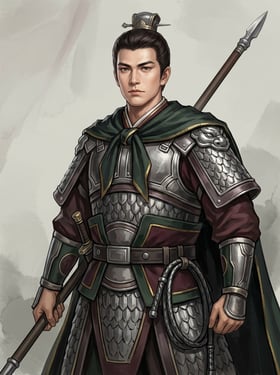
Romance of the Three Kingdoms, in shaping Wen Yang, places heavy emphasis on his surpassing valor, especially his showing at the Battle of Lejia, which differs from the historical record and is more legendary. In the novel, Wen Yang first appears in Chapter 110, then eighteen years old, eight feet tall, in full armor, a steel whip hung at his waist and a long spear grasped in his hand.
When Guanqiu Jian and Wen Qin raised troops against Sima Shi, Wen Yang offered his father Wen Qin a plan: while Sima Shi's camp was not yet secure, to divide the forces into two columns for a night raid on the Wei army. Wen Qin adopted his plan, and Wen Yang led two thousand five hundred troops to strike into the Wei camp from the north of the city. That night, Wen Yang charged in the lead, slashing left and right through the Wei camp, sweeping all before him with none able to withstand him. Because Sima Shi's eye ailment had flared up again, he suffered unbearable pain, yet still bore it, biting his bedclothes to keep from shaking the army's morale. Wen Yang fought through the Wei camp until dawn, yet saw no sign of his father Wen Qin coming to support him. At this point Deng Ai arrived with his army and fought Wen Yang for fifty bouts without a decisive result. Then the main body of the Wei army arrived; Wen Yang's subordinates scattered, and he had no choice but to break out alone. At the Lejia bridge, pursued by several hundred Wei generals, Wen Yang several times reined in his horse and turned back, striking down his pursuers with his steel whip, so that the Wei generals dared not approach. The novel describes Wen Yang "single-handedly repelling" a hundred Wei generals, greatly playing up his unrivaled valor; this episode has no clear basis in the histories and is unique to the novel.
In the Battle of Shouchun, Wen Yang and Wen Hu, following their father Wen Qin, together helped Zhuge Dan defend the city. When the city's grain ran out and Wen Qin advised Zhuge Dan to disperse the northern troops to save food, Zhuge Dan suspected Wen Qin of harboring treachery and killed him. Seeing their father killed, Wen Yang and Wen Hu drew their blades to avenge him, but outnumbered, they finally leapt over the city wall and surrendered to Sima Zhao. Sima Zhao at first, because of his grudge over Wen Yang once having repelled his troops single-handed, wished to behead him, but on Zhong Hui's remonstrance, judging that killing surrendering generals would hinder the siege, pardoned the brothers, bestowed fine horses and brocade robes upon them, and promoted them to Auxiliary General and Marquis Within the Passes. Wen Yang and Wen Hu then rode around the city crying out to persuade the defenders to surrender, further breaking Zhuge Dan's will to resist. This episode broadly agrees with the historical record, but the novel's depiction of Wen Yang's valor makes his surrender all the more dramatic.
Key Relationships
* Wen Qin (kin_of): Wen Yang's father. In both the histories and the novel, Wen Yang followed his father Wen Qin in the revolt against the Sima clan. Wen Qin's killing by Zhuge Dan was the direct cause of Wen Yang's surrender to Sima Zhao.
* Sima Shi (fights_in): In the novel, Wen Yang made a night raid on Sima Shi's main camp at Lejia, directly causing Sima Shi's death from the worsening of his eye ailment (unique to the novel). In the histories, Sima Shi died from the recurrence of his eye ailment, but this had no direct connection to Wen Yang.
* Deng Ai (fights_in): In the novel, Deng Ai once fought Wen Yang for fifty bouts without a decisive result (unique to the novel). In the histories, Deng Ai was an important general in suppressing the revolt of Guanqiu Jian and Wen Qin, but there is no record of him dueling Wen Yang.
* Wen Hu (sibling_of): Wen Yang's elder brother. In both the histories and the novel, Wen Hu acted together with Wen Yang and surrendered to Sima Zhao with him.
* Zhuge Dan (fights_in): An ally of Wen Yang's father Wen Qin, who later killed Wen Qin over their conflict. The brothers therefore surrendered to Sima Zhao.
* Sima Zhao (fights_in): The one Wen Yang finally surrendered to. Sima Zhao pardoned and gave heavy office to Wen Yang, using him to break the morale of the defenders within Shouchun.
Iconic Scenes
* Repelling the enemy single-handed at Lejia: This is Wen Yang's most representative scene in Romance of the Three Kingdoms. He made a night raid on Sima Shi's main camp, charging left and right within it with none able to withstand him. Then at the Lejia bridge, facing the pursuit of several hundred Wei generals, he several times reined in his horse and turned back, repelling his pursuers by his own strength, displaying his "valor that ten thousand men could not withstand" and his "irresistible" character (unique to the novel). This scene greatly enhanced Wen Yang's heroic image in readers' minds.
* His father's death and surrender breaking the army's morale: After Wen Qin was killed by Zhuge Dan, the brothers Wen Yang and Wen Hu surrendered to Sima Zhao. Sima Zhao made use of Wen Yang's special status, ordering him to patrol the city and call out, successfully breaking the morale of the defenders within Shouchun and hastening the city's fall. This scene reflects Wen Yang's political and military influence, playing a key role even as a surrendered general.
* Fifty bouts with Deng Ai without a decisive result: In the novel, while breaking out at Lejia, Wen Yang once fought the Wei general Deng Ai for fifty bouts without a decision. This further sets off Wen Yang's superb martial skill, able to stand against a renowned Wei general (unique to the novel).
Portrait file
Character profile
- Appearance
- Wen Yang was just eighteen years old, eight feet tall, fully clad in armor.
- Character
- Wen Yang had a valor no ten thousand men could withstand; irresistible, he single-handedly drove back a hundred Wei generals.
- Life
- Wen Yang's childhood name was A-Yang; he was the middle son of Wen Qin.
- Weapons
- Wen Yang hung a steel whip at his waist and charged on horseback with leveled spear; he once drew a short blade and struck dead several dozen men.
- Anecdotes
- Wen Yang raided the Wei camp by night and lanced open the tumor of flesh on Sima Shi; later men wrote poems praising his lofty courage. He was once the vanguard of Huainan, following Zhuge Dan to resist Sima Zhao, and later, with his younger brother Wen Hu, surrendered to Wei, being appointed Assistant General and enfeoffed as Marquis Within the Passes.
Relationships
5 relationships
Quotes
5 recorded lines · 3 featured
「趁彼營寨未成,可分兵兩路,左右擊之,可全勝也。」
It showcases Wen Yang's first display of military talent, embodying his youthful valor.
「鼠輩何不惜命也!」
This line displays Wen Yang's ferocity and his contempt for the enemy, shaping his core trait.
「文欽之子猶不見殺,其餘何懼?」
Drawn from the official histories, this is a direct manifestation of Wen Yang's valor, carrying historical significance.
Chapters4 回 ▸
- 史ch.28
- 演ch.110ch.111ch.112
Relationship timeline4 条 ▸
Inner monologues · AI-generated1 段 ▸
- I am Wen Yang, courtesy name Ciqian. At that time, Shouchun was surrounded. The city was in desperate straits, and my fa
Life events3 ▸
- 0255-01-01 · LejiaWen Yang Single-handedly Repulses the Wei Army· Warrior
- 0255-01-01 · ShouchunRebellion of Guanqiu Jian and Wen Qin· Warrior
- 0255-01-01 · ShouchunRebellion of Guanqiu Jian and Wen Qin· Warrior