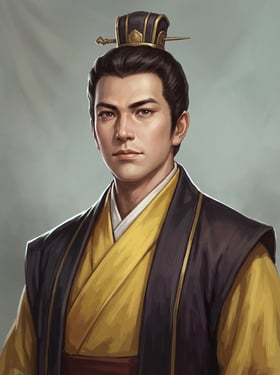
Historical Record
Sun Hao, styled Yuanzong, was a grandson of Sun Quan and a son of Sun He; he was also named Pengzu, with the style Haozong. After Sun Xiu ascended the throne, he enfeoffed Sun Hao as Marquis of Wucheng and sent him to his fief. It is recorded that Jing Yang, a commoner of Xihu, once prophesied that Sun Hao would become greatly noble, and Sun Hao secretly rejoiced at this but dared not let it be known.
After Sun Xiu died, Shu Han had just fallen, Jiaozhi was in revolt, and the realm was in dread, longing to install an older ruler. Wan Yu, Cadet of the Left Army, had once been Magistrate of Wucheng and was on good terms with Sun Hao; he warmly praised Sun Hao to the Chancellor Puyang Xing and the General of the Left Zhang Bu, saying Sun Hao was clear-sighted and decisive in talent and discernment, comparable to Prince Huan of Changsha, and fond of learning and respectful of the law. Puyang Xing and Zhang Bu then persuaded Sun Xiu's consort, Empress Dowager Zhu, to make Sun Hao his successor. Empress Dowager Zhu said: "I am but a widow—what do I know of the concerns of the altars of state? So long as Wu suffers no harm and the ancestral temple has something to rely on, that is enough." And so Sun Hao was welcomed and installed as emperor, then aged twenty-three.
After ascending the throne, Sun Hao changed the reign-era and proclaimed a general amnesty. In the eighth month of the first year of Yuanxing, he appointed Shi Ji and Ding Feng as Grand Marshals of the Left and Right, and Zhang Bu as General of Agile Cavalry, and established additional posts such as Palace Attendant, the promotions and rewards of the various officials all following the old precedents. In the ninth month, he demoted the empress dowager to Empress Jing, posthumously honored his father Sun He as Emperor Wen, and honored his mother Lady He as empress dowager. In the tenth month, he enfeoffed Sun Xiu's heir apparent Sun Wan as Prince of Yuzhang, and his other sons received fiefs as well. At the same time, he established Lady Teng as empress. However, once Sun Hao had his way, his true nature—coarse and overbearing, arrogant and proud, full of taboos, and fond of wine and women—gradually emerged, deeply disappointing court and country alike. Puyang Xing and Zhang Bu came to deeply regret their action, and later, when someone slandered them, Sun Hao executed the two in the eleventh month.
Sun Hao once moved the capital to Wuchang and proclaimed a general amnesty. He forced Empress Jing, Lady Zhu, to her death, and did not hold the mourning in the main hall but in a small chamber in the garden; all the world knew she had not died of illness, and none were not grieved. He also sent Sun Xiu's four sons to the small fortress of Wu, and before long hunted down and killed two of them.
During his reign, Sun Hao dispatched the envoys Ji Zhi and Hong Qiu to the state of Jin, replying to a letter from Emperor Wen of Jin. In the first year of Ganlu, Jiangling reported that sweet dew had fallen, so Sun Hao changed the reign-era to Ganlu and proclaimed an amnesty.
On the eve of the Jin conquest of Wu, Wang Jun came downstream, while Sima Zhou and Wang Hun also pressed upon the border. Sun Hao adopted the advice of the Superintendent of the Imperial Household Xue Ying, the Director of the Secretariat Hu Chong, and others, dispatching envoys to present letters of surrender to Wang Jun, Sima Zhou, and Wang Hun. On the renshen day, Wang Jun arrived first, accepted Sun Hao's surrender, untied his bonds, burned his coffin, and treated him with courtesy. Sun Hao moved his whole household west to Luoyang and was enfeoffed by Jin as Marquis Who Submits to Destiny, granted fields, grain, money, and silk floss. His heir apparent Sun Jin was enfeoffed as a Gentleman of the Household, and his sons who had been princes were enfeoffed as Gentlemen of the Interior. Five years later, Sun Hao died at Luoyang at the age of forty-two and was buried within the borders of Henan County.
In the Novel
In Romance of the Three Kingdoms, Sun Hao's appearance broadly accords with the historical record: as a grandson of Sun Quan and son of Sun He, he was installed as emperor after the death of Sun Xiu. The novel depicts how, during Sun Xiu's reign, Sun Chen wielded overwhelming power at court, while Sun Xiu outwardly showed favor but inwardly kept his guard. After Sun Chen was executed, Sun Xiu enfeoffed Sun Hao as Marquis of Wucheng, foreshadowing his later succession.
The novel emphasizes Sun Hao's cruelty and debauchery after his accession. He indulged in wine and women and favored the Regular Palace Attendant Cen Hun. When Puyang Xing and Zhang Bu remonstrated, Sun Hao was enraged, executed the two and exterminated their three kindreds, so that the court ministers fell silent and dared no longer remonstrate. This differs from the historical record in which Puyang Xing and Zhang Bu were executed for "secretly regretting" their action; the novel rather emphasizes Sun Hao's cruelty and persecution of loyal ministers. The novel also mentions that Sun Hao changed the reign-era to the first year of Baoding and appointed Lu Kai and Wan Yu as Chancellors of the Left and Right.
In the novel, Sun Hao moved the capital to Wuchang, causing the people of Yangzhou bitter hardship; Lu Kai once submitted a memorial of remonstrance, but Sun Hao was displeased. He also undertook great construction works, building the Zhaoming Palace, and summoned the diviner Shang Guang to divine the affairs of the realm. When Shang Guang declared that in the gengzi year "the blue canopy shall enter Luoyang," Sun Hao rejoiced greatly, intending to annex the lands of Han and avenge Shu Han. The Vice Director of the Secretariat Hua He remonstrated, urging him to cultivate virtue and pacify the people, but Sun Hao was enraged and dismissed Hua He, who then withdrew into seclusion.
Lu Kang once submitted a memorial remonstrating with Sun Hao to cultivate virtue and be cautious in punishment, and not to be reckless in warfare, but Sun Hao suspected Lu Kang of colluding with the enemy, stripped him of his military authority, and demoted him to Major. The novel stresses that over his reign of more than ten years Sun Hao killed over forty loyal ministers, and went about always escorted by fifty thousand armored cavalry, so that his ministers lived in fear.
On the eve of the Jin army's attack on Wu, Sun Hao followed Cen Hun's plan and forged linked iron chains and iron spikes to bar the Yangtze across its width, trying to block the Jin army. However, Wang Jun's Jin army swept all before it, and the men of Wu surrendered at the mere sight of them. When the Jin army neared Shitou Fortress, Sun Hao wished to cut his own throat, but at the urging of the Director of the Secretariat Hu Chong and the Superintendent of the Imperial Household Xue Ying, he followed the example of Liu Shan, bound himself and bore a coffin, and led his civil and military officials in surrendering to Wang Jun. After the surrender, Emperor Sima Yan of Jin granted him a seat and conversed with him; Jia Chong once asked about Sun Hao's gouging out of men's eyes and flaying of men's faces in the south, to which Sun Hao replied that such punishments were used only for those who murdered their lords or were treacherous and disloyal, leaving Jia Chong silent. In the end, Sun Hao was enfeoffed as Marquis Who Submits to Destiny.
Key Relationships
* Eastern Wu (lord_of): As the last emperor, Sun Hao ruled the Eastern Wu regime, but his tyrannical rule hastened the fall of Wu.
* Puyang Xing (betrayed_by): Puyang Xing was one of the key figures who installed Sun Hao, but once Sun Hao had his way, being "coarse and overbearing, arrogant and proud," Puyang Xing "secretly regretted it," and was ultimately executed by Sun Hao.
* Zhang Bu (betrayed_by): Together with Puyang Xing he installed Sun Hao, and later likewise regretted it owing to Sun Hao's tyranny, and was ultimately executed by Sun Hao.
* Empress Zhu (enemy_of): Sun Xiu's consort, who at first agreed to make Sun Hao his successor, but after Sun Hao ascended the throne he "forced Empress Jing, Lady Zhu, to her death".
* The Sima clan (defected_to): When the Jin army attacked Wu, Sun Hao ultimately chose to surrender to Jin, becoming the Marquis Who Submits to Destiny of Jin.
* Cen Hun (favored): In Romance of the Three Kingdoms, Cen Hun was the Regular Palace Attendant favored by Sun Hao, who offered the plan to forge iron chains and spikes to block the Jin army, and was ultimately cut to pieces and devoured raw by the enraged soldiers and people of Wu (novel only).
* Lu Kai (remonstrant): Lu Kai repeatedly submitted memorials remonstrating with Sun Hao, including over the hardships of the people after the capital was moved to Wuchang and over strategy in the war against Jin, but Sun Hao mostly did not adopt them.
* Hua He (remonstrant): In Romance of the Three Kingdoms, Hua He once remonstrated with Sun Hao to cultivate virtue and pacify the people and not to lightly start war, but after being rebuked by Sun Hao he withdrew into seclusion (novel only).
* Lu Kang (remonstrant): In Romance of the Three Kingdoms, Lu Kang once submitted a memorial remonstrating with Sun Hao to cultivate virtue and be cautious in punishment and not to be reckless in warfare, and as a result Sun Hao stripped him of military authority and demoted him to Major (novel only).
Iconic Scenes
* Installed as Emperor: After Sun Xiu died, with Shu Han fallen and Jiaozhi in revolt and the realm in dread, longing for an older ruler, Sun Hao was, at the recommendation of Wan Yu, Puyang Xing, and Zhang Bu, welcomed and installed as emperor of Wu at the age of twenty-three.
* Executing Puyang Xing and Zhang Bu: After his accession, Sun Hao's coarse and overbearing nature made Puyang Xing and Zhang Bu, who had installed him, regret it. Later, when someone slandered them, Sun Hao executed the two in the eleventh month of the first year of Yuanxing.
* Forcing Empress Jing, Lady Zhu, to Her Death: During his reign, Sun Hao forced to death Sun Xiu's consort, Empress Jing, Lady Zhu, and did not hold the mourning in the main hall but in a small chamber in the garden, arousing the world's sorrow.
* Moving the Capital to Wuchang: Sun Hao, heeding the words of shamans and astrologers that the palace at Jianye was inauspicious, moved the capital to Wuchang—an act that brought great hardship to the people of Yangzhou.
* Forging Iron Chains and Spikes to Block the Jin Army: In Romance of the Three Kingdoms, when the Jin army attacked Wu, Sun Hao adopted the proposal of the Regular Palace Attendant Cen Hun to forge linked iron chains and iron spikes to bar the Yangtze across its width, trying to block the Jin army (novel only).
* Surrendering Bound and Bearing a Coffin: When the Jin army broke Wu and Wang Jun came to the city walls, Sun Hao, at the urging of Xue Ying and Hu Chong, followed the example of Liu Shan, bound himself and bore a coffin, and led his civil and military officials in surrendering to Wang Jun.
* The Exchange Between Ruler and Minister at Luoyang: After his surrender, Sun Hao was moved to Luoyang, where Emperor Sima Yan of Jin granted him a seat and conversed with him. Jia Chong once asked about the cruel punishments Sun Hao had carried out in the south, to which Sun Hao replied that they were used only for those who murdered their lords or were treacherous and disloyal, leaving Jia Chong silent (novel only).
Portrait file
Character profile
- Character
- Sun Hao was brutal and overbearing by nature, full of suspicions and taboos, fond of wine and women, wanton in punishment and reckless in penalties, growing more savage by the day. He favored those close at hand and hated blunt words, repeatedly putting upright ministers to death.
- Manner of speech
- In his cups Sun Hao mocked his high officials, forcing the assembled ministers to make sport of themselves while drunk.
- Life
- Sun Hao was the grandson of Sun Quan and son of Sun He, first enfeoffed as Marquis of Wucheng. After Sun Xiu died, he was welcomed and set on the throne by Puyang Xing and Zhang Bu, at the age of twenty-three. In the fourth year of Tianji (280) he surrendered to Jin and was enfeoffed as Marquis Who Returns to Allegiance; in the fifth year of Taikang he died at Luoyang.
- Anecdotes
- Sun Hao was the ruler under whom Wu fell, the last emperor of Eastern Wu, and the sovereign whom Lu Kai remonstrated with. He once ordered Ding Feng to attack Hefei, and afterward beheaded Feng's guide-officer and exiled Feng's family.
Relationships
27 relationships
Family3
Lord & vassal2
Friends2
Enemies10
Other9
Quotes
11 recorded lines · 3 featured
「臣於南方,亦設此座以待陛下。」
The bravado of a fallen monarch, embodying his defiance and sarcasm.
「昔漢室失統,九州分裂,先人因時,略有江南,遂分阻山川,與魏乖隔。今大晉龍興,德覆四海。闇劣偷安,未喻天命。至於今者,猥煩六軍,衡蓋路次,遠臨江渚,舉國震惶,假息漏刻。敢緣天朝含弘光大,謹遣私署太常張夔等奉所佩印綬,委質請命,惟垂信納,以濟元元。」
The memorial of Sun Hao Surrenders to Jin, marking the end of the Three Kingdoms era.
「量一中貴,何能誤國?」
A muddleheaded ruler's blind self-assurance toward eunuchs abusing power, one of the causes of his kingdom's ruin.
Chapters8 回 ▸
- 史ch.48ch.53ch.59ch.61ch.64ch.65
- 演ch.113ch.120
Relationship timeline12 条 ▸
Inner monologues · AI-generated3 段 ▸
- I am Sun Hao, courtesy name Yuanzong. Now that I have submitted, looking back toward Jiangdong, what weighs on my heart
- I am Sun Hao, courtesy name Yuanzong. Looking back now, what is hardest to admit may not be what would ultimately become
- My courtesy name was Yuanzong, and I was also once named Pengzu. I was Sun Quan’s grandson and Sun He’s son. As a member
Life events11 ▸
- 0264-01-01 · JianyeEnthronement of Sun Hao· Instigator
- 0265-01-01 · JianyeSun Hao's Purge of Loyal Ministers· Instigator
- 0265-01-01 · WuchangSun Hao Moves the Capital to Wuchang· Instigator
- 0266-01-01 · JianyeLu Kai's Plot to Depose Sun Hao· Victim
- 0272-01-01 · XilingBu Chan's Defection from Wu to Jin· Commander
- 0272-01-01 · XilingBattle of Xiling· Witness
- 0272-01-01 · XilingLu Kang Defeats Yang Zhao and Recovers Xiling· Witness
- 0280-01-01 · JianyeReunification of the Three Kingdoms under Jin· Victim
- 0280-01-01 · JianyeSun Hao's Accession and the Decline of Wu· Instigator
- 0280-01-01 · JianyeSun Hao Surrenders to Jin· Victim
- 0280-01-01 · JianyeJin's Six-Route Conquest of Wu· Victim