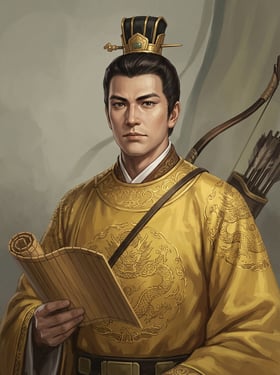
Historical Record
Sun Xiu, styled Zilie, was the sixth son of Sun Quan. At the age of thirteen he studied under the Secretariat Gentleman She Ci and the Court Gentleman Sheng Chong c:5085. In the first month of the second year of Taiyuan, Sun Xiu was enfeoffed as King of Langya and garrisoned Hulin. In the fourth month of that same year, Sun Quan died, and his younger brother Sun Liang succeeded to the throne. The regent Zhuge Ke did not want the kings stationed at strategic military points along the river, and so moved Sun Xiu to Danyang Commandery. The Grand Administrator of Danyang, Li Heng, repeatedly harassed Sun Xiu, who therefore submitted a petition asking to be moved to another commandery, and was at last by edict transferred to Kuaiji c:5085.
After Sun Liang was deposed, Sun Chen, in the jiwei year, sent the Superintendent of the Imperial Clan Sun Kai and the Secretariat Gentleman Dong Chao to welcome Sun Xiu. When Sun Xiu first heard the news he harbored doubts; Sun Kai and Dong Chao set out in detail the true intent of Sun Chen and the others in installing him, and only after hesitating for a day and two nights did Sun Xiu set out. On the wuyin day of the tenth month, Sun Xiu reached Qu'e, where an old man kowtowed and urged him, "When matters drag on, changes arise; all under heaven looks longingly to you. I beg Your Majesty to go swiftly" c:5085. Sun Xiu commended him, and that same day reached the Buse Pavilion. The Martial Guard General Sun En led the hundred officials to welcome him with the imperial carriage and ceremonial escort at the Yongchang Pavilion, and erected a temporary hall. On the jimao day, Sun Xiu arrived and, deferring, would not directly take the imperial seat, but halted instead in the eastern wing. Only after the ministers entreated him repeatedly did Sun Xiu accept the seal and tally, and that same day he took the main hall, proclaimed a general amnesty, and changed the reign title to Yongan c:5085.
In the winter, tenth month of the first year of Yongan, Sun Xiu issued an edict commending the merit of Sun Chen and others in installing him, enfeoffing Sun Chen as Chancellor and Governor of Jing Province, increasing his fief by five counties, and bestowing rewards on other meritorious subjects as well. At the same time, he pardoned the Grand Administrator of Danyang, Li Heng, with whom he had once been at odds, and conferred on him the title of General Who Subdues the Distant c:9709. However, the Sun Chen household held five marquisates, all commanding the palace guards; their power overawed the sovereign and they grew daily more arrogant. Deeply troubled by this, Sun Xiu secretly plotted with Zhang Bu. On the wuchen day, the La festival of the twelfth month, when the hundred officials came to offer congratulations, Sun Xiu ordered armed men to bind Sun Chen, and that very day put him to death c:9711.
During his reign, Sun Xiu applied himself keenly to the classics, wishing to read through the words of the hundred schools, and was especially fond of pheasant-shooting c:9717. He issued an edict establishing academic officials and appointing Erudites of the Five Classics, in order to deepen the transformation of the kingly way c:9715. He also attended to agriculture and sericulture, stressing that "when the granaries are full, people know propriety; when food and clothing are sufficient, people know honor and shame," and sought to open up farmlands broadly and lighten their taxes c:9716. In the third year of Yongan, a rumor arose in Kuaiji Commandery that the deposed emperor Sun Liang would be restored; Sun Liang's palace women reported that he had had a shaman pray and offer sacrifice with malicious words. After the officials reported this, Sun Liang was demoted to Marquis of Houguan and sent off to his fief, killing himself on the way c:1217. In the eighth month of the fifth year of Yongan, Sun Xiu installed the lady Zhu as empress and his son Sun Wan (𩅦) as Crown Prince, and proclaimed a general amnesty c:9717. He even created unusual, rare characters as names for his four sons, in the hope that they might be "easy to avoid in taboo" c:9717. In the winter, tenth month of that year, he appointed Puyang Xing as Chancellor, and Ding Mi and Meng Zong as Imperial Secretaries of the Left and Right. Sun Xiu owed deep old kindness to the Chancellor Puyang Xing and the General of the Left Zhang Bu, and entrusted them with heavy responsibilities. Zhang Bu administered the palace, while Puyang Xing took charge of military and state affairs c:9717.
In the Novel
In Romance of the Three Kingdoms, Sun Xiu's appearance largely accords with the historical record, but with the addition of some details of a legendary cast. For example, while at Hulin, Sun Xiu dreamed one night that he rode a dragon up to heaven; looking back, he could not see the dragon's tail, and on waking he felt it strange. The next day, Sun Kai and Dong Chao arrived to invite him to return to the capital c:1220. This adds to Sun Xiu's accession a mystique of the Mandate of Heaven. The novel also mentions the remonstrance of the old man of Qu'e, Gan Xiu, who stressed, "When matters drag on there will surely be change; I beg Your Highness to go swiftly," which accords with the historical record c:1220.
The novel emphasizes Sun Xiu's wariness and guard against Sun Chen after his accession. In the novel, Sun Xiu "feared an internal upheaval, and so outwardly displayed favor while inwardly guarding against him" c:1220, which echoes the historical record that Sun Xiu "feared he might cause an upheaval, and so repeatedly heaped rewards on him" c:9711, though the novel lays more stress on Sun Xiu's forbearance and strategy. In the episode of putting Sun Chen to death, the novel is also largely consistent with the historical record, describing how Sun Xiu adopted Ding Feng's plan and set an ambush at the La festival gathering to behead Sun Chen c:9720.
When Shu Han was in peril, the novel depicts the lord of Wu Sun Xiu, upon receiving Zhuge Zhan's letter for aid, deliberating with his ministers and concluding, "Since Shu is in crisis, how can I sit by and not rescue it?" and thereupon sending Ding Feng to lead troops to aid Shu c:5088. This embodies Sun Xiu's sense of duty as an ally, though in actual history Wu's dispatch of troops was more a matter of strategic calculation. After Shu Han fell, in the novel the Secretary Hua He counseled Sun Xiu, "Wu and Shu are as lips and teeth. 'When the lips perish, the teeth grow cold.' I reckon Sima Zhao's campaign against Wu is imminent; I beg Your Majesty to strengthen your defenses deeply" c:5089; Sun Xiu adopted his words and deployed his defenses, further shaping Sun Xiu's image as a wise sovereign.
At the end of the novel, Sun Xiu, troubled that Sima Yan, after usurping Wei, would campaign against Wu, fell gravely ill, and before his death summoned the Chancellor Puyang Xing into the palace, instructing him to install the Crown Prince Sun Wan (𩅦). However, the Left Army Director Wan Yu and the General of the Left Zhang Bu instead recommended installing the Marquis of Wucheng, Sun Hao, and in the end Sun Hao was welcomed and installed as sovereign c:1221. This episode is largely consistent with the historical record that Sun Xiu installed the Crown Prince Sun Wan (𩅦) c:9717 but that after his death Puyang Xing and others installed Sun Hao, though the novel, through dialogue and depiction of the characters' psychology, makes this turn more dramatic.
Key Relationships
* Eastern Wu (lord_of): As Sun Quan's sixth son, Sun Xiu eventually inherited the great line of Wu and became Emperor Jing of Wu c:5085. He devoted himself to governing the state, promoting culture and learning, reforming taxation, and trying to bring stability and prosperity to Wu c:9715, c:9716.
* Sun Chen (enemy_of): Sun Chen was the powerful minister who installed Sun Xiu, but his power grew too great and his arrogance too overbearing, and he was at last put to death by Sun Xiu's design c:9711. The novel also stresses Sun Xiu's wariness of Sun Chen and his determination to be rid of him c:1220.
* Sun Liang (kin_of): Sun Liang was Sun Xiu's younger brother, who succeeded to the throne after Sun Quan's death and was later deposed by Sun Chen. After Sun Xiu's accession, Sun Liang was demoted on account of a rumor and at last killed himself (the histories may have it that Sun Xiu had him poisoned) c:1217.
* Sun Hao (kin_of): Sun Hao was Sun Xiu's nephew, installed as emperor by Puyang Xing, Zhang Bu, and others after Sun Xiu's death c:1221.
* Zhang Bu (ally_of): Zhang Bu was Sun Xiu's confidant, deeply trusted even before Sun Xiu's accession, and after the accession favored all the more; he joined with Sun Xiu in plotting to put Sun Chen to death c:9711.
* Ding Feng (ally_of): Ding Feng was an important helper in Sun Xiu's putting Sun Chen to death; he offered Sun Xiu the plan to strike at the La festival gathering and personally carried out the arrest of Sun Chen c:9720. In the novel, Ding Feng also at Sun Xiu's command went to the rescue of Shu Han c:5088.
* Puyang Xing (ally_of): Puyang Xing was appointed Chancellor in the later part of Sun Xiu's reign, assisting Sun Xiu together with Zhang Bu c:9717. Before Sun Xiu's death, he was summoned into the palace and received Sun Xiu's dying charge concerning the Crown Prince's succession c:1221.
* Li Heng (enemy_turned_ally): Li Heng was once Grand Administrator of Danyang, who repeatedly harassed Sun Xiu when he was King of Langya. After Sun Xiu's accession, Li Heng was for a time anxious and fearful, but was at last pardoned by Sun Xiu and advanced in office and rank c:9709.
Iconic Scenes
* Dreaming of the dragon and receiving the mandate; the old man of Qu'e urging him on: At Hulin, Sun Xiu dreamed one night that he rode a dragon up to heaven, foretelling his destiny as emperor. Then, on the road to Jianye, the old man of Qu'e, Gan Xiu, urged him on, adding to his accession a legendary cast and a sense of urgency c:1220. This scene is depicted in detail in the novel, reinforcing the legitimacy of Sun Xiu's accession.
* Cleverly removing Sun Chen and stabilizing the court: After his accession, facing Sun Chen, whose power overawed the whole court, Sun Xiu outwardly displayed favor while secretly plotting with Zhang Bu, Ding Feng, and others. At last, at the La festival gathering, Sun Xiu decisively ordered Sun Chen bound and killed, successfully clearing away the powerful minister and consolidating imperial authority c:9711, c:9720. This was the most decisive step in Sun Xiu's political career, displaying his political skill and resolve.
* Keenly devoted to the classics, fond of pheasant-shooting: During his reign, Sun Xiu had a deep interest in the classics, hoping to read through the words of the hundred schools, and was especially fond of pheasant-shooting. He would often go out at dawn and return only at night, setting aside his books only during this time c:9717. This image displays a refined, studious side of Sun Xiu, forming a contrast with his image of decisively removing a villain.
* Establishing academic officials and attending to agriculture: Sun Xiu issued an edict establishing academic officials and appointing Erudites of the Five Classics, in the hope of "deepening the kingly transformation and elevating custom" c:9715. He also stressed the importance of agriculture and sericulture, advancing the governing idea that "when the granaries are full, people know propriety; when food and clothing are sufficient, people know honor and shame," and sought to improve the people's livelihood by lightening taxes and broadening farmlands c:9716. These measures embody Sun Xiu's reflection, as sovereign, on the long-term development of the state.
* Aiding Shu (novel only): When Shu Han was in peril, Sun Xiu sent Ding Feng to lead troops to its rescue, displaying the loyalty and responsibility of the Wu–Shu alliance c:5088. Although in actual history Wu's dispatch of troops was more a matter of strategic calculation, this episode in the novel shapes Sun Xiu's image as a sovereign who valued duty and loyalty.
* Dying and entrusting the orphan; powerful ministers install Sun Hao: Sun Xiu fell gravely ill from anxiety over affairs of state, and before his death summoned the Chancellor Puyang Xing, entrusting him with the Crown Prince Sun Wan (𩅦). However, after his death, Puyang Xing and Zhang Bu, on account of the Crown Prince's youth, turned instead to install the Marquis of Wucheng, Sun Hao c:1221. This scene reveals the instability of Eastern Wu's later politics and the influence of powerful ministers over the imperial succession.
Portrait file
Character profile
- Character
- He devoted himself keenly to the classics, wishing to peruse fully the words of the Hundred Schools, and was especially fond of shooting pheasants [c:2]. In temperament he was yielding and forbearing, outwardly magnanimous yet inwardly watchful [c:3]. Facing the peril of Shu, he declared, "How could I sit and watch without coming to the rescue?" [c:4].
- Life
- Sun Xiu was Sun Quan's sixth son; at the age of thirteen he studied under She Ci and Sheng Chong [c:5]. He was first enfeoffed as Prince of Langya, and later moved to Danyang and Kuaiji [c:5]. Sun Chen welcomed and enthroned him as emperor; he died in the seventh year of Yong'an (264), at the age of thirty, with the posthumous title Emperor Jing [c:5].
- Anecdotes
- He made the decision to rescue Shu Han [c:1]. After ascending the throne he conspired with Zhang Bu and Ding Feng to execute Sun Chen [c:13, c:17]. He issued an edict to continue the sacrifices to Gu Yong, posthumously honored Lu Xun as Marquis Zhao, and employed such men as Wang Fan, He Shao, and Wei Zhao [c:11, c:14, c:18].
Relationships
18 relationships
Quotes
19 recorded lines · 3 featured
「古者建國,教學爲先,所以道世治性,爲時養器也。自建興以來,時事多故,吏民頗以目前趨務,去本就末,不循古道。夫所尚不惇,則傷化敗俗。其案古置學官,立五經博士,核取應選,加其寵祿,科見吏之中及將吏子弟有志好者,各令就業。一歲課試,差其品第,加以位賞。使見之者樂其榮,聞之者羨其譽。以敦王化,以隆風俗。」
Emphasizes the importance of education to governing the state, reflecting Sun Xiu's philosophy of rule.
「朕以不德,託于王公之上,夙夜戰戰,忘寢與食。今欲偃武脩文,以崇大化。推此之道,當由士民之贍,必須農桑。管子有言:『倉廩實,知禮節;衣食足,知榮辱。』夫一夫不耕,有受其饑,一婦不織,有受其寒;饑寒並至而民不爲非者,未之有也。自頃年已來,州郡吏民及諸營兵,多違此業,皆浮船長江,賈作上下,良田漸廢,見穀日少,欲求大定,豈可得哉?亦由租入過重,農人利薄,使之然乎!今欲廣開田業,輕其賦稅,差科彊羸,課其田畝,務令優均,官私得所,使家給戶贍,足相供養,則愛身重命,不犯科法,然後刑罰不用,風俗可整。以羣僚之忠賢,若盡心於時,雖太古盛化,未可卒致,漢文升平,庶幾可及。及之則臣主俱榮,不及則損削侵辱,何可從容俯仰而已?諸卿尚書,可共咨度,務取便佳。田桑已至,不可後時。事定施行,稱朕意焉。」
Quoting a famous saying of Guanzi, it expounds the relationship between farming and social stability, reflecting his pragmatic outlook.
「聊相開悟耳,何至叩頭乎!如君之忠誠,遠近所知。往者所以相感,今日之巍巍也。詩云:『靡不有初,鮮克有終。』終之實難,君其終之。」
Quoting a famous line from the Classic of Poetry, it admonishes ministers that loyalty is not easy and must be carried through from beginning to end.
Chapters11 回 ▸
- 史ch.47ch.48ch.53ch.55ch.59ch.61ch.64
- 演ch.113ch.117ch.119ch.120
Relationship timeline4 条 ▸
Inner monologues · AI-generated3 段 ▸
- I am Sun Xiu, courtesy name Zilie. In the final years of Yongan, I lay ill on my couch, my breathing growing faint. Yet
- Whenever I think back to the beginning of my reign, what weighed most heavily on me was not my own safety, but whether t
- I am Sun Xiu, courtesy name Zilie, the sixth son of the late emperor. When I was thirteen, I studied under the Secretari
Life events8 ▸
- 0253-01-01 · JianyeSun Jun and Sun Chen's Domination of Wu
- 0258-01-01 · JianyeDeposition of Sun Liang
- 0258-01-01 · JianyeSun Xiu's Execution of Sun Chen· Instigator
- 0258-01-01 · JianyeSun Chen's Regency and Sun Xiu's Restoration· Instigator
- 0258-01-01 · JianyeSun Chen Deposes Sun Liang and Installs Sun Xiu· Instigator
- 0258-01-01 · JianyeExecution of Sun Chen at the Lari Feast· Instigator
- 0264-01-01 · JianyeSun Hao Ascends the Throne· Witness
- 0280-01-01 · JianyeSun Hao's Accession and the Decline of Wu· Witness