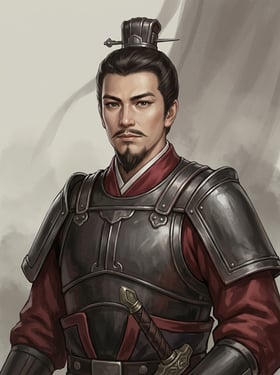
Historical Record
Zhuge Zhan, styled Siyuan, was the son of the Shu Han Chancellor Zhuge Liang. From childhood he displayed exceptional cleverness. In the twelfth year of Jianxing (234 CE), while Zhuge Liang was at the Wugong front, he wrote to his elder brother Zhuge Jin, mentioning that the eight-year-old Zhuge Zhan was "clever and lovable, but I fear his early maturity, lest he not become a vessel of weight," the lines revealing both affirmation of and anxiety over his son's gifts c:3593.
At seventeen, Zhuge Zhan married a princess and was granted the office of Cavalry Commandant. The following year he was promoted to General of the Household of the Feathered Forest, and thereafter his career proceeded smoothly, his offices repeatedly advancing; he successively served as Colonel of Archers Who Shoot at a Sound, Palace Attendant, and Vice Director of the Imperial Secretariat, with the additional title of Military Adviser General c:3593. Zhuge Zhan not only achieved much in administration but was also skilled at calligraphy and painting and had a superb memory. Because the people of Shu Han held a deep yearning for Zhuge Liang, they were especially fond of Zhuge Zhan's quick talent. Whenever the court issued a good ordinance or a fine measure, even if it was not Zhuge Zhan who had initiated it, the people would often proclaim, "This is the work of Lord Ge," so that his fame far exceeded the reality and his prestige was extremely high c:3593.
In the fourth year of Jingyao (261 CE), Zhuge Zhan was appointed Acting Protector-General and Guard General, and together with the General-in-Chief Who Upholds the State, the Marquis of Nanxiang, Dong Jue, jointly managed the affairs of the Imperial Secretariat c:3593. However, the fate of Shu Han reached a turning point in the sixth year of Jingyao (263 CE). The Wei General Who Conquers the West, Deng Ai, led an army against Shu, adopting an unexpected strategy, entering Shu territory from Yinping by way of the Jinggu side road. Zhuge Zhan was ordered to direct the various armies to advance to Fucheng to resist him, but after his vanguard was routed, he withdrew to hold Mianzhu c:3593.
Deng Ai once sent an envoy to urge Zhuge Zhan to surrender, promising, "If you surrender, I will surely memorialize to make you Prince of Langya." However, Zhuge Zhan scorned this, beheaded the envoy, and resolutely gave battle to Deng Ai. In the end, Zhuge Zhan was greatly defeated in the Battle of Mianzhu and died valiantly on the field, aged thirty-seven. His eldest son Zhuge Shang also died for the state together with him c:3593. After the defeat, the Shu army all scattered, and Deng Ai was able to drive straight on to Chengdu. An edict of the Jin dynasty once appraised Zhuge Zhan: "To face calamity and die for righteousness is one of the goods of the realm." c:3593 Zhuge Zhan's second son Zhuge Jing and his nephew Zhuge Xian and others were moved to Hedong in the first year of Xianxi (264 CE). Zhuge Jing later held office under the Jin dynasty, rising to Inspector of Jiangzhou c:3593.
In the Novel
In the Romance of the Three Kingdoms, Zhuge Zhan's image is given more dramatic color and a moral halo. On his first appearance he is depicted as the son of the Martial Marquis Zhuge Liang, styled Siyuan. The novel adds that his mother was the daughter of Huang Chengyan, that is, Lady Huang, and emphasizes that Lady Huang, though ugly in appearance, had rare talent, understanding astronomy above and geography below, with nothing of strategy and the arts of concealment she did not know, and that she gave much assistance to the Martial Marquis's learning c:3596. Before her death, Lady Huang also exhorted Zhuge Zhan with loyalty and filial piety. Zhuge Zhan was clever from childhood, married the daughter of the Later Lord Liu Shan, became Commandant of the Imperial Sons-in-Law, and later inherited his father's title of Marquis of Wuxiang c:3596.
Differing from the historical record, the novel especially emphasizes that during the period when Huang Hao held power, Zhuge Zhan once "feigned illness and did not come out" in protest c:3596; this has no clear basis in the histories and is an episode added by the novel to shape his lofty character. When Deng Ai's great army bore down, Fucheng fell, and Shu Han was in imminent danger, the Later Lord Liu Shan, on the advice of Xi Zheng, sent out three edicts in succession summoning Zhuge Zhan into the palace c:14470.
In the hall, the Later Lord Liu Shan tearfully lamented the national calamity, and Zhuge Zhan too "wept and submitted: 'My father and I have received the deep grace of the Former Emperor and the special treatment of Your Majesty; though our brains be dashed to the ground, we cannot repay it. I beg Your Majesty to send out all the troops of Chengdu and let me lead them in a battle to the death.'" c:14470 This impassioned speech greatly reinforces Zhuge Zhan's image of perfect loyalty and filial piety. The Later Lord allotted him seventy thousand Chengdu troops. At this point Zhuge Zhan's eldest son Zhuge Shang, only nineteen, who had read widely in the books of war and was much practiced in martial arts, volunteered to serve as vanguard; father and son, one in heart, went together to meet the national calamity c:14470.
In the Battle of Mianzhu, the novel depicts the tragic end of Zhuge Zhan and his son in greater detail. When no reinforcements arrived, Zhuge Zhan resolved to hold out no longer; he donned his armor and mounted, and led the three armies in throwing open the city gates and charging out. Seeing this, Deng Ai withdrew his troops to lure the enemy, and Zhuge Zhan pursued and slew with all his might, but fell into an ambush and was hemmed in on all sides by the Wei army. He charged left and right, slaying several hundred of the enemy, but in the end was struck by an arrow and fell from his horse, crying out, "My strength is spent! I will repay the state with my death!" and then drew his sword and took his own life c:6349. His son Zhuge Shang, witnessing his father's death for the state from atop the city, was overcome with grief and indignation, and, ignoring the dissuasion of the Master of Writing Zhang Zun, lamented, "For generations, father and son and grandson, our family has received the deep grace of the state. Now my father has died at the enemy's hands—what use is there in my living!" He then charged out on horseback and also died in the fray c:6349. Through these details, the novel carries the loyal valor of Zhuge Zhan and his son to its utmost.
Key Relationships
* Zhuge Liang (father): Zhuge Zhan was Zhuge Liang's only son, clever from childhood and deeply hoped for and cherished by his father c:3593.
* Liu Shan (sovereign/father-in-law): Zhuge Zhan married a princess and became Commandant of the Imperial Sons-in-Law, serving Liu Shan, and vowed to repay the state with his death in the hour of national calamity c:3596.
* Deng Ai (opponent): In the final years of Shu Han, Zhuge Zhan led an army to resist Deng Ai's invasion and ultimately fought Deng Ai to the death at Mianzhu, dying for the state c:3593.
* Zhuge Shang (son): Zhuge Zhan's eldest son, who died valiantly for the state together with his father in the Battle of Mianzhu, displaying the loyal valor of father and son c:3593.
* Dong Jue (colleague): Zhuge Zhan once jointly managed the affairs of the Imperial Secretariat with the General-in-Chief Who Upholds the State, Dong Jue c:3593.
* Huang Hao (detests): In the novel, Zhuge Zhan, dissatisfied with the eunuch Huang Hao's wielding of power, feigned illness and did not come out, expressing his resistance to the treacherous minister (novel-only) c:3596.
Iconic Scenes
* Zhuge Liang's letter on "fearing his early maturity": In a letter Zhuge Liang wrote from the Wugong front to Zhuge Jin, he mentioned that the eight-year-old Zhuge Zhan was clever and lovable, but he feared his "early maturity," lest he not become a vessel of weight, displaying Zhuge Liang's deep reflection on his son's growth c:3593.
* Feigning illness in resistance to Huang Hao's power: In the novel, Zhuge Zhan, dissatisfied with the eunuch Huang Hao's wielding of power, used illness as a pretext to take no part in court affairs, thereby expressing his lofty character and resistance to the treacherous (novel-only) c:3596.
* Weeping at the edict, vowing to repay the state with death: When Deng Ai's great army bore down and the Later Lord Liu Shan summoned Zhuge Zhan into the palace, Zhuge Zhan wept and submitted that "though our brains be dashed to the ground, we cannot repay it," and asked to lead troops in a battle to the death, displaying his undivided loyal heart of serving the state c:14470.
* Father and son dying for the state at Mianzhu: In the Battle of Mianzhu, Zhuge Zhan beheaded Deng Ai's envoy, vowed not to surrender, and ultimately died valiantly on the field together with his eldest son Zhuge Shang, composing a tragic and heroic chapter of late Shu Han loyalty c:3593. In the novel, Zhuge Zhan took his own life and Zhuge Shang charged out of the city gate to die in battle, adding further tragic color c:6349.
* The people proclaiming "This is the work of Lord Ge": Even when the court's good governance and fine measures were not initiated by Zhuge Zhan, the people often credited them to him, reflecting Zhuge Zhan's lofty prestige in the hearts of the Shu Han populace and their yearning for Zhuge Liang c:3593.
Portrait file
Character profile
- Character
- From childhood Zhuge Zhan was clever and read widely in military texts. He feigned illness and stayed away from office to resist Huang Hao's grip on power. On hearing the imperial edict he wept at once, declaring that even were his body ground to pulp he could not repay it. Faced with Deng Ai's offer of surrender, he tore the letter to pieces and beheaded the envoy; in the end, struck by an arrow, he fell from his horse and cried out, 'My strength is spent! I must repay the state with my death,' then drew his sword and cut his own throat.
- Anecdotes
- Zhuge Zhan was the son of Zhuge Liang, his mother a daughter of Huang Chengyan. He held the posts of Army Escort General and Guard General, and was Commandant of the Imperial Son-in-law (fuma duwei) to the Later Ruler, first taking charge of court affairs. In the end he was defeated by Deng Ai at the Battle of Mianzhu, and after his defeat was beheaded.
Relationships
10 relationships
Quotes
4 recorded lines · 2 featured
「臣父子蒙先帝厚恩,陛下殊遇,雖肝腦塗地,不能補報。願陛下盡發成都之兵,與臣領去決一死戰。」
It expresses the loyalty of Zhuge Zhan and his son to Shu Han and their resolve to serve their country.
「吾力竭矣!當以一死報國!」
It portrays Zhuge Zhan's tragic, heroic willingness to die for his country, a core trait of his character.
Chapters5 回 ▸
- 史ch.33ch.35ch.43ch.45
- 演ch.117
Relationship timeline5 条 ▸
史 ch.35
演 ch.117
- Liu Shan§14
serves
后主驸马都尉;闻三诏即上殿泣奏请兵决一死战
- Zhuge Shang§15
parent_of
父子;自请为先锋
Inner monologues · AI-generated1 段 ▸
- When word came that Fucheng had fallen, I was ordered to lead the army out. At this moment, surely everyone in Chengdu i
Life events3 ▸
- 0263-01-01 · MianzhuBattle of Mianzhu· Killed in action
- 0263-01-01 · ChengduConquest of Shu by Wei· Killed in action
- 0263-01-01 · YinpingDeng Ai's Surprise Attack Through Yinping· Killed in action