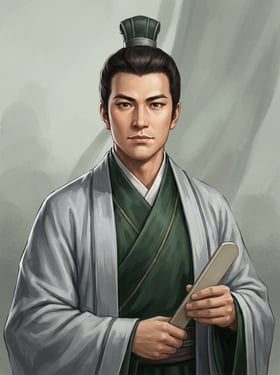
Historical Record
Zhang Wen, courtesy name Boshen, was an important figure of Eastern Wu during the Three Kingdoms period. He held a place in the Wu court through his learning and eloquence. According to the Records of the Three Kingdoms, Zhang Wen once served as a Wu envoy to Shu Han. In Shu Han he engaged in a famous debate with the Yi Province scholar Qin Mi (recorded in the histories simply as "Mi"). At the time, the officials were holding a farewell banquet for Zhang Wen, but Qin Mi was slow to arrive. Zhuge Liang repeatedly sent men to urge him on. Curious as to who Qin Mi was, Zhang Wen asked, and Zhuge Liang called him "a scholar of Yi Province." When Qin Mi arrived, Zhang Wen questioned him, first asking whether Qin Mi was fond of study, to which Qin Mi replied, "Even children of five feet all study—why need it be this humble man!" Zhang Wen then put forth a series of questions in succession: "Does Heaven have a head?", "Does Heaven have ears?", "Does Heaven have feet?", and "Does Heaven have a surname?" Qin Mi answered fluently, his replies cleverly drawing on allusions from the Book of Songs—"He turned his gaze westward" to prove that Heaven has a head in the west, "The crane cries in the marsh, its sound heard in Heaven" to prove that Heaven has ears, and "Heaven's steps are arduous" to prove that Heaven has feet. When asked what surname Heaven bore, Qin Mi answered "Liu," explaining, "The Son of Heaven is surnamed Liu, hence I know this," cleverly linking the Son of Heaven with Heaven, both upholding the legitimacy of Shu Han's rule and displaying his outstanding wit. Zhang Wen was deeply impressed by Qin Mi's gift for argument c:10538.
Zhang Wen also played an important role in the Eastern Wu regime. He once advised Sun Quan that the office of Palace Steward (zhongshuzi) to the heir apparent Sun Deng was the most intimate post and should be filled by a worthy and virtuous man to assist the heir. Sun Quan adopted his advice and appointed Chen Biao and others as Palace Stewards c:10548. This shows that Zhang Wen was not only talented himself but also attentive to the selection and cultivation of the state's talents, playing a positive role in the stability and development of Eastern Wu. He held a certain influence in the political life of Eastern Wu.
In the Novel
In the Romance of the Three Kingdoms, Zhang Wen's portrayal is given more dramatic color and departs somewhat from the historical record. Two figures named Zhang Wen appear in the novel. The first Zhang Wen, courtesy name Boshen, served as Minister of Works during Dong Zhuo's domination. Falsely accused by Dong Zhuo of colluding with Yuan Shu to plot Dong Zhuo's death, he was dragged down from the hall by Lü Bu before the assembly and then beheaded as a public warning, his head presented at the banquet c:1705. This episode has no basis in the official histories and is a fabrication of the novel to underscore Dong Zhuo's cruelty.
The second Zhang Wen, courtesy name Huishu, was a strategist of Eastern Wu. He first appears listed among the famous gentlemen of Jiangdong recruited when Sun Quan widely gathered worthies, ranked alongside Kan Ze, Yan Jun, Xue Zong, and others c:5317. After Liu Bei proclaimed himself emperor, Sun Quan, seeking to consolidate relations with Shu Han, wished to send an envoy into Shu. When Sun Quan lamented that Shu Han had an envoy like Deng Zhi while Wu had no one fit for the mission, Zhang Wen stepped forward and recommended himself. He confidently declared that Kongming too was but a mortal, and what had he to fear c:5318.
Zhang Wen's debate with Qin Mi (rendered in the novel as "Qin Mi, courtesy name Zichi") after his arrival in Shu Han is depicted in detail. As in the historical record, Zhang Wen posed to Qin Mi the questions "Does Heaven have a head?", "Does Heaven have ears?", "Does Heaven have feet?", and "Does Heaven have a surname?" Qin Mi's answers likewise drew on allusions from the Book of Songs and cleverly linked the Son of Heaven being surnamed Liu with Heaven being surnamed Liu c:1706. However, the novel adds an episode in which Qin Mi turns the questions back on Zhang Wen, retorting, "If Heaven, being light and clear, floats upward, why does it tilt to the northwest? And what lies beyond the light and clear, I do not yet know?"—which left Zhang Wen "with no answer to give, so that he rose from his seat and apologized, saying, 'I did not expect Shu to abound in such men of talent! Having just heard your discourse, my befuddled ignorance is suddenly opened.'" c:10537. Seeing this, Kongming, to spare Zhang Wen excessive embarrassment, spoke up to smooth things over. This episode further highlights Qin Mi's eloquence and transforms Zhang Wen's image from one of initial conceit and arrogance into that of a gentleman who can humbly accept and praise his opponent.
Key Relationships
* Tang Gu (student_of): The histories do not clearly record a teacher-student relationship between Zhang Wen and Tang Gu; this information may derive from other sources or an extended reading of the novel.
* Yuan Shu (enemy_of): In the Romance of the Three Kingdoms, Dong Zhuo falsely accused Minister of Works Zhang Wen of colluding with Yuan Shu, leading to Zhang Wen's death c:1705 (novel only).
* Sun Quan's Faction (serves) / Eastern Wu (serves): Zhang Wen was an important official of Eastern Wu, who served as an envoy to Shu Han and offered counsel to Sun Quan at court, such as advising the selection of worthy and virtuous men as Palace Stewards to the heir apparent c:10548.
* Qin Mi (debate opponent): Zhang Wen engaged in a famous debate with Qin Mi in Shu Han, and was deeply impressed by his gift for argument c:10538.
* Zhuge Liang (indirect interaction): Zhuge Liang was present during the debate between Zhang Wen and Qin Mi and had sent men to urge Qin Mi to come. In the novel, Zhuge Liang also spoke up to relieve Zhang Wen's embarrassment c:10537.
* Dong Zhuo (victimizer): In the Romance of the Three Kingdoms, Minister of Works Zhang Wen was falsely accused and killed by Dong Zhuo c:1705 (novel only).
* Lü Bu (executioner): In the Romance of the Three Kingdoms, Lü Bu, on Dong Zhuo's orders, dragged Minister of Works Zhang Wen from the banquet and beheaded him c:1705 (novel only).
Iconic Scenes
* Killed at Dong Zhuo's Banquet: In the Romance of the Three Kingdoms, Minister of Works Zhang Wen, at Dong Zhuo's banquet, was falsely accused by Dong Zhuo of colluding with Yuan Shu, then dragged out before the assembly by Lü Bu and beheaded, his head presented at the banquet—a victim of Dong Zhuo's cruelty c:1705 (novel only).
* Mission to Shu Han: Zhang Wen, as a Wu envoy, went on a mission to Shu Han to consolidate the Wu-Shu alliance. In the novel, he recommended himself for the mission, displaying his confidence and courage c:5318.
* Debate with Qin Mi: This is Zhang Wen's most famous iconic scene. In Shu Han, Zhang Wen and Qin Mi engaged in a brilliant debate over the various attributes of "Heaven." Qin Mi's clever answers deeply impressed Zhang Wen—indeed, in the novel Zhang Wen ultimately rose from his seat to express his thanks, acknowledging Qin Mi's talent c:10537. This debate displayed not only Zhang Wen's thirst for knowledge but also Qin Mi's outstanding intellect, becoming a classic vignette of scholarly exchange during the Three Kingdoms period c:10538.
* Advising Sun Quan: Zhang Wen once advised Sun Quan to select worthy and virtuous men as Palace Stewards to the heir apparent Sun Deng, reflecting his concern for the cultivation of the state's talents and political stability c:10548.
Portrait file
Character profile
- Character
- Zhang Wen was at first conceited and haughty, but after being bested in debate he could leave his seat and offer thanks, showing a capacity to acknowledge and mend his faults [c:3]. He had been the late Grand Commandant, and later served as Commandant of the Guards [c:6], and also as Minister of Works acting as General of Chariots and Cavalry [c:10].
- Manner of speech
- Zhang Wen's manner of speech carried a mocking edge, often expressed through layered questioning, for example, "You are called a scholar; I wonder whether your breast has ever taken in any learning?" [c:18].
- Life
- Zhang Wen had long been on ill terms with Dong Zhuo, who bore him a grudge. Later, when there were changes in the celestial signs, Dong Zhuo, to shift the blame, falsely accused Zhang Wen of colluding with Yuan Shu, and in the end had him flogged to death [c:4]. In another account, he once volunteered to go as an envoy into Shu to return courtesies; at the banquet he was arrogant and self-assured, but was then defeated in debate by Qin Mi's questions of "Does Heaven have a head, ears, feet, and a surname?", left his seat and conceded, and returned with Deng Zhi to Eastern Wu to report [c:5].
- Anecdotes
- Zhang Wen once came as an envoy of Eastern Wu to pay a state visit to Shu; in debate, after being challenged by Qin Mi with the questions of "Does Heaven have a head, ears, feet, and a surname?", he came to hold him in great esteem [c:1]. He had once been General of Chariots and Cavalry, campaigning west against Han Sui [c:7], and was also the Wu envoy returning the state visit to Shu [c:9].
Relationships
7 relationships
Quotes
25 recorded lines · 3 featured
「孔明亦人耳,臣何畏彼哉?」
These words display Zhang Wen's contempt and conceit upon first meeting Zhuge Liang.
「公既出大言,請即以天為問。天有頭乎?」
This line opens the famous debate between Zhang Wen and Qin Mi, highly culturally recognizable.
「不意蜀中多出俊傑!恰聞講論,使僕頓開芧塞。」
These words reflect Zhang Wen's heartfelt admiration for Qin Mi after the debate, shaping his character.
Chapters8 回 ▸
- 史ch.6ch.8ch.38ch.46ch.59
- 演ch.8ch.38ch.86
Relationship timeline2 条 ▸
Inner monologues · AI-generated1 段 ▸
- I was sent by Wu to Shu, and what awaited me was not merely a verbal exchange across the table, but a test of whether ou
Life events4 ▸
- 0208-01-01 · ChaisangZhuge Liang's Debate with the Scholars of Jiangdong· Witness
- 0223-01-01 · WuchangWu and Shu Renew Their Alliance· Advisor
- 0223-01-01 · WuchangDeng Zhi's Mission to Wu to Renew the Alliance· Witness
- 0224-01-01 · ChengduQin Mi's Debate with Zhang Wen· Witness