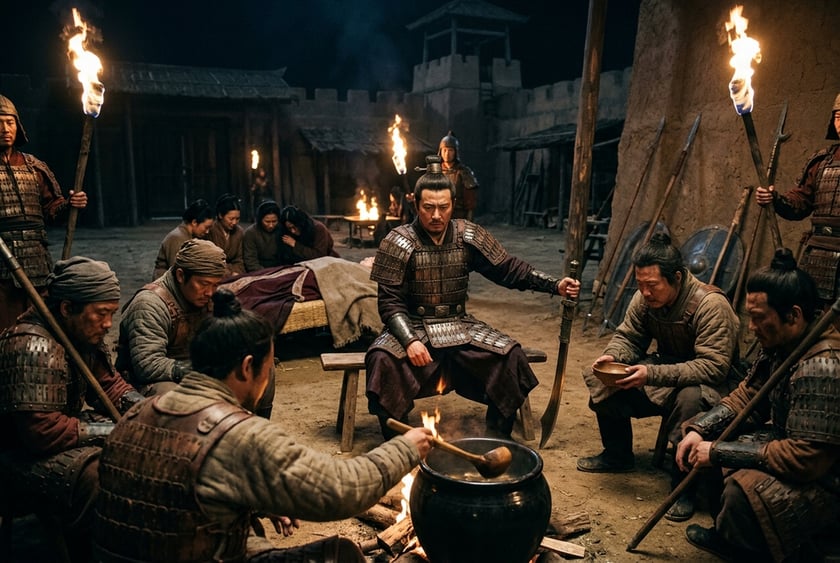
Strategic Background
From a military-history analyst's perspective, the "Six Expeditions out of Qishan" is the Romance of the Three Kingdoms' collective name for Zhuge Liang's series of northern campaigns between 228 and 234 CE — a label that is itself a narrative compression, collapsing six or seven distinct engagements into a single cultural symbol of "stubborn, relentless expedition." The strategic backdrop of Zhugeliangbeifa is formed by three overlapping layers. The first is Shuhan's geopolitical predicament: one commandery of Yizhou against nine commanderies of the Central Plains — pure defense amounted to a slow death, so offense had to serve as defense. The second is Zhuge Liang's personal political covenant: having borne the heavy charge of Baidituogu from Liu Bei, he was compelled to honor the pledge to "restore the Han" to the greatest degree possible within his lifetime. The third is the factional structure inside Shuhan during the Jianxing era — the critical lubricant that kept the three factions in balance (the Jingzhou clique of Zhuge Liang, Ma Liang, and Ma Su; the Eastern Prefecture clique of Li Yan, Fei Yi, and Wu Yi; and the native Yizhou clique of Qiao Zhou and Du Qiong) was the existence of "a powerful external enemy." Once attention turned inward to governance, factional infighting would erupt — northern campaigns were therefore a necessary condition for political stability [c:17706].
Deployment of Forces
Caowei's overall deployment can be divided into two phases. In the first phase (228–231), Cao Zhen and Zhang He presided over the western-front defense, favoring an active "offense-as-defense" approach that confronted the Shuhan forces head-on. The results were disastrous for Wei: Zhang He was killed by arrows at Mumendao, Cao Zhen fell ill and withdrew, and Wei Yan routed Fei Yi at Yangxi — Wei's frontal strategy had failed [c:17707]. In the second phase (231–234), Sima Yi took command of the western front and shifted to a strategy of "holding fortified positions and refusing pitched battle," explicitly declining to meet Zhuge Liang in a decisive field engagement and countering with sheer attrition. Shuhan's deployments likewise evolved in stages: early on, Zhuge Liang preferred advancing "along the flat road through Longright, proceeding by the rules" and vetoed Wei Yan's proposal for a surprise thrust through Ziwu Valley [c:17708]; in the middle phase he began prioritizing garrison farming and supply-line logistics, committing 340,000 troops in five columns for the fifth campaign [c:17708] and ordering Li Hui to manage grain transport on the Xiegudao road; in the final phase he simply directed Shuhan troops and Wei civilian settlers to farm together in a two-civilians-to-one-soldier ratio [c:17709], attempting to convert the war into a long-term war of attrition.
Critical Decision Points
Four decision points in the Six Expeditions deserve repeated analysis. The first is Zhuge Liang's rejection, at the start of the first northern campaign, of Wei Yan's plan for a surprise attack through Ziwu Valley — dismissed with the phrase "this is not a failsafe plan." This decision has been debated by military thinkers ever since; the Romance plants the psychological seed with the line "Wei Yan was deeply displeased" [c:17708], laying narrative groundwork for Weiyanzhisi. The second is Ma Su's loss at Jieting — which instantly reversed the entire advantage of Diyicibeifa, after which Zhuge Liang was deeply ashamed, demoted himself three ranks, and fundamentally changed his approach to personnel for all subsequent campaigns. The third is Kong Ming's standoff with Sima Yi at Wuzhangyuan during the sixth campaign: Sima Yi held firm and refused to come out; Zhuge Liang tried to goad him with women's garments, yet Sima Yi still would not move — a classic case in military history of "winning by waiting." The fourth is the episode of Guan Xing's death from illness and Kong Ming's outpouring of grief [c:17707] — the Romance places this private emotional detail just before the sixth expedition to cast Zhuge Liang as a tragic figure of "the lone minister in an impossible situation," creating an emotional contrast with Sima Yi's cool, fortified-defense strategy.
Outcome and Echoes
In purely military terms, the Six Expeditions out of Qishan never achieved the strategic goal of "recovering the Central Plains" — Shuhan never secured a foothold in Longright, and every campaign ended in withdrawal forced by exhausted supplies or unforeseen personnel crises. In terms of strategic impact, however, the six campaigns did accomplish three secondary objectives. First, they kept Caowei perpetually on the defensive, unable to concentrate forces for a southward campaign against Sunwu. Second, they elevated Jiang Wei as a military successor [c:17706], preserving Shuhan's unified military-political command in its later years. Third, they crystallized the image of Zhuge Liang as a man who "devoted himself without reservation and died in service" into the preeminent spiritual symbol of the scholar-official class for the entire medieval era — an achievement that far outweighed his actual win-loss record. As for his adversary, Sima Yi's "hold and wait" strategy throughout the Six Expeditions preserved his command of the western front and allowed him, after Zhuge Liang's death in 234, to absorb the Guanlong army group — accumulating the decisive political and military capital that would eventually bring Simashi to power. Ironically, Shuhan's northern campaigns had cultivated the most dangerous usurper within Caowei itself.
Counterfactual Analysis
Counterfactual one: had Zhuge Liang adopted Wei Yan's Ziwu Valley surprise attack during the first northern campaign, could he have seized Changan in one blow? Based on modern topographic research, the Ziwu Valley plank road in the late Han period was poorly suited for the movement of a large army; the risk of five thousand elite troops racing toward Changan only to have their supply line immediately severed was extremely high. Even if Changan fell briefly, it could not be held, and Shuhan's most elite mobile force would have been squandered. Zhuge Liang's cautious strategy was tactically sound — the problem is that it relinquished the strategic window for "a gamble." This refusal to gamble ultimately meant that Shuhan remained permanently trapped in the cycle of "able to move, unable to hold." Counterfactual two: had Zhuge Liang lived another ten years, could he have broken through Sima Yi's war of attrition? The answer is almost certainly no — Shuhan's agricultural population and manpower limits were an absolute ceiling; ten more years could not close the resource gap with Caowei. The most valuable thing ten more years of Zhuge Liang would have accomplished was probably not another round of northern campaigns, but the establishment of a stable succession system for military and civil governance — the difficulties that confronted Jiang Wei, and the short tenures of Jiang Wan and Fei Yi, all trace back to internal institution-building that Zhuge Liang never had time to complete. In other words, the true cost of the "Six Expeditions out of Qishan" lay not in military failure but in the fact that one man's effort held the entire political equilibrium of Shuhan in place — and when that man was gone, his successors had nothing solid to stand on.