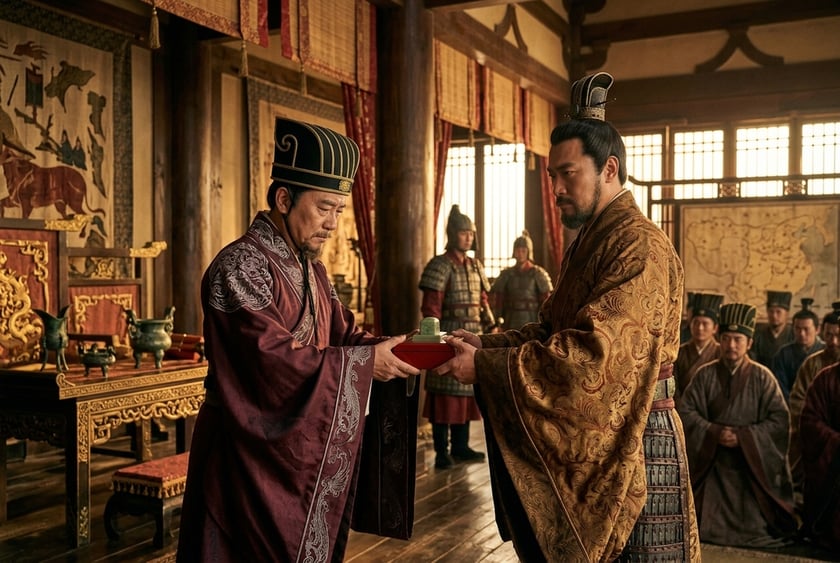
Strategic Background
From the perspective of a military analyst, Xuchuluoyidoumachao — "Xu Chu strips off his armor to fight Ma Chao bare-chested" — is a deliberately constructed "heroic martial-virtue" highlight scene in the novel's account of the Battle of Tongguan, a scene whose narrative function in the strategic account far outweighs its military significance. The Battle of Tongguan in Jian'an year sixteen was the core engagement of Cao Cao's western campaign against the Guanlong coalition (Ma Chao, Han Sui, Yang Qiu, Hou Xuan, Cheng Yin, Li Kan, and eight other factions). Cao Cao's true strategic intent in this campaign was to use the pretext of punishing Zhang Lu to lure Ma Chao and the other Guanxi strongmen into the open and eliminate them in a single engagement — this was the pivotal operation for him to rebuild his northern prestige and restore unified control of the north within two years of his defeat at Chibi. But the novel, in order to give the full "roster of warriors" greater depth, runs in parallel alongside the strategic narrative a "martial-virtue counterpoint" thread: Xu Chu represents the Cao army's "warrior virtue of rabid loyalty"; Ma Chao represents the Xiliangjun's "warrior virtue of bloodline intensity"; and their several bouts around Tongguan are simultaneously a personal duel and a direct collision between "the martial virtue of Caowei's central imperial guard" and "the martial virtue of Guanlong's frontier army" [c:17702].
Deployment
Reading from the novel's text, the event is composed of three scenes. The first is "protecting Cao Cao across the Wei River": with Cao Cao seated on the south bank sword-in-hand watching the army cross, Ma Chao launches a sudden attack unexpectedly; Xu Chu drags Cao Cao down to a boat, vaults aboard in an instant, holds a horse-saddle in his left hand to deflect arrows, grips the rudder with both legs to work the boat, and uses one hand to push the vessel along while raising the saddle as a shield [c:17702]. The second is "intimidating Ma Chao single-handed": Cao Cao rides out of camp alone with a whip to speak with Ma Chao; Xu Chu stands alone behind him; Ma Chao thinks to dash forward and seize Cao Cao, but looking back he sees Xu Chu with "eyes radiating divine light, bearing majestic and awe-inspiring," and "dares not act; he reins in his horse and withdraws" [c:17703][c:17704]. The third is "the bare-chested melee": in front of the two armies' main formations, Xu Chu and Ma Chao trade more than a hundred bouts without either prevailing; they change horses and fight another hundred-plus bouts still without resolution; Xu Chu then strips off his armor and re-engages bare-chested for more than thirty additional bouts, and seizes Ma Chao's spear and snaps the shaft [c:17705]. The three scenes build layer by layer — from "protect" to "intimidate" to "fight" — releasing Xu Chu's "martial virtue of rabid loyalty" across three phases.
Critical Decision Points
Viewed from the "martial-virtue narrative" angle there are three decision points. The first is Cao Cao's allowing Xu Chu to drag him aboard the boat, relinquishing command of the river crossing — the novel uses this to shape an extreme scenario of "the sovereign's life depending on a single general," reinforcing the lord-subject bond of trust [c:17702]. The second is Ma Chao's choice to "rein in and withdraw" rather than act during the "single-rider parley" — the novel specifically allows Ma Chao to "first lose" at a psychological level to Xu Chu's gaze; this is in effect pulling Ma Chao back from "the invincible fierce warrior" to "a real human being who can feel awe," leaving psychological room for his later repeated defeats [c:17704]. The third is Xu Chu's voluntary stripping off of his armor to fight bare-chested — in the novel's terms this is "a singular masterwork of martial virtue," tantamount to placing his own life entirely in disregard and opposing Ma Chao's "I will not be bested" with "I am not afraid to die." Cao Cao's fear that Xu Chu might be harmed and his consequent ordering Xiahou Yuan and Cao Hong to attack from both flanks is precisely an acknowledgment that this single combat might cost him a close-trusted general, and that collective force had to be used to press it back [c:17705]. Together, these three decision points shape the unique "sovereign-fierce warrior" symbiotic relationship of the novel.
Outcome and Resonance
In terms of military results, this engagement did not achieve a decisive victory for Cao Cao's army — Xu Chu took two arrow wounds in his arms; the various commanders retreated in confusion into the camp; Ma Chao drove his attack all the way to the riverbank; and Cao Cao's troops suffered heavy losses of half or more. Cao Cao's subsequent order to "hold the stronghold firmly and do not sally" amounted to conceding that direct force-on-force attrition was unfavorable to him, and he instead adopted Jia Xu's "estrangement stratagem" to divide Han Sui from Ma Chao — that was the true winning move of the Battle of Tongguan. But from the novel's "martial-virtue narrative" standpoint, this engagement was the battle that consecrated Xu Chu as a deity — "all the army henceforth called Chu the Tiger Marquis" became a fixed epithet, paired alongside Zhang Fei's "fierce Zhang Fei" and Guan Yu's "Lord of the Beautiful Beard." Ma Chao afterward said to Han Sui in admiration: "I have seen fierce fighters but none like Xu Chu — a true Tiger Fool" [c:17705]; this remark is the novel's official endorsement in the martial rankings, formally elevating Xu Chu to the tier of fierce generals alongside Lv Bu and Zhang Fei, and implicitly forming the counterpart martial-virtue pairing of "Tiger Marquis vs. Brocade-clad Ma Chao," which together with "Lord of the Beautiful Beard vs. Unrivaled Warrior" (Guan Yu and Ma Chao's later western-Liang exchange) jointly constitute the heroic narrative network of the novel's second half.
Counterfactual Analysis
Shifting the view back to realistic military possibility: during the single-rider parley, had Ma Chao persisted and reached out to seize Cao Cao — could Xu Chu truly have stopped him? The standard historical records note that Xu Chu was physically imposing and powerful enough to subdue a charging bull; and that during the standoff with Ma Chao, Ma Chao had indeed "long heard of Chu's valor" and asked those around Cao Cao "where is the Tiger Marquis?" — this detail is not contradicted between the historical record and the novel. But the historical record contains no "bare-chested melee" episode. The novel's fictional supplement delivers a scene that on a real battlefield could almost never occur: two generals of commander caliber engaging in one-on-one combat with no regard for survival. From a tactical standpoint, a main-force general going bare-armed in single combat would only appear in narrative literature, because no rational commander would expose his most valuable imperial guard general to stray arrows for more than thirty rounds. This choice of "knowing it is not true and yet writing it anyway" reveals precisely Luo Guanzhong's exact reading of his audience's expectations — readers want not "military records" but "the sense of the hero's presence." The reason Xuchuluoyidoumachao has endured through the ages is that it satisfies a cultural imagination concerning "whether a person can charge into battle bare-chested for a belief" — and the function of that imagination outweighs any concrete outcome of victory or defeat.